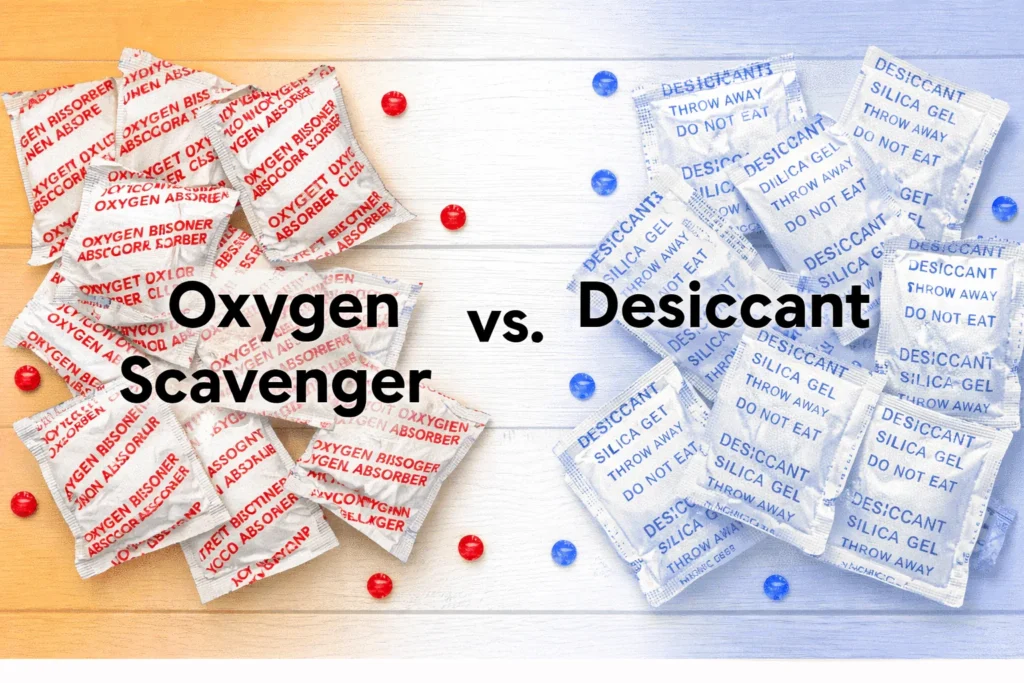
In modern packaging and storage, product degradation rarely happens overnight. It happens slowly — through oxygen exposure or excess moisture. That’s where oxygen scavengers and desiccants play a critical role.
At Beechems, we work with manufacturers across pharmaceuticals, food, nutraceuticals, and specialty chemicals to help protect product integrity throughout the supply chain. Understanding the difference between an oxygen scavenger and a desiccant is the first step toward choosing the right protection strategy.
What Is an Oxygen Scavenger?
An oxygen scavenger (also known as an oxygen absorber) is designed to remove oxygen from a sealed environment. By reducing oxygen levels, it helps prevent oxidation — a major cause of spoilage, discoloration, loss of potency, and microbial growth.
How Oxygen Scavengers Work
Oxygen scavengers typically use iron-based or chemical compounds that react with oxygen, converting it into stable oxides. Once activated, they continuously absorb residual oxygen inside packaging.
Common Uses of Oxygen Scavengers
- Pharmaceutical tablets and capsules
- Dry food and ready-to-eat meals
- Nutraceuticals and supplements
- Medical devices sensitive to oxidation
Key Benefits
- Extends shelf life
- Preserves potency and active ingredients
- Prevents rancidity and discoloration
- Reduces aerobic microbial growth
What Is a Desiccant?
A desiccant is used to control moisture levels inside packaging. Excess humidity can cause clumping, hydrolysis, microbial contamination, and degradation — especially in hygroscopic products.
How Desiccants Work
Desiccants absorb water vapor from the surrounding air, maintaining a stable relative humidity within the package. Common materials include silica gel, molecular sieves, and clay.
Common Uses of Desiccants
- Pharmaceutical bottles and blister packs
- Diagnostic kits and reagents
- Electronics and medical devices
- Powdered chemicals and APIs
Key Benefits
- Prevents moisture-induced degradation
- Maintains product flow and appearance
- Protects against mold and corrosion
- Ensures stability in humid climates
Oxygen Scavenger vs Desiccant: Key Differences
| Feature | Oxygen Scavenger | Desiccant |
|---|---|---|
| Controls | Oxygen levels | Moisture / humidity |
| Primary risk addressed | Oxidation | Hydrolysis, clumping, mold |
| Common materials | Iron-based compounds | Silica gel, molecular sieves |
| Typical industries | Food, pharma, nutraceuticals | Pharma, diagnostics, electronics |
| Can be used together? | ✅ Yes | ✅ Yes |
👉 Important: Oxygen scavengers do not remove moisture, and desiccants do not remove oxygen.
When Should You Use an Oxygen Scavenger?
Choose an oxygen scavenger when:
- The product degrades due to oxidation
- Color, flavor, or potency changes over time
- Aerobic microbial growth is a concern
- Shelf life depends on oxygen control
Examples: Vitamin formulations, dry food powders, sensitive APIs, specialty chemicals.
When Is a Desiccant the Better Choice?
A desiccant is ideal when:
- Moisture causes clumping or dissolution
- The product is hygroscopic
- Stability depends on low relative humidity
- Storage occurs in humid environments
Examples: Tablets, capsules, diagnostic strips, powdered formulations.
Can Oxygen Scavengers and Desiccants Be Used Together?
Yes — and in many cases, they should be.
Some products are sensitive to both oxygen and moisture. In such cases, combining an oxygen scavenger with a desiccant provides dual protection, ensuring maximum shelf life and product stability.
This approach is commonly used in:
- High-value pharmaceuticals
- Nutraceutical blends
- Export packaging with long transit times
Choosing the Right Packaging Protection Solution
Selecting the correct solution depends on:
- Product composition
- Sensitivity to oxygen vs moisture
- Packaging type (bottles, blisters, pouches)
- Storage conditions and distribution climate
At Beechems, we help manufacturers evaluate these factors to determine whether an oxygen scavenger, desiccant, or combined approach is the most effective solution.
Final Thoughts
Understanding the difference between an oxygen scavenger and a desiccant isn’t just technical knowledge — it’s a strategic decision that directly impacts product quality, safety, and shelf life.
By aligning the right protective technology with your product’s specific degradation risks, you can reduce waste, improve compliance, and deliver consistent quality to end users.
Frequently Asked Questions
Q1. What is the main difference between an oxygen scavenger and a desiccant?
The main difference is what they control inside packaging. An oxygen scavenger removes oxygen to prevent oxidation, while a desiccant absorbs moisture to control humidity. They address different causes of product degradation and are often used together for complete protection.
Q2. Can oxygen scavengers remove moisture?
No, oxygen scavengers do not remove moisture. Their function is limited to absorbing oxygen from sealed environments. If moisture control is required, a desiccant must be used separately or alongside an oxygen scavenger.
Q3. When should desiccants be used instead of oxygen scavengers?
Desiccants should be used when moisture is the primary cause of product degradation, such as clumping, hydrolysis, mold growth, or corrosion. Products like tablets, capsules, and hygroscopic powders benefit more from desiccants than oxygen scavengers.
Q4. Is it safe to use oxygen scavengers and desiccants together?
Yes, using oxygen scavengers and desiccants together is safe and often recommended for products sensitive to both oxygen and moisture. This dual-protection approach is common in pharmaceutical, nutraceutical, and specialty chemical packaging.
Q5. How do I choose between an oxygen scavenger and a desiccant for packaging?
The choice depends on your product’s sensitivity. If oxidation reduces shelf life or potency, use an oxygen scavenger. If moisture causes instability or degradation, use a desiccant. For products affected by both, a combined solution provides the best results.
