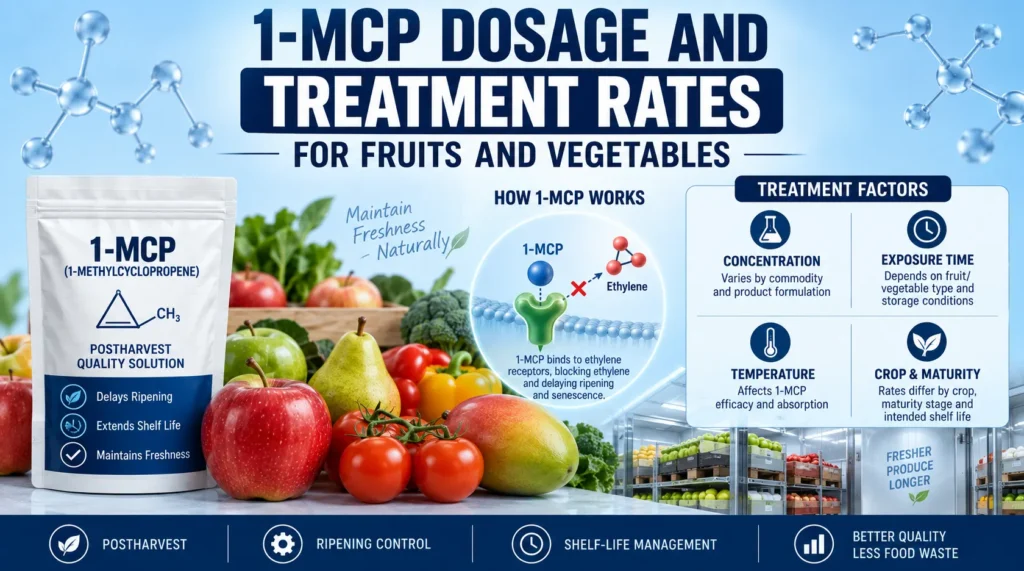
Getting 1-MCP dosage and treatment rates right is what separates a postharvest treatment that actually extends shelf life from one that quietly underperforms. Too little exposure and ethylene receptors aren’t fully blocked; too short a treatment window and produce doesn’t get the full benefit before it’s moved into storage or transit. This guide walks through how 1-MCP dosage is calculated, how treatment time scales with temperature, and the factors that determine the right rate for your produce.
See Bee Chems’ full 1-Methylcyclopropene (1-MCP) product page for formulation details, or browse the broader Shelf Life Extension & Protection range.
How 1-MCP Dosage Actually Works
1-MCP works by occupying ethylene receptor sites inside plant tissue, physically blocking the ripening hormone ethylene from binding and triggering senescence. Because it works at the receptor level rather than by simply diluting ambient ethylene, the goal of dosing isn’t to flood the environment — it’s to reach a concentration in the sealed treatment chamber that’s sufficient to saturate the produce’s ethylene receptors for the full treatment window.
In practice, that means dosage isn’t a single fixed number — it depends on the treatment chamber’s volume, the ambient temperature and humidity, and how much product is being introduced to generate the required vapor concentration.
Step-by-Step: Calculating and Applying 1-MCP Treatment
Dosing 1-MCP correctly is less about a single number and more about a short setup sequence that determines how much vapor concentration actually reaches the produce:
- Start with the numbers that drive dosing: the enclosed volume of whatever chamber or container will hold the produce, plus the ambient temperature and humidity at treatment time. These three figures are what the required dose is calculated against — bigger volumes and different environmental conditions change how much product is needed.
- Get the produce into the sealed environment first. Fruits, vegetables, or flowers go into the container before the treatment chemical is introduced.
- Activate the vapor release. The measured powder dose is placed centrally in a small cup or tray, then mixed with roughly 20 to 40 times its own weight in water — this is what triggers the controlled-release vapor that actually does the work.
- Don’t leave the chamber open. Because vapor begins releasing as soon as water hits the powder, the container needs to be sealed right away to trap the concentration inside rather than letting it dissipate.
- Hold for the temperature-appropriate duration (see the table below) rather than a single fixed time across all conditions.
- Release and move on. Once the hold period is complete, the chamber can be opened and produce transferred into normal storage or transit handling.
Treatment Time by Temperature
Treatment duration is governed primarily by ambient temperature at the time of treatment:
| Ambient Temperature | Treatment Time |
|---|---|
| Above 20°C | 6–12 hours |
| Below 20°C | Up to 24 hours |
Lower temperatures slow the rate of vapor uptake and receptor binding, which is why colder treatment conditions require a longer hold time to reach the same effective dose as a shorter treatment at warmer temperatures.
Factors That Affect Dosage and Treatment Rates
- Chamber volume: Larger enclosed volumes require proportionally more product to reach the target vapor concentration.
- Ambient temperature: Determines treatment duration — above or below the 20°C threshold changes the required hold time significantly.
- Humidity: Affects vapor release and distribution within the chamber, and factors into the dose calculation alongside temperature and volume.
- Crop type and ethylene sensitivity: Highly ethylene-sensitive produce (like many cut flowers) responds strongly even at standard treatment rates, while some crops may need protocol adjustments based on variety and maturity stage.
- Produce maturity at treatment: Treating before peak ethylene release — rather than after ripening has already begun — is what allows 1-MCP to be effective in the first place, since it blocks receptors rather than reversing changes already underway.
Treatment Rates by Produce Type
While the core dosing method (chamber volume, water ratio, temperature-based treatment time) stays consistent, real-world results vary by crop:
- Climacteric fruits (apples, bananas, mangoes, avocados, kiwifruit, tomatoes) are the primary beneficiaries of 1-MCP treatment, since these fruits ripen through a self-accelerating ethylene surge that 1-MCP interrupts by blocking receptor binding before that surge takes hold.
- Fruits prone to softening and browning show some of the most measurable results — for example, persimmon firmness loss has been shown to be delayed from around day 5 to day 15–20 after 1-MCP treatment.
- Leafy vegetables benefit primarily through slowed respiration and reduced yellowing/wilting, allowing more relaxed cold-chain handling during transport.
- Cut flowers are often highly ethylene-sensitive — treated carnations, for instance, have shown vase life more than doubling compared to untreated stems.
Exact rates can vary by variety, harvest maturity, and storage conditions, so it’s worth confirming dosing specifics for your particular crop with a technical team before scaling a new protocol.
Climacteric vs Non-Climacteric Produce: Why It Matters for Dosage
Not every crop responds to 1-MCP the same way, and the reason comes down to how the produce ripens in the first place. Climacteric fruits — apples, bananas, mangoes, avocados, kiwifruit, tomatoes, and persimmons among them — ripen through a self-triggering ethylene surge: once ripening begins, the fruit itself produces more ethylene, which accelerates ripening further. This is exactly the feedback loop 1-MCP interrupts by blocking the receptors before that surge can take hold, which is why dosage and timing matter so much for these crops.
Non-climacteric produce — citrus, grapes, strawberries, and most leafy vegetables — doesn’t ripen through that same ethylene-driven feedback loop. These crops still produce and respond to some ethylene (which is why leafy greens still benefit from reduced yellowing and slower respiration), but there’s no self-accelerating ripening surge for 1-MCP to interrupt. Treating non-climacteric produce can still offer some benefit, but the effect is generally more modest than what’s seen in climacteric fruit, since the underlying ripening mechanism is different.
When 1-MCP Isn’t the Right Solution
- Produce that’s already ripening: Once the ethylene surge is underway, occupying the remaining receptors does little to reverse changes already in motion — 1-MCP is a preventive treatment, not a corrective one.
- Crops where controlled ripening is the goal: Some produce is intentionally exposed to ethylene later in the supply chain to trigger ripening on schedule (bananas being a common example) — over-treating with 1-MCP can make that downstream ripening step less predictable if not carefully managed.
- Non-climacteric crops expecting dramatic results: As covered above, citrus, grapes, and similar produce won’t show the same firmness or shelf-life gains seen in climacteric fruit, so expectations should be set accordingly.
- Situations where flavor development depends on continued ripening: A small amount of post-harvest ripening is sometimes desirable for flavor or sugar development in certain varieties — over-blocking ethylene perception can flatten that development if timing isn’t managed carefully.
1-MCP vs Other Postharvest Ripening Control Methods
1-MCP is one of several tools used to manage ripening and ethylene exposure, and it’s often most effective as part of a broader postharvest strategy rather than a standalone fix:
- 1-MCP vs cold storage: Cold storage slows ripening by reducing respiration rate overall, while 1-MCP specifically blocks ethylene receptor binding. The two are complementary — 1-MCP-treated produce still benefits from proper cold-chain handling, even if the cold-chain requirements can be somewhat relaxed for some crops.
- 1-MCP vs controlled/modified atmosphere storage: Controlled atmosphere (CA) storage manages oxygen and CO₂ levels to slow ripening broadly, while 1-MCP targets ethylene perception specifically. Many exporters use both together for high-value crops on long shipping routes.
- 1-MCP vs ethylene absorbers: As noted in the mechanism section above, ethylene absorbers remove ambient ethylene gas from the storage environment on an ongoing basis, while 1-MCP blocks the produce’s own ethylene receptors in a single upfront treatment. Using both — 1-MCP at treatment, ethylene absorbers throughout storage — covers both the internal and external ethylene exposure pathways.
How to Verify Treatment Effectiveness
Since 1-MCP’s effect isn’t visible immediately after treatment, effectiveness is typically judged over the following days and weeks by comparing treated batches against an untreated control sample under the same storage conditions. Key indicators to track include firmness retention (measured with a penetrometer for fruit, or simply by feel for smaller-scale operations), color change progression, and the number of days before visible ripening signs appear. A properly dosed and timed treatment should show a clearly delayed ripening curve compared to untreated produce from the same harvest lot.
Chamber Setup Best Practices
- Use a properly sealed, airtight chamber — even small gaps let vapor escape and reduce the effective concentration reaching the produce.
- Avoid chambers previously used for other chemical treatments without thorough cleaning, since residues can interfere with results or contaminate produce.
- Distribute produce to allow airflow around all sides rather than densely stacking it, so vapor can reach all treated items evenly.
- Position the treatment cup or tray centrally, as described in the application steps above, to promote even vapor distribution rather than concentrating it near one side of the chamber.
Record-Keeping for Consistent Results
Because effective dosage depends on chamber volume, temperature, and humidity at the time of treatment, keeping a simple log of these variables for each batch makes it far easier to troubleshoot inconsistent results later. A useful record typically includes: treatment date and batch/lot number, chamber volume, ambient temperature and humidity at the time of treatment, powder quantity and water volume used, treatment start and end time, and any observations on produce condition at loading. Over multiple batches, this record makes it possible to spot patterns — for example, noticing that batches treated on unusually humid days consistently show weaker results — that would be hard to catch from memory alone.
Common Dosage Mistakes to Avoid
- Treating after ripening has already begun: 1-MCP blocks ethylene receptors — it can’t reverse ripening changes that have already started, so timing the treatment before peak ethylene release matters as much as the dose itself.
- Incorrect water-to-powder ratio: Too little water can under-release the vapor needed to reach an effective concentration; getting the 20–40× ratio right is part of correct dosing, not just a formality.
- Ignoring temperature when setting treatment time: Using a warm-weather treatment duration in cold conditions under-doses the produce, since vapor uptake slows at lower temperatures.
- Poor chamber sealing: A chamber that isn’t sealed promptly and fully after adding water lets vapor escape, reducing the effective concentration reaching the produce.
- Mixing crops with very different ethylene sensitivity in one batch: Co-treating produce with widely different sensitivity levels can mean some crops are under- or over-exposed relative to their ideal treatment profile.
Storage and Handling After Treatment
1-MCP treatment reduces produce’s sensitivity to ethylene, which is why some crops — particularly leafy vegetables — can tolerate somewhat relaxed cold-chain conditions afterward. That said, “relaxed” doesn’t mean “eliminated”: treated produce still benefits from appropriate temperature and humidity control during storage and transit, since 1-MCP addresses ethylene-driven ripening specifically, not every factor that affects produce quality over time. Treated produce should still be kept away from untreated, high-ethylene-output items (like ripe bananas or tomatoes) where practical, since very high ambient ethylene concentrations can still have some effect even after receptor-blocking treatment.
Safety & Handling
1-MCP is considered non-toxic and safe when used as directed, and it breaks down naturally without leaving chemical residue on treated produce. As with any controlled-release treatment chemical, standard precautions still apply: store product in a cool, dry place away from direct sunlight, follow the specific formulation’s technical data sheet for exact handling instructions, and avoid direct inhalation of concentrated vapor during chamber setup.
You might be interested in: Oxygen Absorbers vs Desiccants
Conclusion
Getting 1-MCP dosage and treatment rates right comes down to matching chamber volume, temperature, and treatment time to the produce being treated — and applying it before ripening accelerates, not after. Combined with ethylene absorbers for ongoing ethylene management during storage, correctly dosed 1-MCP treatment can meaningfully extend shelf life and reduce postharvest losses.
Need help calculating the right 1-MCP dosage and treatment time for your crop and chamber setup? Talk to our technical team for customized dosing guidance.
Frequently Asked Questions
Q1. How is 1-MCP dosage calculated?
Dosage is calculated based on the treatment chamber’s volume along with ambient temperature and humidity, since these factors determine how much product is needed to reach an effective vapor concentration throughout the enclosed space.
Q2. Does treatment time change with temperature?
Yes — treatment above 20°C typically requires 6–12 hours, while treatment below 20°C requires up to 24 hours, since vapor uptake and receptor binding slow down at lower temperatures.
Q3. What water-to-powder ratio is used for 1-MCP treatment?
The powder is typically combined with 20–40 times its weight in water inside the treatment chamber to initiate vapor release.
Q4. Can 1-MCP be used on any fruit or vegetable?
1-MCP is effective across a wide range of crops, including apples, bananas, mangoes, avocados, kiwifruit, tomatoes, leafy vegetables, and cut flowers, though exact treatment response can vary by crop and variety.
Q5. What happens if produce is treated too late?
Since 1-MCP works by blocking ethylene receptors before ripening accelerates, treating produce after the ethylene surge has already begun significantly reduces its effectiveness — timing before peak ethylene release matters as much as getting the dose right.
