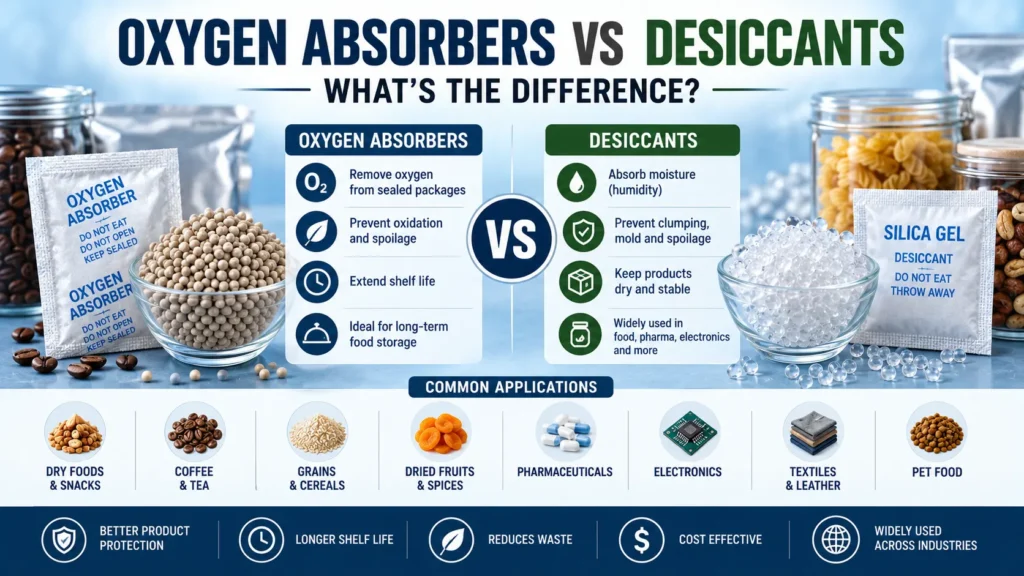
Oxygen absorbers and desiccants are often mentioned in the same breath — both are small packets tucked into packaging to protect what’s inside. But they solve two completely different problems: one removes oxygen, the other removes moisture. Mixing up oxygen absorbers vs desiccants can mean protecting your product from the wrong threat entirely.
This guide breaks down how each oxygen absorber and desiccant actually works, where they differ, and when a product needs one, the other, or both. Browse Bee Chems’ full Adsorbents, Absorbents & Desiccants range to compare all options.
What Is an Oxygen Absorber?
An oxygen absorber is a small sachet — typically containing iron powder — that chemically reacts with oxygen trapped inside sealed packaging. As the iron oxidizes (essentially controlled rusting), it consumes the available oxygen, dropping oxygen levels inside the package to a fraction of a percent. This slows or stops oxidation-driven spoilage: rancidity in fats and oils, discoloration, flavor loss, and the growth of oxygen-dependent mold and insects.
What Is a Desiccant?
A desiccant is a moisture-absorbing material — such as silica gel, clay desiccant, or calcium chloride desiccant — that pulls water vapor out of the air inside a sealed package or container. Desiccants don’t touch oxygen levels at all; their entire job is controlling relative humidity to prevent mold growth, caking, corrosion, and moisture-driven texture changes like sogginess or clumping.
The Chemistry Behind Each One
An oxygen absorber’s reaction needs a small amount of moisture to proceed — the iron powder inside reacts with both oxygen and trace water vapor to form iron oxide (essentially rust), which is why some oxygen absorber sachets are slightly less effective in extremely dry environments. Its absorption capacity is measured in cubic centimeters (cc) of oxygen it can remove, and that number is what determines correct sizing for a given package volume and product type.
Desiccants, by contrast, work through two different mechanisms depending on the material: silica gel and clay physically adsorb water vapor onto their porous internal surface, while calcium chloride is hygroscopic and chemically binds with water, eventually converting to a liquid or gel as it absorbs. Neither desiccant mechanism involves or affects oxygen levels in any way.
Oxygen Absorbers vs Desiccants: Key Differences
| Factor | Oxygen Absorber | Desiccant |
|---|---|---|
| What it removes | Oxygen | Moisture (water vapor) |
| Mechanism | Chemical reaction (iron oxidation) | Physical adsorption or chemical hygroscopic absorption |
| Protects against | Oxidation, rancidity, discoloration, oxygen-dependent pests/mold | Moisture-driven mold, caking, corrosion, sogginess |
| Common materials | Iron powder-based sachets | Silica gel, clay, calcium chloride |
| Typical packaging use | Dry foods, pharmaceuticals, electronics sensitive to oxidation | Any product sensitive to humidity or condensation |
| Visual indicator available | Some absorbers include an oxygen indicator dot | Indicating silica gel grades change color at set humidity levels |
Why the Difference Matters
Using the wrong protection — or only one when a product needs both — can mean spoilage still happens, just from a different cause than the one you guarded against. A desiccant won’t stop nuts from going rancid, and an oxygen absorber won’t stop a hygroscopic powder from clumping in humid storage. Matching the right protection to the actual failure mode is what makes packaging protection effective in the first place.
Can You Use Both Together?
Yes — and for many dry, oxidation-and-moisture-sensitive products, using both is standard practice. Foods like jerky, pet treats, nuts, and some pharmaceuticals face both oxidation risk and moisture risk simultaneously, so combining an oxygen absorber with a desiccant in the same package addresses both failure modes at once, rather than leaving one uncovered.
Applications: When to Use Which
- Oxygen absorbers alone: Products where oxidation is the primary concern and moisture is already controlled by packaging material — e.g., vacuum-sealed or low-humidity environments.
- Desiccants alone: Products sensitive to humidity but not particularly prone to oxidation — e.g., electronics, leather goods, or moisture-sensitive powders in stable-oxygen environments.
- Both together: Dry foods (jerky, dried fruit, pet food, bakery items), pharmaceuticals, and nutraceuticals where both oxidation and humidity threaten shelf life.
How to Verify They’re Still Working
Both oxygen absorbers and desiccants can be checked visually rather than guessed at. Some oxygen absorber sachets include a built-in oxygen indicator dot that changes color once oxygen levels drop to a safe threshold, confirming the absorber activated and did its job. For moisture control, humidity indicator cards placed alongside a desiccant change color at specific relative humidity levels, giving a quick visual confirmation of whether the package stayed dry throughout storage or transit.
Common Mistakes to Avoid
- Leaving sachets exposed to air before sealing: Both oxygen absorbers and many desiccants begin working the moment they’re exposed to air — leaving them out too long before sealing the package wastes their capacity before it’s even needed.
- Under-sizing for package volume: Using a sachet rated for a smaller package than what you’re actually protecting leaves residual oxygen or moisture unaddressed.
- Assuming one covers the other’s job: As covered above, a desiccant does nothing for oxidation and an oxygen absorber does nothing for humidity — assuming otherwise is one of the most common packaging mistakes.
- Poor package sealing: Neither an oxygen absorber nor a desiccant can compensate for a package that isn’t properly sealed, since outside air will simply keep entering and overwhelming their capacity.
Shelf Life and Storage Before Use
Both oxygen absorbers and many desiccants are single-use products that begin reacting as soon as they’re exposed to ambient air, so they should be stored in their original sealed packaging until the moment they’re placed inside the product packaging. Once opened and used, an oxygen absorber cannot be “recharged” — a fresh sachet is needed for each new package. Some desiccants, like silica gel, can be reactivated by heating to drive off absorbed moisture, though this isn’t practical for single-use packaging applications.
You might be interested in: How to Choose Container Desiccants for Shipping
How to Choose the Right One for Your Product
- Identify the failure mode: Does the product spoil from going stale/rancid (oxygen) or from clumping/molding/softening (moisture)? Often it’s both.
- Check your packaging material: Fully oxygen-barrier packaging reduces oxygen absorber demand; non-breathable moisture-barrier packaging reduces desiccant demand — but neither eliminates the need entirely in most real-world packaging.
- Size correctly: Oxygen absorber capacity (in cc) and desiccant capacity both need to match package volume and the product’s own moisture/oxygen content — confirm sizing with your supplier’s technical team.
- Consider shelf-life targets: Longer shelf-life claims generally need higher-capacity protection on both fronts.
Conclusion
Oxygen absorbers and desiccants aren’t interchangeable — one controls oxygen, the other controls moisture, and each protects against a different type of spoilage. Understanding which failure mode your product actually faces (or whether it faces both) is the key to choosing the right protection, rather than assuming either one covers everything. For more on oxygen-based shelf-life protection specifically, see our guide on Oxygen Absorbers for Food Packaging.
Not sure whether your product needs an oxygen absorber, a desiccant, or both? Talk to our technical team for a recommendation based on your product and packaging.
Frequently Asked Questions
Q1. Can I use a desiccant instead of an oxygen absorber?
Ans: No — they address different problems. A desiccant will not slow oxidation or rancidity, since it only removes moisture, not oxygen. If oxidation is a concern, you need an oxygen absorber specifically.
Q2. Do oxygen absorbers also remove moisture?
Ans: No, standard oxygen absorbers only target oxygen. Some combination sachets exist that include both oxygen-absorbing and moisture-absorbing components, but a standard oxygen absorber alone won’t control humidity.
Q3. Is it safe to use oxygen absorbers and desiccants in the same package?
Ans: Yes, this is common practice for products that face both oxidation and moisture risks, such as jerky, dried fruit, and certain pharmaceuticals — the two work independently without interfering with each other.
Q4. Which one do I need for long-term food storage?
Ans: For long-term dry food storage (grains, beans, dehydrated foods), both are typically recommended together — the oxygen absorber prevents oxidation and insect activity, while the desiccant prevents moisture-related spoilage and clumping.
Q5. How do I know if my product needs an oxygen absorber, a desiccant, or both?
Ans: Consider what actually causes the product to spoil: rancidity, discoloration, or oxygen-dependent pests point to an oxygen absorber; clumping, mold, or sogginess point to a desiccant. If both risks apply, use both.
