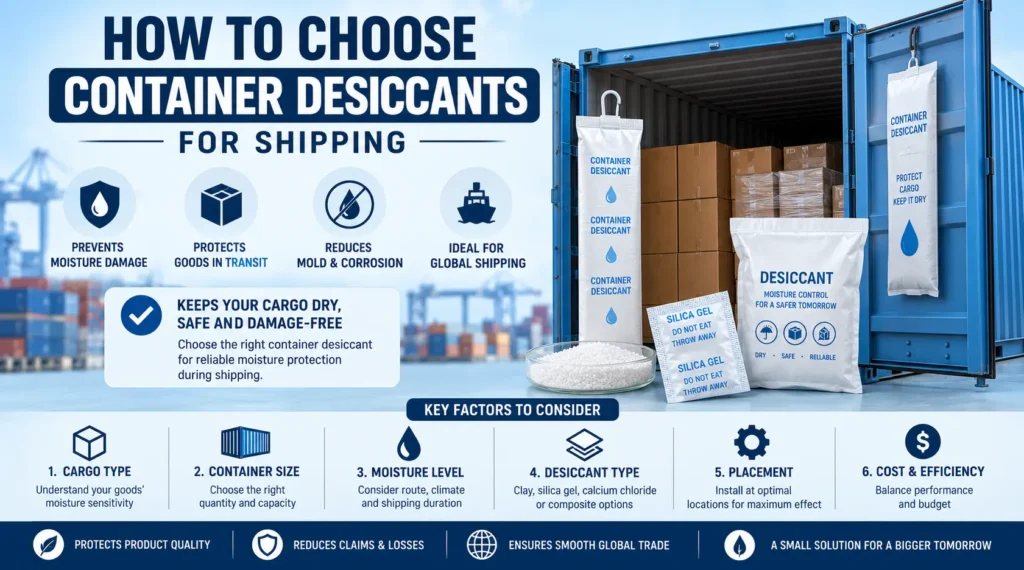
Moisture is one of the most common — and most avoidable — causes of cargo damage in international shipping. Choosing the right container desiccant can mean the difference between goods arriving in perfect condition and a container full of mold, rust, or water-stained packaging. But with several desiccant types, formats, and sizing considerations to weigh, picking the right one isn’t always straightforward.
This guide walks through exactly how to choose a container desiccant for shipping — the types available, the factors that actually affect your decision, and the mistakes that lead to moisture damage even when a desiccant was used. Browse Bee Chems’ full Adsorbents, Absorbents & Desiccants range to compare options.
Why Moisture Control Matters in Shipping Containers
Shipping containers experience significant temperature swings between day and night, and across climate zones during long ocean transits. Warm, humid air inside a container holds moisture until temperatures drop — at which point that moisture condenses on the container’s walls and ceiling, a phenomenon widely known as container rain or container sweat. That condensation drips onto cargo below, leading to:
- Rust and corrosion on metal components
- Mold and mildew on textiles, leather, and packaging
- Warping or swelling of wood and paper-based products
- Short circuits and failure in electronic components
- Cargo rejection, insurance claims, and financial loss
A properly chosen desiccant actively absorbs that excess water vapor before it can condense, keeping humidity low throughout the transit.
How Desiccants Actually Work
Most container desiccants work through physical adsorption — they don’t react chemically with water so much as trap water molecules on or within their internal structure. Clay and silica gel both rely on a porous internal surface area that pulls moisture out of the surrounding air and holds it. Calcium chloride works differently: it’s a chemical (hygroscopic) desiccant that actually dissolves as it absorbs water, converting from a solid into a contained liquid or gel as it works — which is why it’s usually supplied in a leak-proof pouch or container rather than a simple breathable bag.
Understanding this distinction matters because it affects handling: physical desiccants like clay and silica gel stay solid and can be handled or disposed of easily even when saturated, while chemical desiccants like calcium chloride need to be handled and disposed of as a liquid-containing unit once they’ve absorbed their capacity.
Types of Container Desiccants
Not all desiccants work the same way. The main options used in container shipping include:
- Clay desiccant: A natural, low-cost, eco-friendly option effective at moderate humidity levels — a good general-purpose choice for standard shipments.
- Silica gel: Higher absorption capacity than clay, effective across a wider humidity range, commonly used where higher-value or more moisture-sensitive cargo is involved.
- Calcium chloride desiccant: A chemical desiccant that absorbs large volumes of moisture and converts it into a contained liquid or gel, suited to very high-humidity, long-duration shipments where maximum absorption capacity matters most.
Container Desiccant vs Cargo Desiccant: What’s the Difference?
Container desiccant and cargo desiccant are closely related and often used interchangeably — both are moisture-absorbing bags designed to protect goods in transit. The distinction is mostly one of scope: “container desiccant” typically refers to products specifically sized and packaged for hanging or placement inside standard 20-foot and 40-foot shipping containers, while “cargo desiccant” is the broader term covering moisture protection across containers, pallets, and general sealed packaging.
In practice, if you’re shipping a full container load by ocean freight, the container desiccant range is the more specifically targeted choice. If you need moisture protection for palletized or mixed packaging beyond a single container, the cargo desiccant range offers more flexible options.
Key Factors to Consider When Choosing a Container Desiccant
- Container size: A standard 20-foot container needs less desiccant than a 40-foot container — larger enclosed air volume means more potential moisture to absorb.
- Cargo sensitivity: Electronics, pharmaceuticals, and leather goods need tighter humidity control than general hardware or industrial parts.
- Transit duration and route: Longer voyages and routes crossing multiple climate zones increase the risk and duration of temperature-driven condensation.
- Expected humidity and temperature conditions: Origin and destination climate, plus the season of shipment, affect how much moisture the desiccant will need to handle.
- Packaging format: Hanging bags, placed sachets, or bulk units — the right format depends on how the container is loaded and how much handling the desiccant needs to withstand.
Desiccant Packaging Formats Explained
Beyond the desiccant material itself, the packaging format affects how well it performs during handling and transit:
- Hanging bags: Suspended from container walls or roof hooks, keeping the desiccant clear of cargo and allowing airflow on all sides for more even absorption.
- Placed sachets and pillow packs: Set directly on or near cargo — convenient for smaller shipments or where hanging points aren’t available. Bee Chems’ Desiccant Sachets and Bags cover this format across multiple sizes.
- Bulk units: Larger-capacity packs designed for high-volume or long-duration shipments where frequent replacement isn’t practical.
The right format often comes down to how the container is loaded — dense, palletized loads may only leave room for placed sachets, while open-floor loads can accommodate hanging bags distributed evenly across the space.
How Much Desiccant Do You Need?
The right quantity depends on container size, cargo type, transit duration, and expected humidity — there’s no single number that applies to every shipment. As a general rule, larger containers, longer transit times, and more moisture-sensitive cargo all call for a higher desiccant capacity. Rather than guessing, it’s worth confirming the recommended quantity for your specific container size and route with your supplier’s technical team before shipping.
How to Verify Desiccant Performance During Transit
Since a shipping container isn’t opened again until it reaches its destination, there’s no way to physically check a desiccant mid-voyage — which is exactly why humidity indicator cards are commonly packed alongside desiccants. These cards change color at specific relative humidity thresholds, giving a simple visual confirmation the moment the container is opened of whether humidity stayed within a safe range throughout transit — and whether the desiccant was sized correctly for next time.
Desiccants vs Other Moisture Control Methods
Desiccants aren’t the only tool for container moisture control, and in some cases they work best alongside other methods rather than alone:
- Container ventilation: Passive or powered vents can reduce humidity buildup, though they’re less effective for controlling condensation caused by temperature swings alone.
- Vapor barrier liners: Sealed container liners reduce the amount of ambient moisture that enters in the first place, reducing the load a desiccant needs to handle.
- Vapor corrosion inhibitors (VCIs): Used specifically to protect metal parts from rust and corrosion, VCIs work alongside — not instead of — a desiccant, since they address surface oxidation rather than general humidity.
For most standard shipments, a correctly sized desiccant alone is sufficient. Combining it with a vapor barrier liner or VCI is typically reserved for especially high-value, moisture-sensitive, or corrosion-prone cargo.
Common Mistakes to Avoid
- Under-estimating quantity: Using too little desiccant for the container size or cargo sensitivity leaves excess moisture unaddressed.
- Poor placement: Desiccant bags placed in one corner rather than distributed strategically won’t control humidity evenly throughout the container.
- Ignoring transit duration: A desiccant sized for a short regional shipment may not have enough capacity for a multi-week ocean voyage.
- Choosing the wrong desiccant type for cargo value: Using a basic clay desiccant for highly moisture-sensitive electronics or pharmaceuticals, where a higher-capacity option would be more appropriate.
- Not accounting for container loading date vs. climate: Loading in a humid season without adjusting desiccant quantity accordingly increases condensation risk.
You might be interested in: Lithium Silicate vs Sodium Silicate
Step-by-Step: How to Choose the Right Container Desiccant
- Assess your cargo’s moisture sensitivity — general goods, or high-value/moisture-sensitive items like electronics and pharmaceuticals?
- Identify your container size — 20-foot, 40-foot, or other enclosed volume.
- Map your route and transit duration — climate zones crossed and expected voyage length.
- Choose the desiccant type — clay for general/cost-effective protection, silica gel for higher sensitivity, calcium chloride for maximum absorption on long, humid routes.
- Confirm quantity and placement with your supplier’s technical guidance for your specific container and cargo combination.
Conclusion
Choosing the right container desiccant comes down to matching desiccant type and quantity to your container size, cargo sensitivity, and transit conditions — not just grabbing whatever’s cheapest or most familiar. Getting this right protects your cargo, avoids costly claims, and keeps shipments arriving in the condition they left in.
Not sure which desiccant and quantity fits your shipment? Talk to our technical team for a recommendation based on your container size, cargo type, and route.
Frequently Asked Questions
Q1. What is the best desiccant for shipping containers?
Ans: There’s no single “best” option — clay desiccant suits general-purpose, cost-sensitive shipments, silica gel suits higher-sensitivity cargo, and calcium chloride desiccant suits long, high-humidity routes where maximum absorption capacity is needed.
Q2. How many desiccant bags does a shipping container need?
Ans: It depends on container size, cargo type, transit duration, and expected humidity levels. A standard 20-foot or 40-foot container typically needs multiple bags placed strategically — confirm the right quantity with your supplier’s technical team for your specific shipment.
Q3. Can container desiccants prevent container rain completely?
Ans: A correctly sized and placed desiccant significantly reduces the moisture available to condense, which greatly lowers the risk of container rain, but factors like extreme humidity, poor placement, or under-dosing can still allow some condensation to occur.
Q4. Is clay desiccant strong enough for long ocean shipments?
Ans: Clay desiccant works well for general, moderate-humidity shipments, but for longer voyages or higher-humidity routes, a higher-capacity option like silica gel or calcium chloride desiccant may provide more reliable protection.
Q5. Do I need a different desiccant for electronics vs general cargo?
Ans: Moisture-sensitive cargo like electronics generally benefits from a higher-absorption desiccant such as silica gel, while general goods and industrial components are often adequately protected with a cost-effective clay desiccant.
