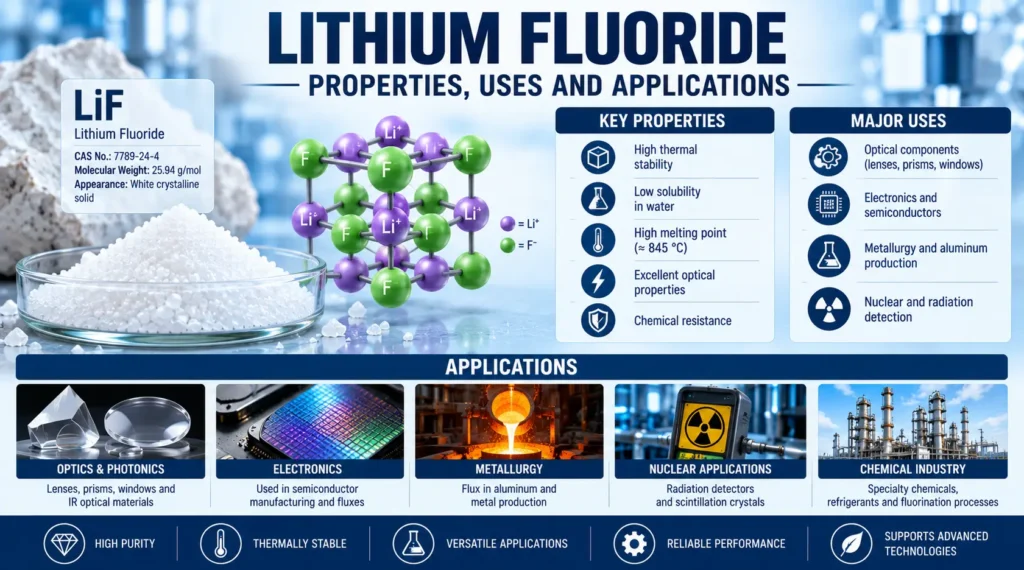
Lithium fluoride is one of the simplest yet most technologically important alkali metal halides in the chemical industry. Despite its small molecule size, this compound plays an outsized role in fields ranging from optics and ceramics to nuclear technology and battery manufacturing. In this guide, we break down the lithium fluoride formula, its key physical and chemical properties, and the industries that depend on it — along with what to look for when sourcing it from lithium fluoride suppliers.
What Is Lithium Fluoride?
Lithium fluoride (LiF) is an inorganic compound formed from lithium and fluoride ions. It appears as a white, odorless crystalline solid and is the lithium salt of hydrofluoric acid. Because of its unique combination of optical transparency, thermal stability, and low refractive index, lithium fluoride is widely used in high-precision industrial and scientific applications where few other materials can perform as reliably.
Lithium Fluoride Formula and Structure
The lithium fluoride formula is LiF, made up of one lithium cation (Li⁺) and one fluoride anion (F⁻). It crystallizes in a face-centered cubic (rock salt) structure — the same lattice arrangement seen in sodium chloride (NaCl) — where each lithium ion is surrounded by six fluoride ions and vice versa. This tightly packed ionic structure is what gives lithium fluoride its high melting point, strong lattice energy, and excellent transparency to ultraviolet and infrared light.
Key identifiers:
- Chemical formula: LiF
- Molar mass: 25.94 g/mol
- Molecular structure: Cubic (rock-salt) crystal lattice
- Appearance: White crystalline powder or crystal
- CAS Number: 7789-24-4
Physical and Chemical Properties of Lithium Fluoride
Understanding the properties of lithium fluoride helps explain why it’s chosen for such specialized applications:
- Melting point: Approximately 845°C — notably high for an alkali halide, due to strong ionic bonding.
- Boiling point: Around 1,676°C.
- Density: About 2.64 g/cm³.
- Solubility: Lithium fluoride has very low solubility in water (roughly 0.13 g per 100 mL at room temperature), unlike most other alkali halides such as sodium chloride or potassium chloride. This low solubility is a direct result of its high lattice energy.
- Optical properties: LiF is transparent across a very wide range of the electromagnetic spectrum — from deep ultraviolet (down to ~104 nm) through to the infrared — making it valuable in optical components.
- Thermal stability: Highly stable at elevated temperatures, which supports its use in high-temperature industrial processes.
- Refractive index: Low refractive index (~1.39), useful for anti-reflective coatings and lens applications.
Industrial Uses and Applications of Lithium Fluoride
Lithium fluoride’s distinct properties make it valuable across a wide range of industries:
1. Optics and Photonics
Because of its wide transparency range, lithium fluoride is used to manufacture optical windows, lenses, and prisms for ultraviolet and vacuum-UV spectroscopy equipment, as well as components in lasers and other precision optical instruments.
2. Ceramics and Glass Manufacturing
LiF is added as a flux in ceramic glazes and specialty glass formulations. It lowers the melting/sintering temperature of the mixture, improves flow, and helps produce smoother, more durable glass and ceramic surfaces.
3. Welding and Metallurgy
Lithium fluoride is a key ingredient in welding and brazing fluxes, particularly for aluminum and other non-ferrous metals. It helps dissolve metal oxides on the surface, improving weld quality and preventing porosity.
4. Battery and Energy Storage Technology
Lithium fluoride is used in the formulation of solid electrolyte interphase (SEI) layers in lithium-ion and lithium-metal batteries, contributing to battery stability and cycle life. It’s also studied as a component in next-generation solid-state battery electrolytes.
5. Nuclear Industry
LiF is a core component of FLiBe (lithium fluoride-beryllium fluoride) molten salt mixtures, historically used as a coolant and solvent in molten salt nuclear reactors, thanks to its high thermal stability and neutron transparency.
6. Aluminum Smelting
Lithium fluoride is used as an additive in aluminum electrolysis (alongside cryolite) to improve current efficiency and reduce energy consumption in the smelting process.
Lithium Fluoride Price and Sourcing Considerations
Lithium fluoride pricing depends on purity grade, particle size, and order volume — industrial-grade LiF for fluxes and ceramics is priced differently from high-purity, optical-grade lithium fluoride used in precision instruments. When requesting a quote from a lithium fluoride manufacturer, it helps to specify:
- Required purity (%) and grade (industrial vs. optical/electronic grade)
- Particle size or crystal form needed
- Order quantity and packaging requirements
- Application (so the supplier can recommend the right specification)
Choosing the Right Lithium Fluoride Suppliers
Not all lithium fluoride suppliers offer the same consistency in purity and particle size — both of which are critical for applications like optics and battery manufacturing, where even small impurities can affect performance. When evaluating lithium fluoride suppliers, look for:
- Consistent batch-to-batch purity and quality control
- Technical documentation (COA, MSDS) provided with every shipment
- Manufacturing experience with alkali metal salts and specialty chemicals
- Ability to customize grade and packaging for your specific application
Bee Chems has over 50 years of experience manufacturing specialty and industrial chemicals, including a full range of lithium salts — lithium fluoride, lithium chloride, lithium bromide, and lithium acetate. As a trusted lithium fluoride manufacturer and supplier, Bee Chems provides consistent quality, technical support, and customized formulations for industries including electronics, ceramics, energy storage, and metallurgy.
Safety and Handling
Lithium fluoride should be handled with standard chemical safety precautions:
- Use appropriate PPE (gloves, safety glasses, dust mask) when handling powder form
- Avoid inhalation of dust; work in a well-ventilated area or under a fume hood
- Store in a cool, dry place away from moisture and incompatible materials
- Refer to the Safety Data Sheet (SDS) for full handling and first-aid guidance.
Also Read: What is Molecular Sieve?
Conclusion
Lithium fluoride may be a simple compound in formula (LiF), but its unique combination of thermal stability, low solubility, and wide optical transparency makes it indispensable across a surprising range of industries — from precision optics and battery technology to ceramics, welding, and even nuclear applications. Whether you’re formulating a new glass composition, developing next-generation battery electrolytes, or sourcing flux material for metallurgy, understanding lithium fluoride’s properties and grades is the first step to choosing the right specification for your application.
Sourcing from an experienced, quality-focused manufacturer makes all the difference in performance and consistency. With over 50 years of expertise in specialty and industrial chemicals — including colloidal silica and a full range of lithium salts — Bee Chems is well-positioned to supply the lithium fluoride grade your application demands, backed by technical support and reliable documentation on every order.
Frequently Asked Questions
Q1. What is the chemical formula of lithium fluoride?
Ans: The lithium fluoride formula is LiF, composed of one lithium ion and one fluoride ion.
Q2. What is the molar mass of lithium fluoride?
Ans: The molar mass of lithium fluoride is 25.94 g/mol.
Q3. Is lithium fluoride soluble in water?
Ans: No, lithium fluoride has very low water solubility (about 0.13 g/100 mL at room temperature), which is unusual among alkali metal halides.
Q4. What is lithium fluoride used for?
Ans: Lithium fluoride is used in optical components, ceramic glazes, welding fluxes, battery technology, nuclear reactor coolant mixtures (FLiBe), and aluminum smelting.
Q5. Is lithium fluoride the same as lithium chloride?
Ans: No. While both are lithium halide salts, lithium fluoride (LiF) has much lower water solubility and a higher melting point than lithium chloride (LiCl), which is highly soluble and commonly used in desiccants and dehumidification.
Q6. Where can I buy lithium fluoride in bulk?
Ans: Bee Chems supplies industrial and high-purity grades of lithium fluoride in bulk quantities, with customized packaging and technical documentation for buyers across industries.
