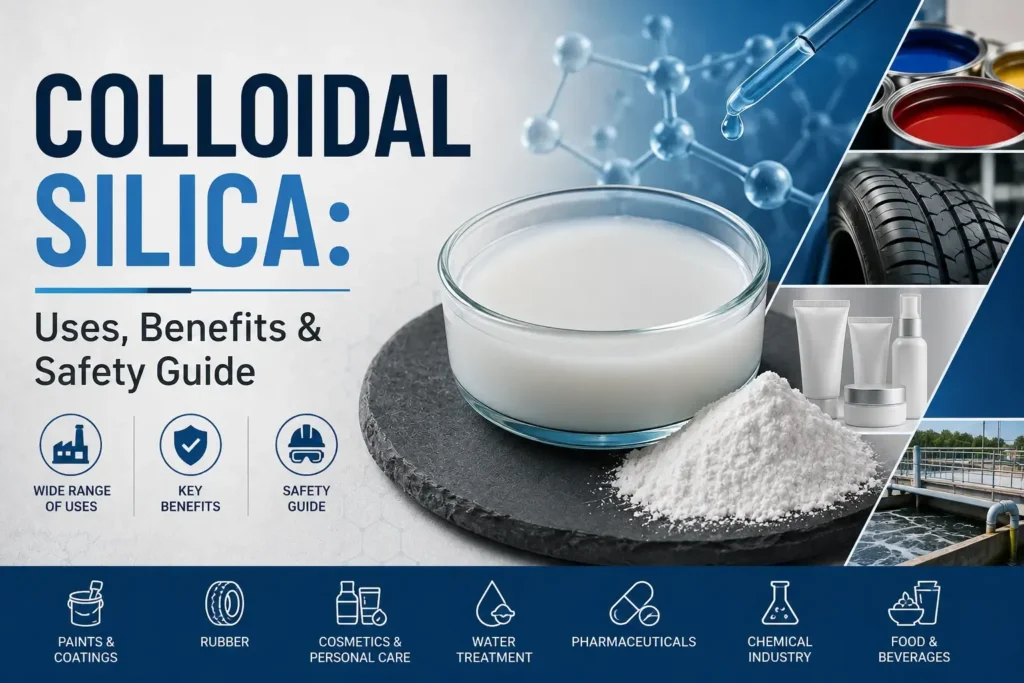
Colloidal silica is a suspension of nanoscale silicon dioxide (SiO₂) particles dispersed in a liquid, usually water. Unlike bulk silica, these particles stay suspended rather than settling out, which gives colloidal silica its defining properties: high surface area, strong binding ability, and controllable particle size. Bee Chems has manufactured colloidal silica in India since 1972, and was the first Indian company to produce it domestically.
This guide covers what colloidal silica is, how it’s made, its main grades, its benefits, where it’s used, how it compares to sodium silicate, and how to handle it safely. Browse our full colloidal silica product range or explore the broader Nano Sols and Silicates category.
What Is Colloidal Silica?
Colloidal silica consists of amorphous (non-crystalline) SiO₂ nanoparticles, typically 1–100 nanometers in size, stabilized in an aqueous solution so they don’t clump together or settle. The “colloidal” part of the name refers to this stable suspension — the particles are small and light enough that Brownian motion keeps them evenly dispersed rather than sinking.
Because the particles are so small, colloidal silica has an extremely high surface-area-to-volume ratio. That’s what makes it useful as a binder, a strengthening agent, and a carrier for other active ingredients across construction, industrial, and specialty chemical applications.
How Colloidal Silica Is Made?
Colloidal silica is produced through one of two primary industrial processes:
1. Ion Exchange Method
This is the most common commercial method. It starts with sodium silicate solution, which is passed through an ion-exchange resin to remove sodium ions and produce silicic acid. The silicic acid is then polymerized under controlled conditions (temperature, pH, and concentration) to grow uniform silica particles to the desired size, after which the dispersion is stabilized — usually with a small amount of alkali (sodium or ammonium) to prevent gelation.
2. Sol-Gel (Stöber) Process
Used more often for specialty or high-purity grades, this method hydrolyzes a silicon alkoxide (such as TEOS — tetraethyl orthosilicate) in an alcohol-water mixture with a catalyst. It allows very precise control over particle size and size distribution, making it popular for electronics, optical, and precision-casting applications.
The finished product is filtered, concentrated, and stabilized to ensure long-term shelf stability without particles aggregating or gelling prematurely.
Grades of Colloidal Silica
| Grade | Description |
|---|---|
| Standard construction-grade | Moderate particle size and concentration, optimized for concrete densification and surface hardening |
| Fine particle-size grades | Used in precision applications like chemical-mechanical polishing (CMP) slurries and catalyst supports |
| High-concentration grades | Used where a smaller dosage needs to deliver a stronger binding or hardening effect |
| Stabilized/coating-grade | Formulated for consistent film formation in paints, coatings, and textile treatments |
Choosing the right grade depends on the specific application — a grade optimized for concrete densification isn’t the same one you’d use for a polishing slurry. For applications needing an even finer particle size, see our colloidal nano silica grade. Bee Chems also manufactures related silicate products, including potassium silicate and lithium silicate, under the same Nano Sols and Silicates line.
Key Benefits of Colloidal Silica
- High binding strength relative to the amount used, thanks to the large surface area of the nanoparticles
- Improved durability in treated surfaces — colloidal-silica-densified concrete resists abrasion and dusting significantly better than untreated concrete
- Water-based and low-VOC, since the carrier is water rather than a solvent, which matters for indoor and environmentally sensitive applications
- Chemically stable across a range of pH and temperature conditions when properly formulated, giving it a longer usable shelf life than some alternative binders
- Versatile carrier — because of its fine particle size, it can be formulated into coatings, textiles, and papers without adding significant bulk or weight
Uses of Colloidal Silica
Because of its unique binding, thickening, and reinforcing properties, colloidal silica is used across a wide range of industries:
- Construction: Concrete densifiers, surface hardeners, and protective coatings (detailed below).
- Precision investment casting: As a binder for ceramic shell molds in metal casting.
- Textiles and paper: As a retention aid and coating agent to improve strength and printability.
- Catalysis: As a carrier or support material for industrial catalysts.
- Electronics: In chemical-mechanical planarization (CMP) slurries for polishing silicon wafers.
- Refractories: As a binder for high-temperature ceramic and refractory products.
- Adhesives and coatings: To improve scratch resistance, anti-blocking, and matting properties.
- Water treatment: As a flocculation aid in certain purification processes.
Colloidal Silica vs. Sodium Silicate: Key Differences
Colloidal silica and sodium silicate are related but distinct products, and buyers sometimes confuse them:
| Colloidal Silica | Sodium Silicate | |
|---|---|---|
| Form | Stable suspension of discrete SiO2 nanoparticles | Alkaline solution of dissolved sodium silicate ions |
| pH | Typically near-neutral to mildly alkaline | Strongly alkaline |
| Reaction with concrete | Reacts with free lime to densify without leaving a soluble residue | Can leave soluble sodium salts (efflorescence risk) after reaction |
| Typical use case | High-performance concrete densification, precision polishing, coatings | Adhesives, detergents, general silicate chemistry, and as a precursor to make colloidal silica |
| Relationship | Often manufactured from sodium silicate via ion exchange | The raw material/precursor for colloidal silica |
In short: sodium silicate is the broader, more alkaline starting material; colloidal silica is a refined, particle-based product made from it (or synthesized separately) for applications needing controlled particle size and minimal residue. For concrete densification specifically, colloidal silica generally outperforms sodium silicate because it doesn’t leave behind the soluble salts that can cause efflorescence (white surface staining) over time.
Colloidal Silica in Construction: Concrete Densifiers & Coatings
Construction is one of the largest and fastest-growing applications for colloidal silica, primarily in two forms:
-
Concrete Densifiers
When applied to cured concrete, colloidal silica’s nanoparticles penetrate the pore structure and react with free lime (calcium hydroxide) — a byproduct of cement hydration that would otherwise remain unreacted and weak. This reaction forms additional calcium silicate hydrate (C-S-H), the same binding compound that gives concrete its strength. The result is a denser, harder, more abrasion- and chemical-resistant surface, commonly used in:
- Industrial and warehouse floors
- Parking structures
- Polished concrete finishes
- Loading docks and high-traffic commercial floors
Because the reaction happens throughout the penetrated depth (not just at the surface), colloidal silica densifiers tend to produce more consistent, long-lasting results compared to sodium-silicate-based hardeners, with lower risk of surface efflorescence or dusting.
-
Protective Coatings
Colloidal silica is also used as a component in protective and decorative coatings, where it contributes:
- Improved abrasion and scratch resistance
- Enhanced adhesion to mineral substrates
- Reduced dusting and improved surface gloss
- Compatibility with sealers and stains for polished concrete systems
Its low VOC profile (being water-based) also makes it attractive for projects targeting sustainability certifications like LEED.
Safety & Handling Guidelines
Colloidal silica in its liquid, suspended form is generally low-hazard compared to dry crystalline silica dust, but standard industrial chemical handling practices still apply:
- Skin and eye contact — colloidal silica can cause mild irritation on prolonged contact; wear gloves and eye protection when handling concentrated product
- Ventilation — handle in a well-ventilated area, particularly when spraying or applying as a coating, to avoid inhaling fine mist
- Storage — store in sealed containers at the manufacturer’s recommended temperature range; freezing or extreme heat can destabilize the suspension and cause particles to aggregate
- Important distinction — the health concerns associated with “silica dust” in occupational safety discussions relate to crystalline silica dust from cutting, grinding, or sandblasting solid materials — not the amorphous, liquid-suspended colloidal silica covered in this guide. Always check the specific product’s Safety Data Sheet (SDS) for exact handling instructions, as formulations vary by grade and manufacturer
- Disposal — follow local regulations for chemical waste disposal; do not pour concentrated product directly into drains without checking local wastewater discharge rules
Why Choose Bee Chems for Colloidal Silica
Bee Chems has manufactured colloidal silica in India since 1972 and was the first Indian company to produce it domestically — over five decades of production experience behind every batch. As a specialty chemical manufacturer with dedicated Nano Sols and Silicates and Construction Chemicals product lines, Bee Chems supplies colloidal silica in multiple grades suited to construction densification, coatings, and industrial applications, with direct technical support to help you choose the right grade for your project.
Frequently Asked Questions
Q1. Is colloidal silica the same as sodium silicate?
Ans: No. Sodium silicate is an alkaline solution and is often the raw material used to manufacture colloidal silica via ion exchange. Colloidal silica is a refined suspension of discrete silica nanoparticles with different properties and use cases — see the comparison above.
Q2. Is colloidal silica dangerous to work with?
Ans: Colloidal silica in liquid form is considered low-hazard with standard precautions (gloves, eye protection, ventilation). It should not be confused with crystalline silica dust, which carries separate, well-documented inhalation risks from cutting or grinding solid materials — colloidal silica is amorphous and suspended in liquid, not airborne dust.
Q3. What’s the main benefit of using colloidal silica on concrete?
Ans: It penetrates and densifies the surface by reacting with free lime to form additional C-S-H binder, which reduces dusting and improves abrasion resistance — without leaving the soluble salt residue that sodium silicate treatments can leave behind.
Q4. Can colloidal silica be used indoors?
Ans: Yes — because it’s water-based with low VOC content, it’s commonly used for indoor concrete floor treatments in warehouses and industrial facilities where solvent-based alternatives would be less suitable.
