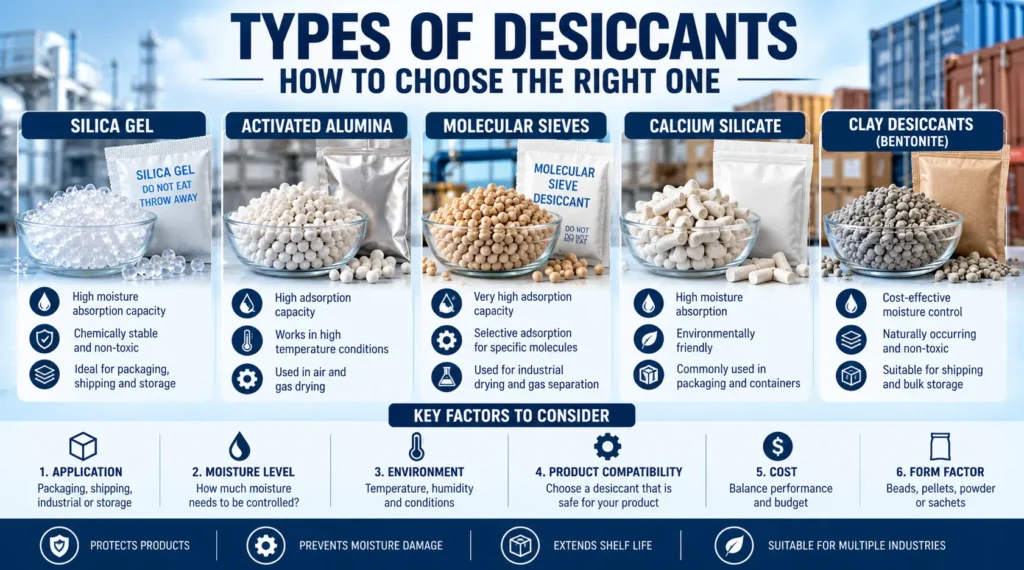
A desiccant is any material that absorbs or adsorbs moisture from its surroundings — and each type is engineered for a different job. From silica gel and clay desiccant to molecular sieve, activated alumina, and calcium chloride desiccant, every desiccant has an ideal humidity range, format, and application where it delivers the best protection for the money.
This guide walks through the main types of desiccants, how each works, where each performs best, and how to match the right one to your product. Browse Bee Chems’ full Adsorbents, Absorbents & Desiccants range to see every option in one place.
Why Moisture Control Matters
Moisture is one of the most common causes of product damage during storage and transport. Excess humidity can lead to mold and mildew on textiles, leather, and packaging; rust and corrosion on metal parts; caking and clumping in powders and granules; degraded tablets and capsules in pharmaceutical packs; and short circuits or reduced performance in electronic components. Even a well-sealed package can trap enough moisture at the time of packing, or let in small amounts over weeks of shipping, to cause these problems. A properly chosen desiccant keeps the humidity inside the package or enclosure within a safe range, protecting both product quality and brand reputation, while reducing returns, claims, and waste.
How Desiccants Work: Adsorption vs Absorption
Desiccants fall into two broad mechanisms. Adsorbent desiccants — like silica gel, clay, molecular sieve, and activated alumina — trap water molecules on their porous internal surface without changing physical form. Absorbent (hygroscopic) desiccants — like calcium chloride — chemically bind with water and convert into a contained liquid or brine as they work. Understanding which mechanism suits your setup helps you pick the right capacity, format, and handling approach.
Types of Desiccants
Silica Gel
Silica gel is the most widely recognized desiccant — a porous, amorphous form of silicon dioxide that adsorbs moisture efficiently across moderate to high humidity at ambient temperature. It’s available as white (regular) beads and as indicating grades — blue and cobalt-free orange — that change color as they saturate, giving a quick visual check. Widely used in packaging, electronics, pharmaceuticals, leather goods, and general shipping.
Clay Desiccant
Clay desiccant is a natural, eco-friendly option made from specially processed clay. It adsorbs moisture reliably at moderate humidity levels, stays dry without liquefying or leaking, and offers economical protection for everyday packaging needs. It’s widely used in food packaging, pharmaceuticals, electronics, textiles, and export shipments in sachet, bag, and bulk formats.
Molecular Sieve
Molecular sieve is a synthetic crystalline zeolite with precisely uniform pores, available in 3A, 4A, 5A, and 13X grades. It’s the go-to choice where very low dew points are required—performing even at low relative humidity and high temperature. Typical uses include industrial gas drying, refrigerant drying, insulated glass, and PSA oxygen and nitrogen generation.
Activated Alumina
Activated alumina is a highly porous form of aluminum oxide known for strong moisture adsorption and long cycle stability. It works under both static and dynamic conditions, can be regenerated across multiple cycles, and is widely used in compressed air drying, chemical processing, and purification applications.
Calcium Chloride Desiccant
Calcium chloride desiccant is a hygroscopic desiccant with very high absorption capacity — it pulls in large volumes of moisture and holds it as a contained liquid or brine. Supplied in leak-proof pouches, it’s a natural fit for high-humidity, long-duration applications such as shipping containers and cargo holds.
Key Benefits of Each Desiccant Type
- Silica gel: Wide humidity range, color-indicating blue and cobalt-free orange grades for easy monitoring, chemically inert, and available as beads, sachets, and bags.
- Clay desiccant: Natural and eco-friendly, non-toxic and chemically inert, stays dry without leaking, and available in sachets, bags, bulk packs, and beads or balls.
- Molecular sieve: Precisely uniform pores for selective adsorption, dew points down to -60°C, strong performance at low humidity and elevated temperature, and regenerable for repeated cycles.
- Activated alumina: High surface-area-to-weight ratio, long cycle stability, reliable in both static and dynamic conditions, and inert and non-toxic.
- Calcium chloride desiccant: Very high moisture-holding capacity at high humidity, ideal for large enclosed spaces, and supplied in leak-proof formats for cargo and container use.
Food-Grade, Pharmaceutical-Grade, and Non-Toxic Desiccants
When a desiccant sits close to food, medicine, or sensitive consumer goods, material safety matters as much as moisture capacity. Silica gel, clay, molecular sieve, and activated alumina are all chemically inert and non-toxic when used as intended, which is why they’re common in food and pharmaceutical packaging. For indicating silica gel, many buyers specify cobalt-free grades such as Bee Chems’ orange silica gel to meet modern regulatory expectations. Calcium chloride is best suited to sealed, leak-proof pouches for shipping and storage spaces. Whichever type you choose, desiccant packets should always be marked “do not eat” and kept out of reach of children and pets.
Can You Combine Different Desiccants?
Yes, and in industrial drying it’s common practice. A layered setup uses silica gel or activated alumina to remove the bulk of the moisture first, followed by molecular sieve as a polishing stage to reach very low dew points. This protects the molecular sieve from heavy moisture loading and extends its working life. In packaging, another popular pairing is a desiccant for moisture control together with an oxygen absorber for oxidation control, since the two address completely different spoilage risks.
Desiccant Forms: Bags, Packets, Sachets, and Bulk
Beyond material type, desiccants come in different physical formats. Desiccant packets and sachets are small, breathable pouches placed directly inside product packaging—see Bee Chems’ Desiccant Sachets and Bags. Desiccant bags are larger-format units used for cartons, pallets, and containers. Bulk desiccant — loose beads or granules — is used in dryers, columns, and industrial drying vessels. The right format depends on package size, handling needs, and how the desiccant will be used.
How to Choose the Right Desiccant
- Define your humidity target. Moderate protection for general packaging suits silica gel or clay; very low dew points call for molecular sieve.
- Consider temperature conditions. High-temperature or low-humidity environments are where molecular sieve shines; ambient conditions are well served by silica gel or clay.
- Match to the application. Shipping containers and cargo often use calcium chloride or clay bags; gas and air drying uses molecular sieve or activated alumina; sealed consumer packaging typically uses silica gel or clay sachets.
- Balance budget and performance. Clay offers economical, eco-friendly protection for everyday needs, silica gel adds indicating options, and molecular sieve delivers precision performance for demanding processes.
- Think about how it will be used. Continuous drying systems benefit from regenerable desiccants (molecular sieve, activated alumina, silica gel), while clay and calcium chloride are convenient ready-to-use options for sealed packaging and shipping.
- Verify performance. Pair desiccants with humidity indicator cards to confirm humidity stayed within a safe range.
How Much Desiccant Do You Need?
There’s no single formula that fits every product, because the right quantity depends on the volume of the enclosed space, how moisture-sensitive the product is, how long it will be stored or shipped, and the humidity and temperature it will experience. As a general rule, larger enclosed volumes, longer storage or transit times, and more sensitive products all call for higher desiccant capacity. Packaging that isn’t well sealed will also use up desiccant capacity faster, since outside air keeps adding moisture. Rather than guessing, confirm the recommended quantity for your specific package size and conditions with your supplier’s technical team.
Common Mistakes When Choosing a Desiccant
- Choosing without a humidity target: Each desiccant has an ideal range—silica gel and clay for general packaging, molecular sieve for very low dew points—so define the target first.
- Picking by price alone: The right desiccant is the one that protects your product at the humidity level it needs, not simply the lowest-priced option.
- Under-sizing the quantity: Too little desiccant for the package volume leaves excess moisture unaddressed.
- Leaving desiccant exposed before sealing: It starts absorbing moisture immediately, so capacity is used up before the product is even packed.
- Not matching format to use: Sachets, bags, and bulk beads each suit different setups—choosing the format that fits how the desiccant will be handled makes a real difference.
Storage and Handling of Desiccants
Desiccants begin working as soon as they’re exposed to humid air, so they should be kept in their original sealed packaging until the moment of use. Store them in a cool, dry place away from direct sunlight, and reseal any opened bulk containers promptly. When packing, add the desiccant as late in the process as practical and seal the package quickly. Used desiccant should be disposed of according to local regulations and the supplier’s safety data sheet, with calcium chloride handled as a liquid brine once it has absorbed its capacity.
Desiccants for Specific Industries and Applications
Shipping, Logistics and Export
Long ocean voyages and changing climates make moisture one of the biggest risks to export cargo. Calcium chloride and clay desiccant bags are standard choices here, protecting goods from container rain, mold, and corrosion — see our guide on how to choose container desiccants for shipping.
Pharmaceutical and Healthcare Packaging
Tablets, capsules, diagnostic kits, and medical devices need tightly controlled humidity to stay stable through their shelf life. Silica gel and molecular sieve sachets are widely used in bottles, blister packs, and test-kit pouches, chosen for the tightest humidity requirements.
Electronics and Electrical Components
Moisture can cause corrosion, short circuits, and failures in circuit boards and connectors. Silica gel and molecular sieve are commonly packed with electronic components for storage and transport, and molecular sieve is also used in insulated glass units and circuit-breaker applications.
Food and Dry Food Packaging
Food-grade silica gel and clay desiccants protect dry foods, spices, snacks, and bakery products from moisture-related spoilage and caking. They’re often combined with an oxygen absorber where oxidation is also a concern.
Textiles, Leather and Footwear
Garments, leather goods, and shoes are prone to mold, odor, and discoloration during storage and shipping. Silica gel and clay desiccant sachets keep humidity down inside cartons and bags, helping goods arrive in showroom condition.
Industrial Gas, Air and Process Drying
Compressed air systems, gas pipelines, refrigeration circuits, and chemical processes depend on very dry streams. Molecular sieve and activated alumina in columns and dryers deliver the low dew points and regeneration capability these systems need.
Machinery, Automotive and Spare Parts
Metal components stored or shipped for long periods are vulnerable to rust. Clay and silica gel desiccants, along with container desiccant bags for larger loads, help keep stored machinery and spare parts corrosion-free.
Sustainable and Eco-Friendly Desiccant Choices
Sustainability is an increasingly important factor in packaging decisions. Clay desiccant is made from naturally occurring clay and can be disposed of responsibly, making it a popular choice for brands with environmental goals. Regenerable desiccants such as silica gel, molecular sieve, and activated alumina can be reused across many cycles in industrial systems, which reduces waste and replacement frequency. Choosing the right quantity — enough to protect the product without excess — also reduces material use and packaging bulk.
What to Look for in a Desiccant Supplier
Beyond the desiccant type itself, supplier quality has a direct impact on results. Look for a manufacturer that tests every batch for adsorption efficiency and consistency, offers multiple formats (sachets, bags, bulk packs, and drums) and sizes, and can supply custom sizes, packaging materials, and private labeling for your brand. Access to a technical team that can recommend the right type and quantity for your humidity target, plus the ability to supply reliably in both small and bulk volumes, are equally important. Bee Chems offers silica gel, clay desiccant, molecular sieve, activated alumina, and calcium chloride desiccant, so you can compare and source the right option with a single partner.
You might be interested in: Lithium Fluoride: Properties and Uses
Conclusion
Every desiccant has a job it does best. Silica gel and clay cover most general packaging, calcium chloride handles high-moisture shipping, and molecular sieve and activated alumina take on industrial drying where precision and regeneration matter. Matching the type to your humidity target, temperature, and application is what keeps products dry and protected.
Not sure which desiccant is right for your product? Talk to our technical team for a recommendation based on your humidity, temperature, and packaging requirements.
Frequently Asked Questions
Q1. What are the main types of desiccants?
Ans: The most common types are silica gel, clay desiccant, molecular sieve, activated alumina, and calcium chloride. Each uses a different mechanism and suits different humidity levels, temperatures, and applications.
Q2. Which desiccant is best for general packaging?
Ans: For most general packaging, silica gel and clay desiccant are the standard choices — silica gel for its wide humidity range and indicating options, clay for natural, economical, eco-friendly protection.
Q3. What’s the difference between silica gel and clay desiccant?
Ans: Both adsorb moisture effectively for general packaging. Silica gel works across a wide humidity range and comes in color-indicating grades, while clay desiccant is a natural, eco-friendly choice that performs reliably at moderate humidity levels.
Q4. Which desiccant works at very low humidity?
Ans: Molecular sieve is the desiccant of choice at very low humidity and high temperature, capable of reaching dew points as low as -60°C.
Q5. Which desiccant has the highest moisture capacity?
Ans: Calcium chloride offers the highest absorption capacity at high humidity, making it an excellent fit for shipping containers and other high-moisture environments.
Q6. Can desiccants be reused?
Ans: Molecular sieve, activated alumina, and silica gel can be regenerated by heating, which restores their capacity for repeated use. Clay and calcium chloride are ready-to-use options designed for sealed packaging and shipping, where no regeneration step is needed.
