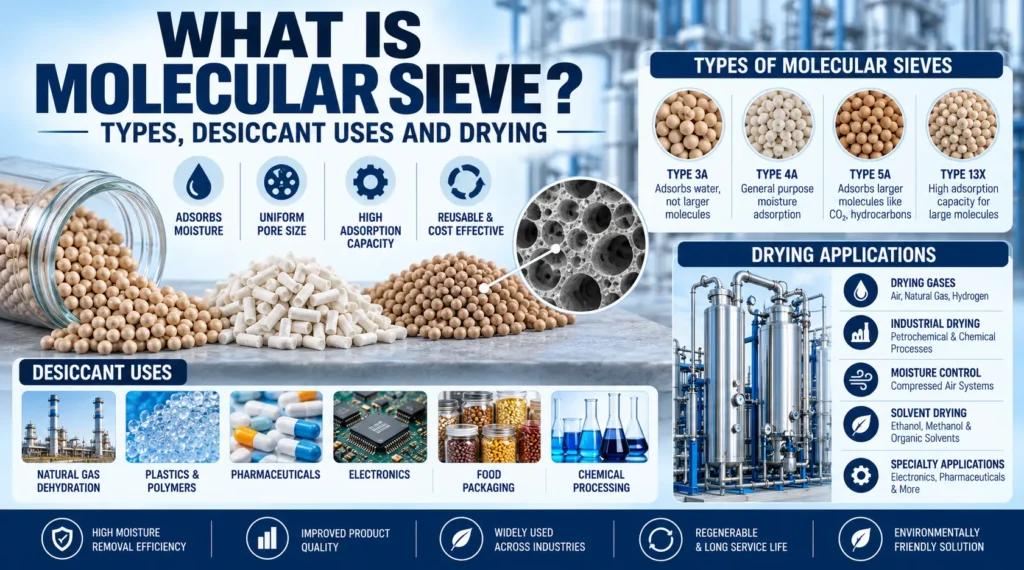
A molecular sieve is one of the most versatile adsorbents used across industrial drying and gas purification — capable of pulling moisture down to dew points as low as -60°C and working effectively even at very low relative humidity, conditions where most other desiccants lose their effectiveness. But “molecular sieve” isn’t a single material; it’s a family of synthetic zeolite grades, each engineered with a different pore size for a different job.
This guide covers what a molecular sieve actually is, how a molecular sieve desiccant works, the differences between the 3A, 4A, 5A, and 13X molecular sieve grades, and where each is used. Explore Bee Chems’ full Molecular Sieves (Molcat™) range, or browse the broader Adsorbents, Absorbents & Desiccants category.
What Is a Molecular Sieve?
A molecular sieve is a synthetic crystalline zeolite — a metal alumina-silicate — built from a three-dimensional lattice of tetrahedral building blocks, each made of an aluminum or silicon cation surrounded by four oxygen anions (AlO₄ and SiO₄). This structure forms a mesh of cavities and narrow pores with an extremely high internal surface area and, critically, a pore diameter that’s precisely uniform and controlled at the molecular scale.
That uniform pore size is what gives molecular sieves their defining property: molecules smaller than the pore diameter are adsorbed into the crystal structure, while larger molecules are excluded entirely. It’s a selective, size-based filter operating at the molecular level — which is exactly where the name comes from.
How Molecular Sieves Work
Unlike desiccants that simply soak up whatever moisture is nearby, a molecular sieve’s selectivity is determined by its pore size. Water molecules and other small polar compounds pass into the pores and are held there through reversible adsorption, while larger molecules are physically blocked from entering. Because this adsorption is reversible, molecular sieves can later be regenerated — by heating or pressure reduction — to drive off the adsorbed molecules and restore capacity for reuse.
This mechanism is also why molecular sieves remain effective under conditions where other desiccants struggle: they continue performing at very low relative humidity (as low as 10–20%) and under high-temperature conditions, making them the adsorbent of choice for demanding industrial drying applications.
Types of Molecular Sieve: 3A, 4A, 5A, and 13X
Molecular sieve grades are named after their approximate pore diameter in angstroms, and each grade is suited to different molecules and applications.
Molecular Sieve 3A
With the smallest common pore size, 3A molecular sieve adsorbs water while excluding larger molecules like ethanol — making it the standard choice for drying polar liquids such as ethanol and other alcohols without removing the liquid itself along with the water.
Molecular Sieve 4A
The most widely used general-purpose grade, 4A molecular sieve adsorbs water along with slightly larger molecules, making it a common choice for static dehumidification in packaging, general gas and liquid drying, and a broad range of industrial dehydration applications.
Molecular Sieve 5A
With a larger pore size than 4A, 5A molecular sieve can separate normal (straight-chain) hydrocarbons from branched and cyclic hydrocarbons, in addition to standard drying duty — making it useful in hydrocarbon separation and certain gas purification processes.
13X Molecular Sieve
The largest common pore size in the standard grade lineup, 13X molecular sieve is used for applications requiring larger-molecule adsorption — including CO₂ removal, air pre-purification, general gas drying, and sweetening applications that require removing larger sulfur compounds.
Beyond these four standard grades, specialty molecular sieve formulations exist for specific applications — including high-capacity water-resistant air-drying grades, PET drying, ethanol drying, refrigerant drying, and carbon molecular sieves (CMS) used specifically for nitrogen generation via pressure swing adsorption (PSA).
Specialty Molecular Sieve Grades Explained
Beyond the four standard grades, several specialty molecular sieve formulations are built for specific process conditions:
- AD / ADHP: High-capacity, water-resistant air-drying grades engineered to hold up to -60°C dew points even under demanding air-drying conditions.
- PETD: Formulated specifically for PET (polyethylene terephthalate) drying in plastics processing.
- XHN: Used in refrigeration systems, where it needs to remain stable in contact with refrigerant chemistries.
- ED: Purpose-built for ethanol drying applications.
- IGT: Used in insulation applications, such as insulated glass units.
- SF: Designed for circuit breaker applications, where moisture control affects electrical insulation performance.
- CMS (Carbon Molecular Sieve): A carbon-enriched molecular sieve with a fine, roughly 4-angstrom pore structure, used specifically to separate air into nitrogen and oxygen for PSA nitrogen generation systems — widely applied in petrochemicals, metal heat treatment, electronics manufacturing, and food packaging.
Molecular Sieve Desiccant Uses
As a desiccant, molecular sieve is used across a wide range of drying applications, including:
- Drying refrigerants in air conditioners, refrigerators, freezers, and heat pumps to prevent freeze-up and corrosion
- Air drying for instrument air systems
- Static dehumidification in packaging — pharmaceuticals, test kits, electronic components, and perishable chemicals
- Ethylene, solvent, paraffin, and alcohol drying
- Ethanol drying and production
Molecular Sieve for Gas Drying and Purification
Beyond straightforward drying, molecular sieves play a central role in industrial gas processing:
- Dehydration of hydrocarbon gas or liquid, with or without olefins present
- Hydrogen recycle treatment, recovery, and purification
- Normal and iso-paraffin separation
- CO₂ and H₂S adsorption
- SF₆ removal and CO/N₂ removal from hydrogen-rich streams
- Oxygen generation for medical applications (including ventilators) and nitrogen generation via pressure or vacuum swing adsorption
This range of applications is why molecular sieves are considered one of the most diversified adsorbents used across the petroleum, petrochemical, fertilizer, and industrial chemical process industries.
Molecular Sieve in Pressure Swing Adsorption (PSA) Systems
Pressure swing adsorption is one of the most common industrial uses for molecular sieve, and it’s worth understanding why the pore structure makes it so well-suited to the job. In a PSA system, air is passed through a molecular sieve bed under pressure — the sieve selectively adsorbs one gas component (nitrogen, in an oxygen-generation system) while allowing the other to pass through and be collected. When the bed approaches saturation, pressure is reduced, releasing the adsorbed gas so the bed can be regenerated and reused in the next cycle. This is exactly how molecular sieves are used for both medical oxygen generation and industrial nitrogen generation, cycling continuously between adsorption and regeneration without needing to replace the material.
Molecular Sieve Forms and Packaging
Molecular sieve is supplied in both bead and pellet form across the standard grades, with the right choice depending on the application’s flow characteristics and equipment design — beads generally offer more uniform packing in a vessel, while pellets can offer different pressure-drop characteristics depending on the system. For bulk industrial supply, molecular sieve is typically packed in 20 kg cartons, 25 kg HDPE drums, or 125–150 kg metal drums, depending on order volume and handling requirements.
Common Mistakes to Avoid When Using Molecular Sieve
- Exposing it to air before use: Molecular sieve begins adsorbing moisture the moment it’s exposed to ambient air, so leaving it unsealed before installation wastes capacity before the system is even running.
- Choosing the wrong grade for the target molecule: Using a 4A grade where a 3A is needed (or vice versa) can mean co-adsorbing something you didn’t intend to remove, or failing to adsorb what you actually need to.
- Under-regenerating the bed: Insufficient regeneration temperature or time leaves residual moisture in the sieve, reducing its effective capacity on the next adsorption cycle.
- Ignoring crush strength and form factor for the application: The wrong bead/pellet form or crush strength for a given vessel’s flow conditions can lead to excessive dusting or pressure drop over time.
Molecular Sieve vs Other Desiccants
Molecular sieve isn’t the only desiccant option, and it isn’t always the right one. Its selective, uniform pore structure gives it a real edge at low humidity and high temperature, but that performance comes at a higher cost than more general-purpose options. For a full breakdown of how it compares to silica gel — including when each one actually makes sense — see our guide, Silica Gel vs Molecular Sieve: Which Is Better? We’ve also compared it against another common industrial adsorbent in Activated Alumina vs Molecular Sieve: Key Differences Explained.
Can Molecular Sieves Be Regenerated and Reused?
Yes. Because molecular sieve adsorption is a reversible physical process rather than a chemical reaction, saturated molecular sieve can typically be regenerated by heating or reducing pressure to drive off the adsorbed moisture or gas molecules. This regeneration step restores the sieve’s adsorption capacity, allowing it to be reused across multiple cycles — a key reason molecular sieve is favored in continuous industrial drying and gas-processing systems using pressure or temperature swing adsorption.
How to Choose the Right Molecular Sieve Grade
- Drying polar liquids like ethanol? 3A molecular sieve avoids co-adsorbing the liquid itself.
- General-purpose gas or liquid drying, or static packaging dehumidification? 4A molecular sieve is the standard default.
- Separating straight-chain from branched/cyclic hydrocarbons? 5A molecular sieve is built for that separation.
- Removing CO₂, larger sulfur compounds, or doing air pre-purification? 13X molecular sieve’s larger pore size handles bigger molecules.
- Nitrogen generation via PSA? Carbon molecular sieve (CMS) is purpose-built for that separation, distinct from the standard zeolite grades.
Beyond grade selection, form (beads vs. pellets), crush strength, and dew-point requirements also factor into choosing the right specification — worth confirming against your process conditions with a technical team.
Conclusion
A molecular sieve’s precisely uniform pore structure is what sets it apart from ordinary desiccants — enabling selective adsorption, very low achievable dew points, and reliable performance across a wide range of industrial drying and gas purification applications. Choosing the right grade, from 3A through 13X (or a specialty formulation), comes down to matching pore size to the specific molecules you need to adsorb or exclude.
Frequently Asked Questions
Q1. What is the difference between molecular sieve 3A, 4A, 5A, and 13X?
Ans: The grades differ primarily in pore size: 3A is smallest and suited to drying polar liquids like ethanol without co-adsorbing them, 4A is the general-purpose drying grade, 5A separates straight-chain from branched hydrocarbons, and 13X has the largest pore size, used for CO₂ removal and larger-molecule adsorption.
Q2. Is molecular sieve a desiccant?
Ans: Yes, molecular sieve is widely used as a desiccant, particularly where very low humidity or dew points need to be reached — conditions where other common desiccants like silica gel become less effective.
Q3. How low a dew point can molecular sieve achieve?
Ans: Molecular sieves can bring dew points down to as low as -60°C and remain effective at relative humidity as low as 10–20%, which is significantly lower than what many other desiccants can reliably handle.
Q4. Can molecular sieve be reused after it’s saturated?
Ans: Yes, molecular sieve can typically be regenerated by heating or reducing pressure to release the adsorbed moisture or gas, restoring its capacity for repeated use in continuous drying or gas-processing systems.
Q5. What industries use molecular sieve the most?
Ans: Molecular sieves are widely used in oil & gas, petrochemicals, pharmaceuticals, electronics, refrigeration, packaging, and industrial gas production, largely because of their reliability at low humidity and high temperature.
