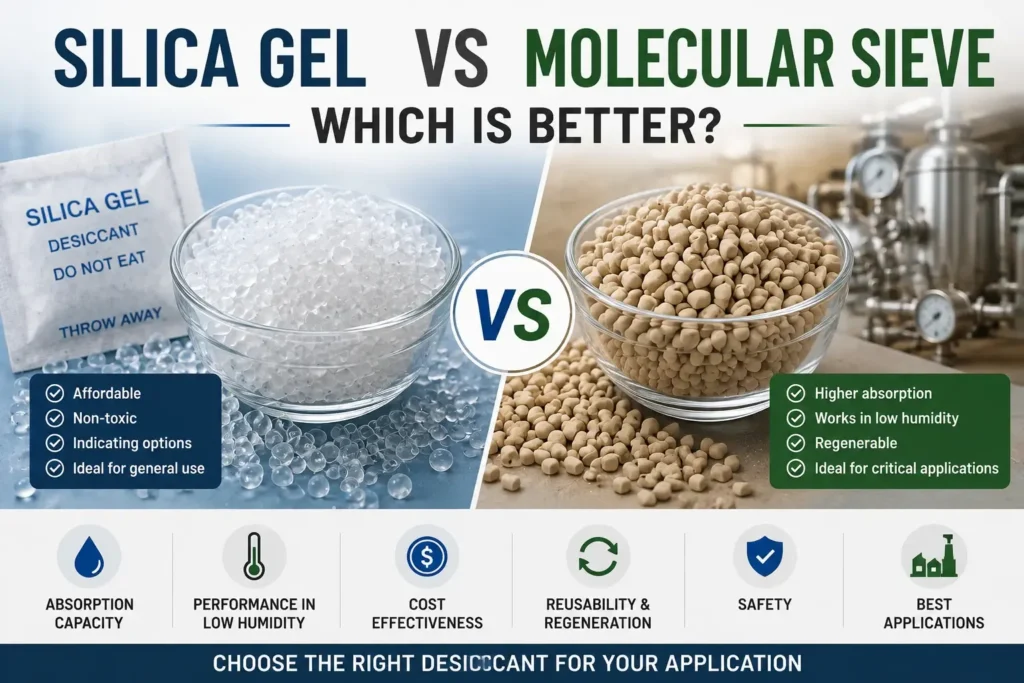
When it comes to controlling moisture — in packaging, industrial gas streams, insulated glass units, or storage tanks — two desiccants dominate the market: silica gel and molecular sieve. They’re often used interchangeably in casual conversation, but they’re chemically different materials with distinct adsorption behavior, and choosing the wrong one can mean under-performing moisture control or unnecessary cost.
This guide breaks down the difference between silica gel and molecular sieve, how each one actually works, where each performs best, and how to decide which is the right desiccant for your application. Browse our full Adsorbents, Absorbents & Desiccants range to see all the grades we manufacture.
What Is Silica Gel?
Silica gel is an amorphous, porous form of silicon dioxide (SiO₂) manufactured to have a highly porous internal structure. It’s not actually a “gel” in the everyday sense — it’s a rigid, granular solid with a network of microscopic pores that give it an enormous internal surface area (roughly 700–800 m² per gram), which is what allows it to physically adsorb water vapor from the surrounding air.
Key Characteristics of Silica Gel
- Amorphous (non-crystalline) structure with a broad, uneven pore-size distribution
- Adsorbs moisture efficiently at ambient temperature and relative humidity above ~40%
- Available in white/regular (e.g. Bee Chems’ Sorbogel® Silica Gel), and indicating grades — Silica Gel Blue and cobalt-free Silica Gel Orange
- Low cost and widely available in beads or granules
- Common in packaging, electronics, pharmaceuticals, and general shipping/storage applications
What Is Molecular Sieve?
Molecular sieve is a synthetic crystalline zeolite — an aluminosilicate mineral structure engineered to have a highly uniform pore diameter, unlike the irregular pores of silica gel. Because every pore is essentially the same size, molecular sieves don’t just adsorb by surface area — they adsorb selectively, letting molecules smaller than the pore diameter in while excluding larger ones. This is literally where the name comes from: it “sieves” molecules.
Key Characteristics of Molecular Sieve
- Crystalline structure with a precise, uniform pore size (commonly 3Å, 4Å, 5Å, or 13X grades — see Bee Chems’ Molcat™ Molecular Sieves)
- Adsorbs moisture down to very low residual levels, even at low humidity and elevated temperature
- Can selectively separate specific gas molecules, not just water
- Higher cost than silica gel due to more complex manufacturing
- Common in natural gas dehydration, cryogenic air separation, insulated glass units, and refrigerant drying
Difference Between Silica Gel and Molecular Sieve
| Feature | Silica Gel | Molecular Sieve |
|---|---|---|
| Structure | Amorphous SiO₂ with irregular pore sizes | Crystalline zeolite with uniform, precise pore size |
| Adsorption mechanism | Physical adsorption based on surface area | Selective adsorption based on molecular size (“sieving”) |
| Effective humidity range | Best above ~40% RH | Effective even at very low humidity (<10% RH) |
| Operating temperature | Performs best at ambient temperature; loses capacity as temperature rises | Retains strong adsorption capacity even at elevated temperatures |
| Moisture capacity | High total capacity at high humidity | Lower total capacity, but achieves much lower final dew points |
| Selectivity | Non-selective — adsorbs based on pore size distribution only | Selective — can separate specific molecules (e.g., water vs. hydrocarbons) |
| Regeneration | Regenerates at relatively low temperatures (~120°C) | Requires higher regeneration temperatures (~200–300°C) |
| Cost | Lower | Higher |
| Typical use case | Packaging, electronics, general shipping desiccants, humidity indicators | Natural gas dehydration, insulated glass, cryogenic/PSA gas separation, refrigerant drying |
How They Work: Adsorption Mechanism Explained
Both materials are physical adsorbents — they trap water molecules on their internal surface rather than reacting chemically with them (unlike a chemical desiccant such as calcium chloride, e.g. Bee Chems’ Calcium Chloride Desiccant). But the mechanism differs in an important way:
- Silica gel relies purely on surface area and capillary condensation within its irregular pore network. It picks up moisture readily when humidity is moderate-to-high, but its adsorption capacity drops off sharply as relative humidity falls, because there isn’t enough vapor pressure to drive water into the pores efficiently.
- Molecular sieve relies on strong electrostatic interactions within its uniform crystal lattice, plus its precise pore geometry. This lets it continue pulling water molecules out of the air even when very little moisture is present — which is exactly why it’s the material of choice when you need to hit very low dew points (e.g., -60°C or lower) rather than just “dry.”
Which Is Better? A Decision Guide
There’s no universal winner — the right choice depends entirely on the application:
Choose Silica Gel When:
- You need a cost-effective, general-purpose desiccant for packaging or storage
- Ambient relative humidity is moderate to high
- You need a visual humidity indicator (blue/orange indicating grades)
- The application doesn’t require extremely low residual moisture levels
Choose Molecular Sieve When:
- You need to achieve very low dew points or trace-level moisture removal
- Operating conditions involve low humidity, high temperature, or high pressure
- You need selective separation (e.g., removing water without removing other gases, or vice versa)
- The application is industrial gas drying, cryogenic separation, insulated glass, or refrigerant systems
In many industrial dehydration systems, both are actually used together — silica gel or activated alumina as a bulk-moisture pre-drying stage, followed by molecular sieve as a polishing stage to hit ultra-low final moisture specs (see our Activated Alumina vs Molecular Sieve comparison for how that third material fits in). This layered approach balances cost with performance.
Applications at a Glance
| Application | Preferred Desiccant | Why |
|---|---|---|
| Product packaging & shipping | Silica gel | Cost-effective, sufficient for ambient humidity control |
| Pharmaceutical & electronics packaging | Silica gel | Low cost, effective at typical storage humidity |
| Insulated glass (IGUs) | Molecular sieve | Must perform across wide temperature swings without releasing moisture |
| Natural gas dehydration | Molecular sieve | Needed to hit pipeline-spec dew points |
| Compressed air drying | Molecular sieve or silica gel (staged) | Depends on required final dew point |
| Cryogenic air separation | Molecular sieve | Removes both moisture and CO₂ to prevent freezing in cryogenic equipment |
| Refrigerant/AC systems | Molecular sieve | Must dry refrigerant to very low moisture levels without degrading at operating temperature |
Safety & Handling
Both silica gel and molecular sieve are generally regarded as low-hazard, inert solids, but a few handling notes apply:
- Dust exposure: Fine dust from either material can cause mild respiratory or eye irritation; use standard dust masks and eye protection when handling bulk/loose material.
- Not for consumption: Standard desiccant packets are marked “do not eat” — while non-toxic in small amounts, they are a choking hazard and not intended for ingestion.
- Indicating silica gel: Older orange-indicating silica gel used cobalt chloride, which is classified as a carcinogen in some regulations — Bee Chems’ Silica Gel Orange is cobalt-free; check the SDS if this matters for your application.
- Regeneration handling: Both materials release absorbed moisture as steam during thermal regeneration — ensure adequate ventilation and follow equipment-specific procedures.
- Storage: Store in sealed, moisture-proof packaging until use; both materials will begin adsorbing ambient moisture immediately once exposed to air.
Why Choose Bee Chems for Silica Gel & Molecular Sieve
Bee Chems has been serving the silica and alumina chemicals industry since 1972, with an integrated manufacturing setup covering silica gel, activated alumina, and molecular sieves under one roof. Our Sorbogel® Silica Gel range — including Blue and cobalt-free Orange indicating grades — and our Molcat™ Molecular Sieves are backed by decades of production experience and direct technical support to help you choose the right desiccant for your application.
You might be wondering: Colloidal Silica: Uses, Benefits
Conclusion
Silica gel and molecular sieve solve the same basic problem — controlling moisture — but through very different mechanisms, and that difference is exactly what determines which one you should use. For general packaging and moderate-humidity storage, silica gel offers the best balance of cost and performance. For industrial gas drying, insulated glass, or any application demanding very low residual moisture, molecular sieve is the better-engineered solution.
Need help selecting the right desiccant grade for your application? Talk to our technical team for a recommendation based on your specific humidity, temperature, and dew-point requirements.
Frequently Asked Questions
Q1. Is molecular sieve better than silica gel?
Ans: Not universally — molecular sieve achieves lower final moisture levels and works better at low humidity or high temperature, but it costs more. Silica gel is more cost-effective for general-purpose, moderate-humidity applications.
Q2. Can silica gel and molecular sieve be used together?
Ans: Yes. Many industrial drying systems use silica gel or activated alumina for bulk moisture removal first, followed by molecular sieve to polish the gas or liquid down to very low residual moisture.
Q3. Which desiccant lasts longer?
Ans: Molecular sieve generally has better long-term structural stability and can be regenerated repeatedly at higher temperatures, but both materials will eventually lose capacity with extended use and require replacement per manufacturer guidance.
Q4. Does molecular sieve work in very dry conditions where silica gel doesn’t?
Ans: Yes — this is molecular sieve’s key advantage. Its uniform pore structure keeps pulling moisture out of the air even at low relative humidity, where silica gel’s adsorption capacity drops significantly.
Q5. Is silica gel safe to use in food packaging?
Ans: Food-grade silica gel is commonly used as a packaging desiccant and is considered safe when kept in its sealed sachet — it should never be opened or ingested.
