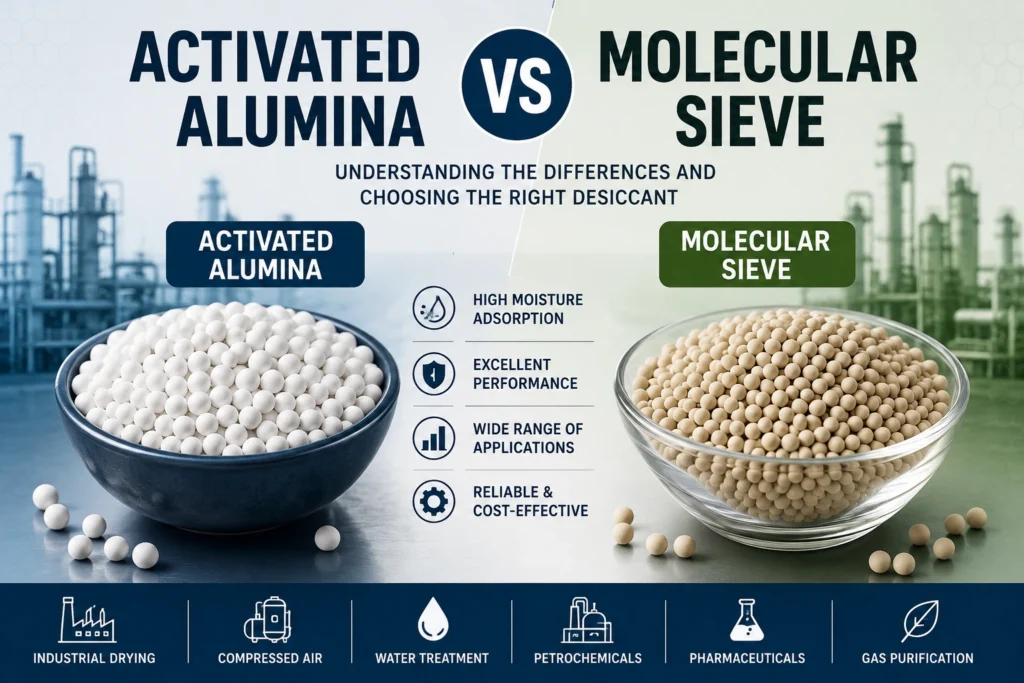
Industrial operations depend on clean, dry air and gas streams to maintain efficiency, protect equipment, and ensure product quality. Excess moisture can lead to corrosion, catalyst poisoning, product spoilage, freezing in pipelines, and expensive maintenance. This is why desiccants play such a critical role in industries ranging from petrochemicals and pharmaceuticals to electronics, compressed air systems, and food processing.
Among the most widely used adsorbents are activated alumina and molecular sieve. Although both are designed to remove moisture and impurities, they differ significantly in their structure, adsorption mechanism, performance, and ideal applications.
If you’re deciding between these two desiccants, understanding their strengths and limitations will help you select the most efficient and cost-effective solution for your process.
What Is Activated Alumina?
Activated Alumina is a highly porous form of aluminum oxide (Al₂O₃) manufactured through a controlled activation process. It appears as small, hard spherical beads with an extensive internal surface area that enables it to adsorb water vapor and various contaminants.
Unlike absorbent materials that soak up liquids, activated alumina works by adsorbing moisture onto its porous surface. This allows it to remove significant amounts of water while maintaining its physical structure.
Its excellent mechanical strength, thermal stability, and regeneration capability make it one of the most trusted desiccants for industrial drying applications.
Key Features of Activated Alumina
- High moisture adsorption capacity
- Excellent crush strength
- Uniform bead size
- Low dust generation
- High thermal stability
- Easy regeneration
- Long operational lifespan
- Cost-effective industrial drying solution
Because of these properties, activated alumina is widely used in continuous industrial processes where reliability and durability are essential.
What Is a Molecular Sieve?
A molecular sieve is a synthetic crystalline aluminosilicate, commonly known as a zeolite. Unlike activated alumina, molecular sieves have highly uniform microscopic pores of specific sizes.
These precisely engineered pores allow molecular sieves to separate molecules according to their size. Smaller molecules enter the pores and become trapped, while larger molecules pass through.
This unique characteristic enables molecular sieves to remove moisture even at extremely low humidity levels and selectively separate gases in specialized industrial applications.
Depending on the application, molecular sieves are available in different pore sizes such as 3A, 4A, 5A, and 13X.
How Do These Desiccants Remove Moisture?
Although both products remove water vapor, they do so differently.
Activated Alumina
Activated alumina uses physical adsorption. Moisture molecules adhere to the enormous internal surface area of the porous beads. As humid air or gas flows through the desiccant bed, water molecules accumulate until the material reaches its adsorption capacity.
The desiccant can then be regenerated by heating, restoring its drying performance.
Molecular Sieve
Molecular sieves use highly uniform pore openings combined with strong electrostatic attraction. Water molecules are strongly attracted into the crystal structure, allowing molecular sieves to continue removing moisture even when humidity levels become extremely low.
This makes molecular sieves ideal for applications requiring exceptionally dry gases.
Activated Alumina vs. Molecular Sieve: Quick Comparison
|
Feature |
Activated Alumina |
Molecular Sieve |
|
Material |
Activated Aluminum Oxide |
Synthetic Zeolite |
|
Structure |
Highly porous |
Uniform crystalline pores |
|
Moisture Removal |
Excellent |
Superior at very low humidity |
|
Selective Adsorption |
No |
Yes |
|
Mechanical Strength |
Excellent |
Very Good |
|
Regeneration |
Easy |
Requires higher temperatures |
|
Initial Cost |
Lower |
Higher |
|
Operating Cost |
Lower |
Moderate to High |
|
Best Application |
General industrial drying |
Ultra-low dew point and gas separation |
Moisture Adsorption Performance
One of the most important factors when selecting a desiccant is how effectively it removes moisture under different operating conditions.
Activated Alumina
Activated alumina performs exceptionally well when removing moderate to high levels of humidity. It quickly adsorbs water vapor and maintains stable performance over long operating cycles.
It is an excellent choice for applications where standard industrial drying is sufficient.
Molecular Sieve
Molecular sieves excel when extremely low moisture levels are required. They continue adsorbing water molecules even after activated alumina has reached its practical drying limit.
Industries requiring ultra-low dew points typically prefer molecular sieves because of their superior drying capability.
Adsorption Capacity Under Different Conditions
Environmental conditions greatly influence desiccant performance.
Activated alumina performs efficiently across a wide range of temperatures and humidity levels, making it ideal for general-purpose drying systems.
Molecular sieves are particularly effective when:
- Humidity is extremely low
- Product purity is critical
- Trace moisture must be eliminated
- High-performance gas drying is required
If your application only requires routine moisture removal, activated alumina often provides a more economical solution.
Mechanical Strength and Durability
Industrial desiccants operate under demanding conditions, including pressure fluctuations, airflow cycling, and repeated regeneration.
Activated alumina offers excellent mechanical durability, including:
- High crush resistance
- Low abrasion loss
- Minimal dust formation
- Stable bead structure
These characteristics help reduce maintenance costs and maintain consistent airflow through drying systems.
Molecular sieves are also durable but require careful handling to minimize attrition in certain applications.
Regeneration and Reusability
One major advantage of both materials is that they can be regenerated and reused.
Activated Alumina Regeneration
Activated alumina is regenerated by heating the saturated material, releasing the trapped moisture and restoring adsorption capacity.
Benefits include:
- Lower regeneration temperatures
- Reduced energy consumption
- Multiple regeneration cycles
- Long service life
Molecular Sieve Regeneration
Molecular sieves also require thermal regeneration but typically need higher temperatures and longer heating cycles.
While regeneration costs may be higher, they are justified in applications demanding extremely dry conditions.
Contaminant Removal Capabilities
Both materials remove moisture, but activated alumina also performs well in several purification applications.
Activated alumina is commonly used to remove:
- Fluoride from drinking water
- Arsenic
- Selenium
- Sulfur compounds
- Trace contaminants
Molecular sieves, on the other hand, are better suited for separating molecules based on size and selectively removing gases such as carbon dioxide, ammonia, and hydrocarbons.
Common Industrial Applications of Activated Alumina
Activated alumina is widely used because of its versatility and affordability.
Compressed Air Dryers
Removes moisture from compressed air systems to protect pneumatic equipment and improve operational efficiency.
Natural Gas Drying
Prevents corrosion and hydrate formation in natural gas pipelines.
Water Treatment
Specialized grades help remove fluoride, arsenic, and other contaminants from drinking water.
Petrochemical Plants
Maintains dry process streams for improved production efficiency.
Refrigeration Systems
Protects refrigeration components by removing moisture that could freeze or damage equipment.
Chemical Manufacturing
Supports moisture-sensitive manufacturing processes where product consistency is essential.
Common Applications of Molecular Sieves
Molecular sieves are commonly selected for highly specialized applications.
These include:
- Oxygen generation plants
- Nitrogen generation systems
- LNG processing
- Ethanol dehydration
- Pharmaceutical manufacturing
- Electronics production
- Solvent drying
- Air separation units
- High-purity gas processing
Which Desiccant Is More Cost-Effective?
Cost should always be evaluated alongside process requirements.
Activated Alumina
Advantages include:
- Lower purchase cost
- Lower regeneration expense
- Longer operational life
- Reduced maintenance
- Excellent value for standard drying systems
Molecular Sieve
Although more expensive, molecular sieves deliver outstanding performance where moisture specifications are extremely strict.
For many industrial users, the additional investment is worthwhile because it ensures product quality and process reliability.
Can Activated Alumina and Molecular Sieve Be Used Together?
Yes. In fact, many industrial drying systems combine both materials.
A typical configuration uses:
Stage 1: Activated Alumina removes the majority of moisture.
Stage 2: Molecular Sieve removes the remaining trace moisture to achieve an ultra-low dew point.
This combination improves efficiency, extends molecular sieve life, and reduces operating costs.
Factors to Consider Before Choosing a Desiccant
Selecting the right desiccant requires evaluating several operating conditions.
Moisture Level
How much water needs to be removed from the process?
Required Dew Point
Does your application require standard drying or extremely dry conditions?
Operating Temperature
Will the desiccant operate in high-temperature environments?
Gas Composition
Are there contaminants besides water that need to be removed?
Regeneration Capability
Can your system support thermal regeneration?
Budget
Consider both the initial investment and long-term operating costs rather than purchase price alone.
Why Choose Bee Chems Activated Alumina?
At Bee Chems, we manufacture high-quality activated alumina designed for reliable moisture removal across demanding industrial environments.
Our activated alumina products are engineered to deliver:
- High adsorption efficiency
- Excellent mechanical strength
- Uniform bead size
- Low attrition loss
- Superior regeneration performance
- Consistent product quality
- Long service life
Our products support industries including:
- Oil & Gas
- Petrochemicals
- Chemical Processing
- Air Separation
- Water Treatment
- Pharmaceutical Manufacturing
- Electronics
- Industrial Compressed Air Systems
With decades of manufacturing expertise and stringent quality control, Bee Chems provides dependable adsorption solutions that help improve process efficiency while reducing maintenance and operating costs.
Conclusion
Choosing between activated alumina and molecular sieve depends entirely on your process requirements. While both are highly effective desiccants, they are designed for different operating conditions and performance expectations.
Activated alumina offers an excellent balance of adsorption capacity, durability, regeneration efficiency, and cost-effectiveness, making it the preferred choice for general industrial drying, compressed air systems, natural gas dehydration, and water treatment. Molecular sieves, on the other hand, excel in specialized applications that require ultra-low moisture levels, selective adsorption, and high-purity gas processing.
For industries seeking a dependable and economical moisture control solution, Bee Chems Activated Alumina delivers consistent performance, long service life, and reliable quality. Whether your application involves drying air, purifying gases, or treating water, our activated alumina products are designed to support efficient, uninterrupted industrial operations.
Frequently Asked Questions
Q1. What is the main difference between activated alumina and molecular sieve?
Activated alumina is a porous aluminum oxide desiccant used for general moisture removal, while molecular sieve is a synthetic zeolite with uniform pores that removes moisture at much lower humidity levels and can selectively adsorb molecules based on their size.
Q2. Which is better for compressed air drying: activated alumina or molecular sieve?
Activated alumina is widely preferred for compressed air dryers because it offers excellent moisture adsorption, high mechanical strength, easy regeneration, and lower operating costs. A molecular sieve is generally chosen only when ultra-low dew points are required.
Q3. Can activated alumina and molecular sieve be used together?
Yes. Many industrial drying systems use activated alumina as the first layer to remove bulk moisture, followed by molecular sieves to eliminate residual moisture. This combination improves drying efficiency, extends desiccant life, and reduces overall operating costs.
Q4. Is activated alumina reusable after saturation?
Yes. Activated Alumina can be regenerated by heating to release the adsorbed moisture. When regenerated correctly and operated under recommended conditions, it can withstand multiple adsorption cycles while maintaining reliable drying performance.
Q5. What industries commonly use activated alumina?
Activated alumina is widely used in compressed air systems, petrochemical plants, natural gas processing, water treatment, chemical manufacturing, pharmaceuticals, refrigeration, and electronics industries where efficient moisture removal is essential for reliable operations.
Q6. Does a molecular sieve remove more moisture than activated alumina?
Yes. Molecular sieves can achieve much lower moisture levels than activated alumina because of its uniform pore structure and stronger attraction to water molecules. It is preferred for high-purity gas processing and applications requiring extremely low dew points.
Q7. How do I choose between activated alumina and molecular sieve?
Your choice depends on the required dew point, operating conditions, gas composition, regeneration method, and budget. Activated alumina is ideal for general industrial drying, while molecular sieves are recommended for critical applications requiring ultra-low moisture.
