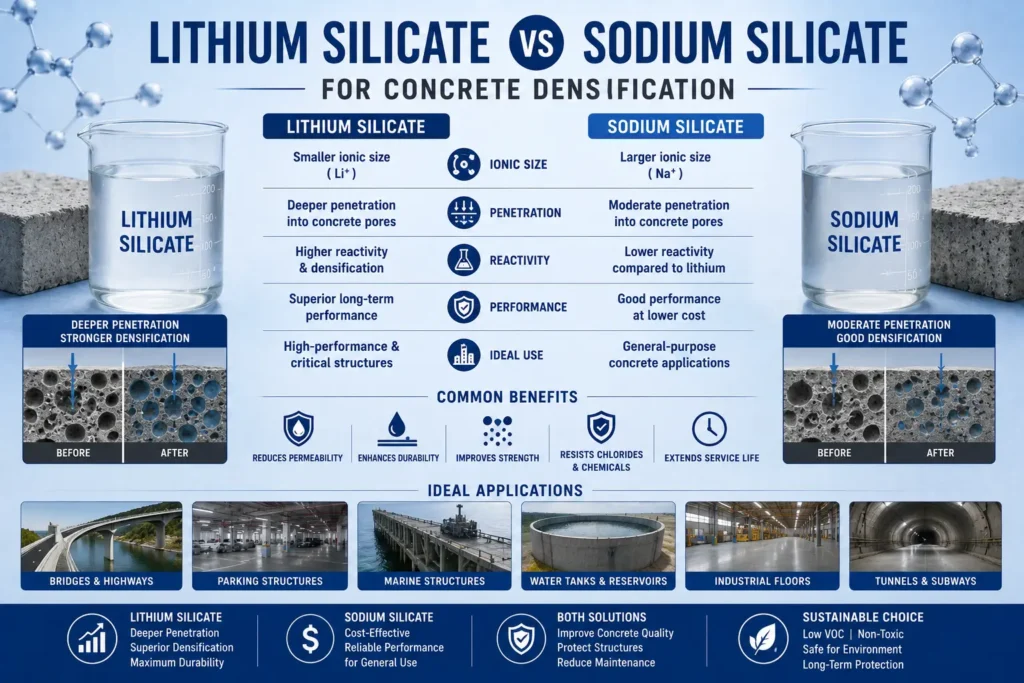
When it comes to hardening and densifying concrete floors, two chemistries dominate the market: lithium silicate and sodium silicate. Both react with free lime inside cured concrete to build a denser, harder surface — but they don’t behave the same way, and choosing the wrong one can mean extra labor, slower turnaround, or a finish that doesn’t hold up.
This guide breaks down lithium silicate vs sodium silicate for concrete densification — how each one works, where a lithium silicate densifier and a sodium silicate concrete densifier actually differ in performance, and how to decide which is right for your project. Browse Bee Chems’ full Construction Chemicals range to see our densifier products.
What Is Lithium Silicate?
Lithium silicate is a water-soluble, inorganic compound of lithium oxide and silica. As a lithium concrete densifier, its smaller lithium ion allows it to penetrate deeper into the concrete matrix than larger alkali ions, where it reacts with free calcium hydroxide to form additional calcium silicate hydrate (C-S-H) — the same binding compound that gives concrete its strength. This reaction densifies and hardens the surface, reducing dusting and improving abrasion resistance.
What Is Sodium Silicate?
Sodium silicate — also known as water glass — is one of the oldest and most widely used inorganic densifying chemistries, made by fusing sodium carbonate and silica sand at high temperature. As a sodium silicate concrete densifier, it works through the same basic mechanism as lithium silicate: reacting with free lime to build additional C-S-H within the concrete’s pore structure. It remains a cost-effective, well-established option for general-purpose concrete hardening and dust-proofing.
How the Densification Reaction Works
Both chemistries rely on the same underlying chemistry: cured concrete always contains a portion of unreacted free calcium hydroxide (lime), left over from cement hydration, which does nothing for the concrete’s strength on its own. When a silicate densifier penetrates the surface, its reactive silica combines with that free lime to form more C-S-H gel, filling capillary pores and hardening the surface from within — rather than just coating it.
The difference lies in how efficiently each ion penetrates and reacts. Lithium’s smaller ionic radius lets it move deeper into the concrete’s pore structure and react more completely, while sodium’s larger ion penetrates less efficiently and tends to leave more unreacted, soluble sodium salts behind after the reaction.
Lithium Silicate vs Sodium Silicate: Key Differences
| Factor | Lithium Silicate Densifier | Sodium Silicate Densifier |
|---|---|---|
| Penetration depth | Deeper, due to smaller ion size | Shallower, reacts closer to the surface |
| Reaction efficiency | Reacts more completely with free lime | Reacts less efficiently; more unreacted residue possible |
| Efflorescence / salt residue risk | Lower — leaves minimal soluble byproduct | Higher — often requires rinsing off excess sodium salts |
| Application timing | Can often be applied earlier, including on newer (“green”) concrete | Typically applied only to fully cured concrete |
| Post-application labor | Generally single-pass, minimal rinsing | Often needs neutralizing/rinsing after dwell time |
| Cost | Higher | Lower |
| Typical use case | Premium polished concrete, fast-turnaround projects | General-purpose, cost-sensitive densification |
Where Does Potassium Silicate Fit In?
Lithium and sodium aren’t the only silicate chemistries used in concrete — potassium silicate is sometimes used as a middle-ground option. Its potassium ion is larger than lithium but smaller than sodium, giving it penetration and reaction characteristics that generally sit between the two. In practice, though, lithium and sodium silicate remain the two dominant choices for dedicated concrete densification, with potassium silicate seeing more use in other construction and industrial silicate applications.
Application Process: How Silicate Densifiers Are Applied
While exact procedures vary by product and manufacturer, the general application process for both lithium and sodium silicate densifiers follows a similar pattern:
- Surface preparation: The concrete is cleaned, and any existing coatings, curing compounds, or surface contaminants that could block penetration are removed — typically by grinding or mechanical abrasion.
- Dilution: The densifier is diluted with water according to the product’s technical data sheet, based on concrete porosity and desired reaction depth.
- Application: The diluted densifier is applied evenly by low-pressure sprayer, ensuring full, uniform coverage without pooling.
- Dwell time: The product is left to penetrate and react with free lime for a set dwell period, often while keeping the surface visibly wet by re-misting if it dries too quickly.
- Rinsing (sodium silicate) or squeegeeing (lithium silicate): Sodium silicate treatments are typically rinsed to remove unreacted surface residue; lithium silicate treatments generally require only squeegeeing off any excess before it dries.
- Mechanical polishing (optional): On polished concrete projects, the floor is then honed and polished to the desired sheen level after the densifier has fully cured.
Always follow the specific product’s technical data sheet for dilution ratios, dwell times, and equipment recommendations — these vary by concrete porosity, ambient temperature, and product grade.
Common Application Mistakes to Avoid
- Applying too early or too late: Treating concrete before it’s ready (or, for sodium silicate, before it’s fully cured) can reduce reaction efficiency and surface performance.
- Letting the product dry out mid-application: If the densifier dries before it fully reacts, it can leave a hazy or uneven residue instead of a clean, densified finish.
- Skipping surface prep: Existing sealers, curing compounds, or surface contamination block penetration entirely, regardless of which chemistry is used.
- Not rinsing sodium silicate treatments: Leaving unreacted sodium salts on the surface is one of the most common causes of efflorescence and slippery residue complaints.
- Over-diluting to save cost: Under-dosing either chemistry reduces the amount of C-S-H formed, leading to a weaker, less durable result than the product is capable of.
Environmental & Safety Considerations
Both lithium and sodium silicate are water-based, inorganic chemistries with low VOC content, which makes them attractive for projects targeting sustainability certifications like LEED compared to solvent-based coatings. That said, both are alkaline in their concentrated form, so standard precautions apply:
- Wear gloves and eye protection when handling concentrated product
- Ensure adequate ventilation during spray application
- Avoid contact with skin and eyes; rinse immediately if contact occurs
- Always consult the product-specific Safety Data Sheet (SDS) before handling, storage, or disposal, since exact hazard classifications vary by grade and manufacturer
Benefits of a Lithium Silicate Densifier
- Improves concrete hardness and abrasion resistance
- Reduces surface dusting and water absorption
- Lower efflorescence risk thanks to deeper, more complete reaction
- Faster project turnaround with minimal post-treatment rinsing
- Enhances long-term durability and wear resistance for high-traffic floors
Benefits of a Sodium Silicate Densifier
- Lower material cost, making it attractive for large-area or budget-conscious projects
- Long track record as a reliable general-purpose hardener
- Effective dust-proofing for warehouses and industrial floors
- Widely available and well understood by concrete contractors
Which One Should You Choose?
Choose a lithium silicate densifier if you need deeper penetration, faster project turnaround, minimal efflorescence risk, or the ability to treat newer concrete — common on premium polished concrete floors, distribution centers, and fast-track commercial projects.
Choose a sodium silicate densifier if budget is the primary driver and the project allows for the additional rinsing/neutralizing step and longer cure-to-treatment timelines — common on general warehouse floors and large-area industrial dust-proofing where cost per square foot matters more than premium finish.
For nano-silica-based alternatives that combine strong densification with additional surface protection, see Bee Chems’ Densifiers, Sealers and Guards range.
Applications
- Industrial and warehouse floors
- Distribution and logistics centers
- Manufacturing plant floors
- Parking structures
- Polished concrete systems
- Commercial and retail flooring
You might be interested in: Hydrated vs. Crystalline Calcium Silicate
Conclusion
Lithium silicate and sodium silicate both densify concrete through the same core reaction — combining with free lime to build additional C-S-H — but they differ sharply in penetration, reaction efficiency, labor, and cost. Lithium silicate suits projects that need speed, depth, and a clean finish; sodium silicate remains a dependable, budget-friendly choice for general industrial floors.
Not sure which densifier fits your project? Talk to our technical team for a recommendation based on your concrete age, project timeline, and budget.
Frequently Asked Questions
Q1. Is lithium silicate better than sodium silicate for concrete?
Ans: Not universally — lithium silicate offers deeper penetration, faster turnaround, and lower efflorescence risk, making it preferred for premium and fast-track projects. Sodium silicate remains a cost-effective, reliable choice for general-purpose densification where budget matters more than speed or finish quality.
Q2. Can lithium silicate be applied to new concrete?
Ans: Lithium silicate can often be applied earlier in the concrete’s life than sodium silicate, though exact timing still depends on the specific product and project conditions — always confirm with the technical data sheet before application.
Q3. Why does sodium silicate need to be rinsed after application?
Ans: Because sodium’s larger ion doesn’t react as completely with free lime, unreacted sodium silicate can remain on the surface as a soluble salt residue. If left unrinsed, this residue can cause efflorescence (white staining) or a slippery film, so it’s typically rinsed off after the reaction dwell time.
Q4. Does lithium silicate cost more than sodium silicate?
Ans: Yes, lithium silicate is generally more expensive per unit than sodium silicate, but its deeper penetration, single-pass application, and reduced labor can offset the higher material cost on time-sensitive projects.
Q5. Can lithium and sodium silicate be used together?
Ans: They’re typically chosen as alternatives rather than combined, since each is formulated to work as a standalone densifying treatment — mixing chemistries without technical guidance isn’t standard practice. Consult your supplier’s technical team before combining silicate treatments.
