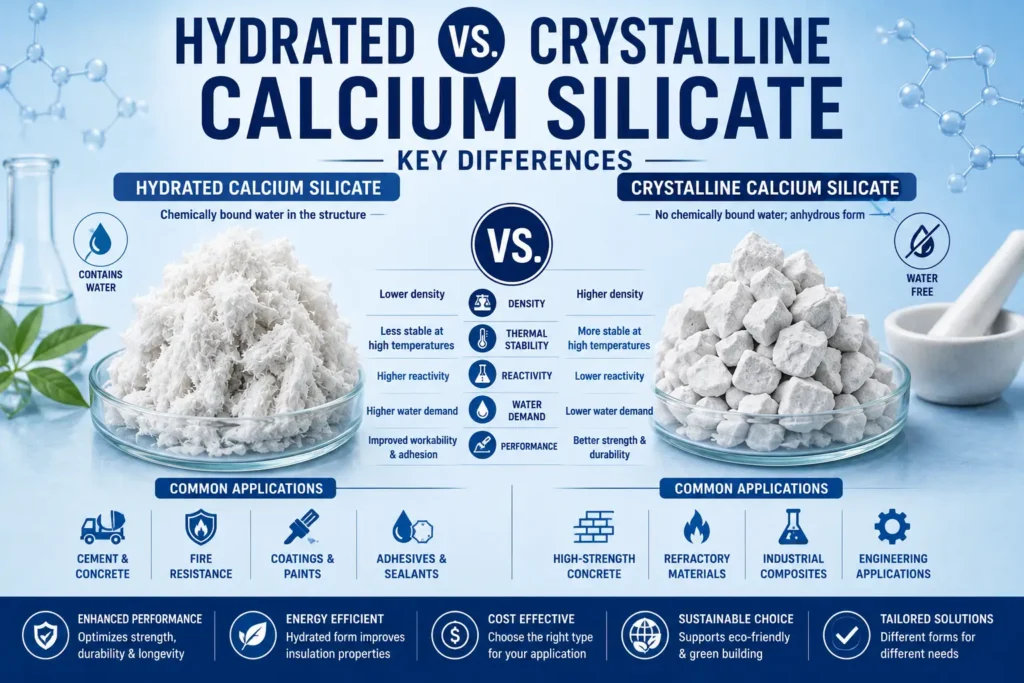
Calcium silicate is not a single compound but a family of related materials built from calcium, silicon, and oxygen. Depending on how it’s formed, calcium silicate can end up as an amorphous, hydrated powder or as an ordered, crystalline structure — and that structural difference changes almost everything about how the material performs, from surface area and absorbency to thermal stability and mechanical strength.
This guide breaks down hydrated vs. crystalline calcium silicate, covering how each form is made, where their properties diverge, and how to choose the right one for your application. Browse Bee Chems’ full Nano Sols and Silicates range to see our calcium silicate grades.
What Is Hydrated Calcium Silicate?
Hydrated calcium silicate is a synthetic, amorphous form of calcium silicate, typically produced through a controlled precipitation reaction between a soluble silicate source and a calcium salt. Because it lacks the ordered lattice structure of crystalline materials, it forms a highly porous, fine particle with a large internal surface area.
This amorphous structure is what gives hydrated calcium silicate its defining characteristics: high water and oil absorption capacity, low bulk density, and small, controllable particle size. It’s also generally considered safer to handle than naturally occurring crystalline forms, precisely because it doesn’t share their fibrous or crystalline particle morphology.
What Is Crystalline Calcium Silicate?
Crystalline calcium silicate refers to forms of the material with a defined, repeating atomic lattice — either occurring naturally (such as wollastonite, a naturally mined calcium silicate mineral) or produced synthetically through hydrothermal or autoclave crystallization processes that grow ordered structures like tobermorite or xonotlite.
Unlike the amorphous hydrated form, crystalline calcium silicate’s ordered structure gives it needle-like or platy particle morphology, greater dimensional stability, and — in engineered board and pipe-insulation products — much higher performance at elevated temperatures.
Hydrated vs. Crystalline Calcium Silicate: Structural Differences
The core distinction comes down to atomic order:
- Hydrated (amorphous): No long-range order — calcium, silicon, and oxygen atoms are arranged randomly, creating an irregular, highly porous particle structure with a large surface area.
- Crystalline: A repeating, ordered lattice — atoms are arranged in a fixed, predictable pattern, producing denser, more structurally defined particles (often fibrous or platy) with comparatively lower surface area.
This structural difference is the root cause of nearly every property difference discussed below.
Key Properties of Hydrated and Crystalline Calcium Silicate
| Property | Hydrated (Amorphous) | Crystalline |
|---|---|---|
| Particle structure | Irregular, porous, amorphous | Ordered, fibrous or platy lattice |
| Surface area | High | Comparatively lower |
| Oil/water absorption | High | Low to moderate |
| Bulk density | Low | Higher |
| Particle size control | Fine, tunable during synthesis | Determined by crystal growth/mineral form |
| Typical origin | Synthetic precipitation | Natural mineral or hydrothermal synthesis |
Thermal, Mechanical, and Chemical Properties
Crystalline calcium silicate structures — particularly the tobermorite and xonotlite forms used in insulation manufacturing — offer significantly higher thermal stability, often performing reliably at temperatures well above what amorphous forms can withstand, along with better compressive strength and dimensional stability under load. This is why crystalline calcium silicate boards are a standard choice for high-temperature industrial insulation and fire protection.
Hydrated calcium silicate, by contrast, isn’t engineered for structural or high-temperature performance — its value lies in functional properties: absorption capacity, low density, and fine particle size. It’s chemically stable across normal processing conditions but isn’t intended to bear mechanical load or extreme heat the way crystalline insulation-grade material is.
Applications of Hydrated Calcium Silicate
- Food additive — anti-caking and moisture-absorbing agent
- Pharmaceutical products, including antacid formulations and tablet excipients
- Absorbent for liquids and gases in industrial processes
- Paints and coatings — as a flatting and anti-settling agent
- Filler in paper and plastics manufacturing, adding body to the final product
- Carrier/filler in fertilizers and insecticides
Applications of Crystalline Calcium Silicate
- High-temperature pipe insulation and insulation boards
- Fireproof ceilings, fire-rated boards, and ceiling tiles
- Refractory material in industrial furnaces
- Friction materials such as brake pads and clutch facings (as an asbestos-free reinforcement)
- Building materials — bricks, roof tiles, building boards, and some cement/glass formulations
Hydrated vs. Crystalline Calcium Silicate: A Comparison
| Factor | Hydrated Calcium Silicate | Crystalline Calcium Silicate |
|---|---|---|
| Structure | Amorphous | Ordered crystal lattice |
| Primary role | Functional additive (absorbent, anti-caking, filler) | Structural/thermal material (insulation, fireproofing) |
| Thermal performance | Not engineered for high heat | High-temperature stable |
| Mechanical strength | Low — not load-bearing | Higher — used in structural insulation boards |
| Typical industries | Food, pharma, paints, plastics, paper, agriculture | Construction, insulation, refractories, friction materials |
| Handling | Generally considered safer due to amorphous, non-fibrous structure | Requires standard precautions for fibrous/particulate materials — always check the SDS |
How to Choose the Right Calcium Silicate for Your Application
The right choice comes down to what the material needs to do in your application:
- Choose hydrated calcium silicate if you need a functional additive — an absorbent, anti-caking agent, or filler—where high surface area and fine particle size matter more than structural strength.
- Choose crystalline calcium silicate if your application involves high-temperature exposure, fire protection, or structural insulation, where the ordered lattice’s thermal and mechanical stability is essential.
Also factor in regulatory requirements (e.g., food-grade or pharmaceutical-grade specifications), particle size and absorption specs, and supply consistency — always confirm the exact grade and specification against your application’s technical data sheet before finalizing a formulation.
You might be interested in: Potassium Silicate in Agriculture
Conclusion
Hydrated and crystalline calcium silicate share a chemical family but serve very different purposes — one is a fine, absorbent, amorphous powder suited to food, pharma, and industrial filler applications; the other is a structurally engineered, high-temperature material built for insulation and fire protection. Understanding which structure your application actually needs is the first step to specifying the right grade.
Frequently Asked Questions
Q1. Is hydrated calcium silicate the same as crystalline calcium silicate?
Ans: No. Both are calcium-silicon-oxygen compounds, but hydrated calcium silicate is amorphous (no ordered structure), while crystalline calcium silicate has a defined, repeating atomic lattice. This structural difference drives most of their property and application differences.
Q2. Which form of calcium silicate is used in food products?
Ans: Hydrated (amorphous) calcium silicate is the form typically used as a food additive, primarily as an anti-caking and moisture-absorbing agent.
Q3. Why is crystalline calcium silicate used for insulation instead of hydrated calcium silicate?
Ans: Crystalline calcium silicate’s ordered lattice structure gives it much higher thermal stability and mechanical strength, making it suitable for high-temperature pipe insulation and fireproofing — properties the amorphous hydrated form isn’t engineered to provide.
Q4. Is hydrated calcium silicate safe to handle?
Ans: Synthetic hydrated calcium silicate is generally considered safer to handle than natural crystalline forms, due to its amorphous, non-fibrous particle structure. As with any industrial material, standard handling precautions apply, and the product-specific Safety Data Sheet (SDS) should always be consulted.
Q5. Can calcium silicate be produced in different grades?
Ans: Yes. Calcium silicate can be manufactured in industrial, agricultural, and food grades, varying by water/oil absorption capacity, bulk density, particle size, and surface area, depending on the application.
