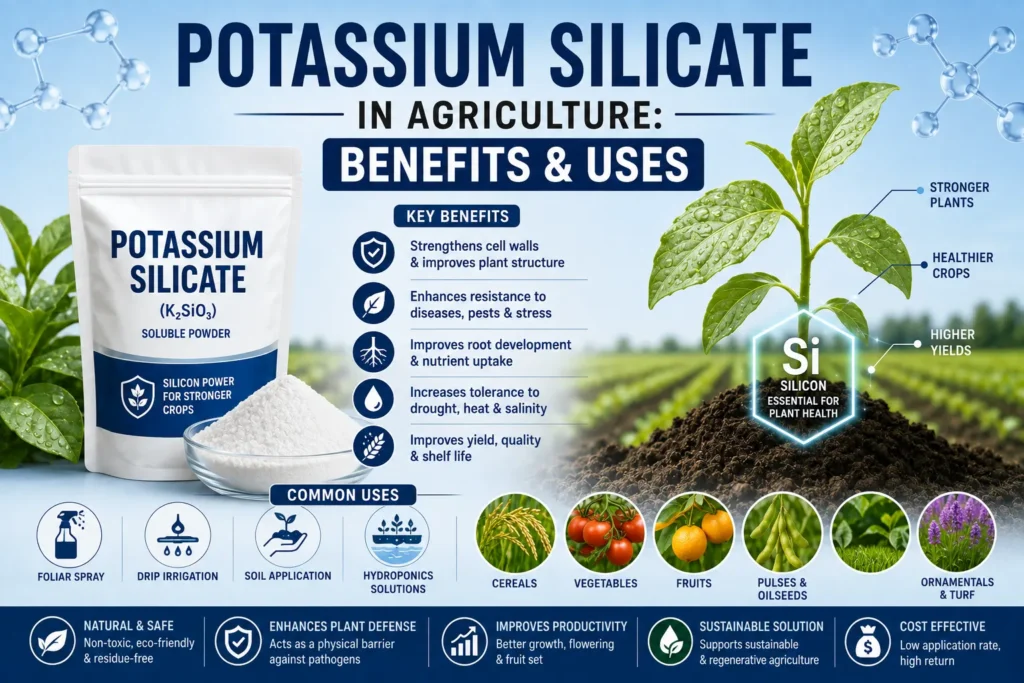
Potassium silicate is used in agriculture as a source of two nutrients at once: potassium, which plants need in large amounts, and soluble silicon, which most soils supply poorly. Applied as a foliar spray or through fertigation, it strengthens cell walls, hardens leaf surfaces against pests and fungal attack, and helps crops hold up under drought, heat and saline conditions. It is used most widely in rice, sugarcane, wheat, horticulture and protected cultivation.
This guide covers how it works in the plant, which crops respond, how it is applied, and how it compares with other silicon sources.
What Is Potassium Silicate?
Potassium silicate is an alkaline salt of potassium and silica, supplied as a clear liquid solution or as a soluble powder. In water it releases potassium ions and monosilicic acid — the only form of silicon a plant root can actually absorb.
That last point matters. Soil is full of silicon, but almost all of it is locked in mineral form that plants cannot take up. Intensive cropping removes plant-available silicon faster than weathering replaces it, which is why silicon deficiency is common in continuously cropped soils even though the element is abundant.
| Property | Detail |
|---|---|
| Appearance | Clear to slightly hazy liquid, or soluble powder |
| Supplies | Potassium (K₂O) and soluble silica (SiO₂) |
| Plant-available silicon form | Monosilicic acid |
| Solution character | Alkaline |
| Application methods | Foliar spray, fertigation, hydroponic nutrient solution |
Why Silicon Matters to Plants
Silicon is not classed as an essential nutrient for most crops, in the sense that a plant can complete its life cycle without it. It is, however, firmly established as a beneficial element, and in several major crops the practical difference is large.
Once absorbed, monosilicic acid moves to the leaves and stems and is deposited as amorphous silica in and around cell walls. That deposition is what produces most of the observed effects.
Stronger cell walls and better standing ability
Silica deposition stiffens stems and leaves. In cereals this shows up as improved standing ability — plants are less prone to lodging under wind, rain or heavy grain load. Leaves also hold a more erect posture, which improves light interception across the canopy.
A physical barrier against pests and disease
The silica layer beneath the leaf cuticle is a mechanical obstacle. Fungal hyphae have to penetrate a hardened surface, and chewing insects meet an abrasive one. This is why silicon application is associated with reduced pressure from diseases such as blast and powdery mildew, and from stem-boring and leaf-feeding insects.
It is a physical mechanism, not a chemical one. Silicon does not act as a fungicide or insecticide — it raises the cost of entry. It supports a crop protection programme; it does not replace one.
Tolerance of drought, heat and salinity
Silicon deposits around stomata and in the leaf epidermis reduce uncontrolled water loss, helping plants maintain turgor under water stress. Under saline conditions, silicon is associated with reduced sodium uptake and transport to the shoot, limiting the damage salt does to photosynthesis.
For growers on marginal or saline-affected land, this is often the reason silicon is applied at all.
Better nutrient balance
Silicon interacts usefully with other nutrients. It is associated with reduced uptake of toxic elements such as aluminium and manganese in acidic soils, and with improved phosphorus availability. The potassium supplied alongside it supports water regulation, enzyme activity and sugar transport in its own right.
Potassium Silicate for Plants: Which Crops Respond
Not every crop takes up silicon to the same degree. Response is strongest in species that accumulate it heavily.
High silicon accumulators — strongest response
- Rice — the classic silicon-responsive crop. Associated with reduced blast and sheath blight pressure, better standing ability and improved grain filling.
- Sugarcane — a very heavy silicon remover. Long-term cane soils are frequently silicon depleted.
- Wheat, barley and other cereals — lodging resistance and foliar disease pressure.
Moderate accumulators — worthwhile response
- Cucurbits — cucumber, melon, pumpkin. Widely used against powdery mildew pressure.
- Tomato, chilli, capsicum — protected cultivation especially.
- Banana and sugar beet
Ornamentals and protected cultivation
Roses, gerbera and other greenhouse ornamentals benefit from sturdier stems and reduced mildew pressure. In hydroponics and soilless media there is effectively no silicon supply at all unless it is added, which makes supplementation more important, not less.
How Potassium Silicate Is Applied
Foliar spray
The most common method. Applied to leaf surfaces, usually at intervals through the vegetative and early reproductive stages. Rates and intervals vary by crop and growth stage, so follow the recommendation supplied with the product.
- Spray in the cooler part of the day to reduce scorch risk
- Ensure good coverage of both leaf surfaces
- Do not exceed the recommended concentration — potassium silicate is alkaline and excessive rates can mark foliage
Fertigation and soil application
Delivered through drip or in irrigation water, giving a steady supply of soluble silicon to the root zone. Suited to sugarcane, banana and protected horticulture where fertigation is already in place.
Hydroponics and soilless media
Added to the nutrient solution. Because inert media supply no silicon, this is where deficiency is most predictable and supplementation most consistently useful.
Compatibility — read this before tank mixing
Potassium silicate is alkaline. Mixing it directly with acidic fertilisers or with calcium and magnesium salts can cause precipitation or gelling, blocking nozzles and wasting product.
- Never mix concentrates. Dilute potassium silicate fully before adding anything else.
- Keep it away from calcium and magnesium — in hydroponics, dose from a separate tank.
- Jar test first. Mix a small sample at field dilution and leave it 30 minutes. If it clouds, thickens or forms solids, do not tank mix.
- Check pH after mixing. It will raise solution pH; adjust if your crop needs it lower.
Potassium Silicate Fertilizer vs Other Silicon Sources
| Source | Silicon availability | Speed | Also supplies | Best suited to |
|---|---|---|---|---|
| Potassium silicate | High — soluble | Fast | Potassium | Foliar, fertigation, hydroponics |
| Sodium silicate | High — soluble | Fast | Sodium | Industrial use; sodium limits agricultural suitability |
| Calcium silicate / slag | Low — slow release | Slow | Calcium, liming effect | Bulk soil correction over seasons |
| Diatomaceous earth | Low | Very slow | — | Soil amendment |
| Rice husk ash | Low to moderate | Slow | Potassium, organic matter | Soil building |
Why potassium silicate is usually chosen for in-season use: it is immediately plant available, it can go through a sprayer or a drip line, and the potassium it carries is a nutrient the crop wants anyway. Slow-release sources such as calcium silicate are cheaper per unit of silicon but correct soil status over seasons rather than feeding a crop in front of you.
Note that sodium silicate, while chemically similar and widely used in industry, introduces sodium — which is why potassium silicate is the preferred agricultural grade.
Limitations and Good Practice
Silicon is not a rescue treatment. Setting expectations honestly:
- It is preventive, not curative. The benefit comes from silica deposited in tissue before stress or infection arrives. Applying it to an already-infected crop will not reverse the damage.
- Response varies by crop. A high accumulator such as rice will show more than a low accumulator.
- It supplements, it does not replace. Silicon supports a crop protection and nutrition programme rather than substituting for either.
- Soil silicon status matters. Long-cropped, weathered and sandy soils tend to be most depleted and most responsive.
Where possible, test soil available silicon before planning a programme.
You might be interested in: Lithium Acetate in Organic Synthesis
Potassium Silicate From Bee Chems
Bee Chems manufactures potassium silicate in liquid and powder grades for agricultural and industrial use, and has supplied silicates since 1972. Every consignment is supplied with a certificate of analysis.
If you are planning a silicon programme and are unsure which grade or concentration suits your crop and application method, send us your crop, soil type and delivery method and our technical team will advise.
Conclusion
Potassium silicate in agriculture offers a practical way to combine essential potassium nutrition with the tissue-strengthening, stress-tolerance benefits of silicon in a single, water-soluble input. Whether applied as a foliar spray, through fertigation, or in a hydroponic reservoir, it’s a versatile addition to a modern crop nutrition program.
Looking for the right potassium silicate grade for your application? Talk to our technical team for guidance on grade selection and application rates.
Frequently Asked Questions
Q1. What is potassium silicate used for in agriculture?
Ans: It is used as a combined source of potassium and plant-available silicon. Applied as a foliar spray or through fertigation, it strengthens cell walls, improves standing ability, adds a physical barrier against fungal disease and insect feeding, and helps crops tolerate drought, heat and salinity.
Q2. Is potassium silicate good for plants?
Ans: Yes, particularly for silicon-accumulating crops such as rice, sugarcane, wheat and cucurbits, and in hydroponic systems where no silicon is otherwise supplied. The benefit is preventive, so it is most useful applied before stress or disease pressure arrives.
Q3. How is potassium silicate fertilizer applied?
Ans: Most commonly as a dilute foliar spray during vegetative and early reproductive stages, or through fertigation. In hydroponics it is added to the nutrient solution, dosed separately from calcium and magnesium to avoid precipitation.
Q4. Can potassium silicate be mixed with other fertilisers?
Ans: Not without checking. It is alkaline and can precipitate or gel when mixed with acidic fertilisers or calcium and magnesium salts. Always dilute it fully first, keep it separate from calcium and magnesium, and jar test any intended tank mix at field dilution before spraying.
Q5. Does potassium silicate control pests and diseases?
Ans: It reduces pressure rather than controlling outbreaks. Silica deposited in leaf tissue forms a physical barrier that makes fungal penetration and insect feeding harder. It is not a fungicide or insecticide and should support, not replace, a crop protection programme.
Q6. Which crops benefit most from potassium silicate?
Ans: Rice and sugarcane respond most strongly, followed by other cereals, cucurbits, solanaceous vegetables, banana and greenhouse ornamentals. Hydroponic and soilless crops benefit regardless of species, since those systems supply no silicon on their own
