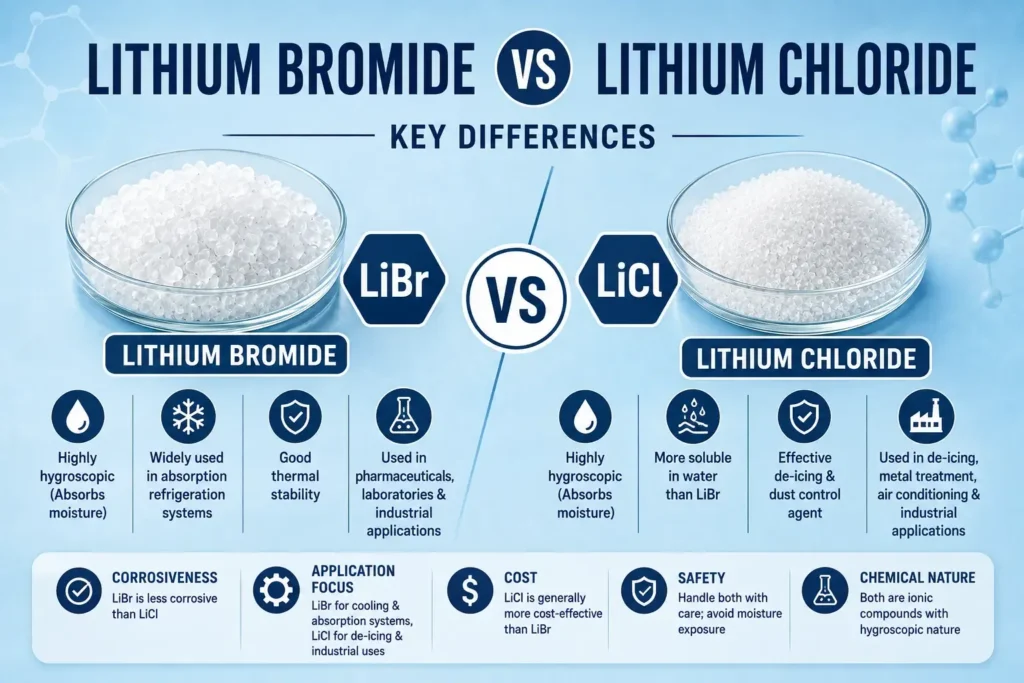
Lithium bromide and lithium chloride sit next to each other on the shelf, share the same lithium cation, and are both prized for one property: an extraordinary appetite for water. That similarity is exactly why they get confused — and why substituting one for the other can quietly wreck a system’s performance.
The short version: lithium bromide is the absorption-chiller salt, and lithium chloride is the desiccant-and-electrolysis salt. They overlap in moisture control, but their solubility, cost and chemistry push them toward genuinely different jobs.
This guide breaks down the difference between lithium bromide and lithium chloride — properties, mechanism, cost, applications, and a decision framework for choosing between them. Browse our full Lithium Salts & Solutions range to see the grades we manufacture.
Lithium Bromide: Properties and Primary Role
Lithium bromide (LiBr) is an inorganic salt formed from lithium and bromine — a white crystalline solid that is among the most hygroscopic materials in common industrial use. Its defining commercial characteristic is exceptionally high water solubility, which lets it form very concentrated aqueous solutions that remain stable and pumpable.
That single property is what built its industry: lithium bromide is the working absorbent in vapour absorption machines (VAMs), the chillers that produce cooling from waste heat, steam or direct-fired gas instead of from electrically driven compressors.
Key Characteristics of Lithium Bromide
- Chemical formula LiBr, CAS 7550-35-8, molar mass 86.85 g/mol
- Melting point approximately 552 °C
- Very high water solubility — roughly 167 g per 100 mL at 20 °C, about twice that of lithium chloride
- Extremely hygroscopic; forms stable, highly concentrated brines
- Usually supplied as a solution at a specified concentration rather than as a dry solid
- Corrosive to common metals in solution, so inhibited formulations are standard
- Available from Bee Chems in multiple concentrations and custom packaging
Lithium Chloride: Properties and Primary Role
Lithium chloride (LiCl) is the chloride analogue — also a white crystalline solid, also strongly hygroscopic, and highly soluble in water as well as in alcohol and ether. It is produced by reacting a lithium base such as lithium carbonate or lithium hydroxide with hydrochloric acid.
Where lithium chloride differs is breadth. It is not tied to one flagship application. It serves as a liquid and solid desiccant, as a brazing flux constituent, as the electrolyte for producing lithium metal, and as a laboratory reagent — a wider but shallower footprint than lithium bromide’s.
Key Characteristics of Lithium Chloride
- Chemical formula LiCl, CAS 7447-41-8, molar mass 42.39 g/mol
- Melting point approximately 610 °C — notably higher than lithium bromide
- High water solubility — roughly 85 g per 100 mL at 20 °C
- Strongly hygroscopic; forms stable complexes with water
- Supplied in solid form (anhydrous LiCl or hydrous LiCl·H₂O) and as an aqueous solution
- Lower molar mass means more moles of salt per kilogram purchased
- Available from Bee Chems in solid and aqueous grades
Difference Between Lithium Bromide and Lithium Chloride
| Feature | Lithium Bromide | Lithium Chloride |
|---|---|---|
| Chemical formula | LiBr | LiCl |
| CAS number | 7550-35-8 | 7447-41-8 |
| Molar mass | 86.85 g/mol | 42.39 g/mol |
| Melting point | ~552 °C | ~610 °C |
| Water solubility (20 °C) | ~167 g/100 mL — roughly double | ~85 g/100 mL |
| Typical supplied form | Aqueous solution at specified concentration | Solid (anhydrous or hydrous) and aqueous solution |
| Flagship application | Vapour absorption chillers and refrigeration | Desiccant dehumidification, brazing flux, lithium metal electrolysis |
| Relative cost per kg | Higher — bromine is costlier than chlorine | Lower |
| Suitability for molten-salt electrolysis | Not used for lithium metal production | Standard electrolyte, typically in a LiCl/KCl bath |
| Key operational risk | Crystallisation in chiller circuits if concentration or temperature limits are exceeded | Caking and moisture pickup if containers are left open |
| Breadth of use | Narrow and deep — dominated by absorption cooling | Broad — cooling, drying, metallurgy, electronics, laboratory |
How They Work: Moisture Absorption Explained
Both salts work by the same underlying physics. A concentrated solution of either has a water vapour pressure well below that of the surrounding air. Expose the solution to a humid air stream or a low-pressure water vapour space, and water migrates out of the vapour phase and into the brine, because vapour always moves from higher to lower vapour pressure. Neither salt is consumed in the process — the diluted brine is regenerated with heat, driving the absorbed water back off so the solution can be recirculated.
The difference lies in how far you can push the concentration. Lithium bromide’s much higher solubility means it can be run as a far more concentrated brine before crystals begin to drop out. A more concentrated brine means a lower vapour pressure, and a lower vapour pressure means the salt can pull water vapour down to the very low pressures that an absorption chiller’s evaporator needs in order to boil water at around 4–6 °C and produce useful chilled water. Lithium chloride simply saturates too early to hit those conditions efficiently.
Run the comparison in a liquid desiccant dehumidifier instead, and the calculus flips. There you are stripping moisture from air at ordinary atmospheric pressure, not chasing a deep vacuum. Lithium chloride’s solubility is entirely sufficient for that duty — so the deciding factor becomes cost per kilogram, and the cheaper chloride wins.
In lithium metal production the mechanism is different again and moisture is irrelevant. Molten lithium chloride, usually blended with potassium chloride to lower the operating temperature, acts as the electrolyte in an electrolytic cell: current through the molten bath reduces lithium ions to lithium metal at the cathode while chlorine is released at the anode. Lithium bromide has no role here.
Selecting the Right Salt for Your Duty
There is no universal winner. The right salt depends entirely on the duty.
Choose Lithium Bromide When:
- You are charging, topping up or replacing the absorbent in a vapour absorption chiller or absorption refrigeration system
- The application requires water vapour pressure driven very low, beyond what a chloride brine can reach
- You need a very highly concentrated brine that stays stable without crystallising
- The system was engineered around lithium bromide — its heat exchangers, inhibitor package and control limits are all specified for that salt
- You are working in heat transfer or heat-recovery processes built on absorption cycles
Choose Lithium Chloride When:
- You need a liquid or solid desiccant for dehumidification and industrial drying at atmospheric pressure
- Cost per kilogram matters and the duty does not demand bromide-level solubility
- You need an electrolyte for lithium metal production by molten-salt electrolysis
- The application is a brazing flux or brazing bath, where the chloride dissolves surface oxides so filler metal wets cleanly
- You are working in photovoltaic cell manufacturing, laboratory synthesis, or as a general drying agent
- You need the salt as a dry solid rather than a solution
A practical warning worth stating plainly: do not substitute one for the other in an absorption chiller. The machine’s corrosion inhibitor package, crystallisation margins and heat-exchanger design are all matched to lithium bromide. Charging a chloride brine instead will cost you capacity and can damage the plant.
Recommended Salt by Application
| Application | Preferred Salt | Why |
|---|---|---|
| Vapour absorption chillers | Lithium bromide | Only its solubility supports the concentration needed for deep vacuum operation |
| Absorption refrigeration | Lithium bromide | Established working fluid with proven cycle performance |
| Heat transfer & heat recovery systems | Lithium bromide | Suits absorption-cycle thermodynamics |
| Liquid desiccant dehumidification | Lithium chloride | Sufficient solubility at far lower cost |
| Industrial drying & moisture control | Either — commonly lithium chloride | Chloride is more economical unless the system specifies bromide |
| Brazing fluxes and brazing baths | Lithium chloride | Dissolves surface oxides for clean filler-metal flow |
| Lithium metal production | Lithium chloride | Standard molten-salt electrolyte, typically LiCl/KCl |
| Photovoltaic cell manufacturing | Lithium chloride | Established in solar materials processing |
| Laboratory reagent & drying agent | Lithium chloride | Widely available in high-purity solid grades |
Storage and Handling Guidelines
Both salts are handled under broadly similar precautions, and both share one practical hazard rooted in the property that makes them useful — they will pull water out of the air given any opportunity.
- Keep containers sealed. Both are strongly hygroscopic and will absorb atmospheric moisture, causing caking in solids and dilution in solutions. Close containers between uses and store in a dry area.
- Expect corrosivity in solution. Lithium bromide brines in particular are corrosive to common metals, which is why absorption systems run an inhibitor package — typically based on salts such as lithium nitrate or lithium molybdate — and exclude oxygen from the circuit. Bee Chems supplies lithium nitrate and other lithium derivatives for exactly this kind of formulation work.
- Use standard PPE. Gloves and eye protection when handling concentrated product; avoid prolonged skin contact and avoid breathing mist when spraying or transferring.
- Treat lithium salts as systemically toxic if ingested. These are industrial chemicals, not food-grade materials, and lithium compounds carry real toxicity on ingestion. Never use either as a salt substitute or allow contamination of food-contact surfaces.
- Check the SDS for your specific grade. Concentrations and inhibitor packages vary, and the Safety Data Sheet for the exact product you receive is the authority on handling, storage and disposal.
Why Choose Bee Chems for Lithium Bromide & Lithium Chloride
Bee Chems has manufactured specialty chemicals from its Kanpur plant since 1972, and one advantage of that is straightforward: we make both salts, so the recommendation you get is not shaped by what happens to be in stock.
We supply lithium bromide in customised concentrations with packaging to suit, and lithium chloride in anhydrous, hydrous and aqueous grades, packed in 25/50 kg poly-lined drums, 250 kg HDPE barrels and 1000 L IBC tote tanks. Alongside them we produce lithium hydroxide, lithium acetate, lithium silicate, lithium fluoride, lithium nitrate and other derivatives — so a single enquiry can cover the whole lithium side of your formulation.
Behind that sits an in-house general and R&D laboratory used for in-process quality control, over five decades of product development experience, and more than 200 regular customers across sectors from pharma and oil to electronics and paints. If you are unsure which salt your duty calls for, tell us the application and we will advise before you order. Request a quote →
Conclusion
Lithium bromide and lithium chloride are close chemical cousins that have specialised into different roles. Lithium bromide’s roughly double solubility lets it form the ultra-concentrated brines that absorption chillers depend on, and that is where nearly all of it goes. Lithium chloride is cheaper, available as a dry solid, higher-melting, and consequently far more versatile — the salt of choice for desiccant dehumidification, brazing fluxes, lithium metal electrolysis and laboratory work.
Match the salt to the duty rather than to the price list, and never swap one for the other in equipment engineered around a specific absorbent. For a deeper look at where the chloride is used, see our guide to the top 7 applications of lithium chloride.
Frequently Asked Questions
Q1. What is the main difference between lithium bromide and lithium chloride?
Ans: Solubility and application. Lithium bromide dissolves in water roughly twice as readily as lithium chloride, which lets it form the ultra-concentrated brines that vapour absorption chillers require. Lithium chloride is cheaper, available as a dry solid, and used mainly for desiccant dehumidification, brazing fluxes and lithium metal production.
Q2. Can lithium chloride replace lithium bromide in an absorption chiller?
Ans: No. The machine’s crystallisation margins, corrosion inhibitor package and heat-exchanger design are all specified for lithium bromide. A chloride brine cannot reach the required concentration and vapour pressure, so you would lose cooling capacity and risk damaging the plant.
Q3. Which is more expensive, lithium bromide or lithium chloride?
Ans: Lithium bromide is generally more expensive per kilogram, because bromine is a costlier raw material than chlorine. Where a duty does not require bromide-level solubility, lithium chloride is usually the more economical choice.
Q4. Which one is more hygroscopic?
Ans: Both are strongly hygroscopic. In practice lithium bromide is the more aggressive absorbent because its far higher solubility allows a much more concentrated solution, and it is concentration that drives the vapour-pressure difference doing the work.
Q5. Why is lithium bromide used in absorption chillers instead of lithium chloride?
Ans: An absorption chiller has to pull water vapour down to a very low pressure so that water boils at around 4–6 °C in the evaporator. Reaching that requires an extremely concentrated brine with a very low vapour pressure. Lithium bromide’s solubility supports that concentration; lithium chloride saturates too early.
Q6. Do both salts need corrosion inhibitors?
Ans: Both are corrosive to common metals in solution, but inhibitor packages are most critical in lithium bromide absorption systems, which run inhibitors such as lithium nitrate or lithium molybdate and exclude oxygen from the circuit to protect the equipment over long service life.
Q7. Does Bee Chems supply both lithium bromide and lithium chloride?
Ans: Yes. We manufacture both, along with lithium hydroxide, lithium acetate, lithium silicate, lithium fluoride and lithium nitrate. Share your application, required concentration or form, and quantity, and we will recommend the appropriate grade and quote accordingly.
