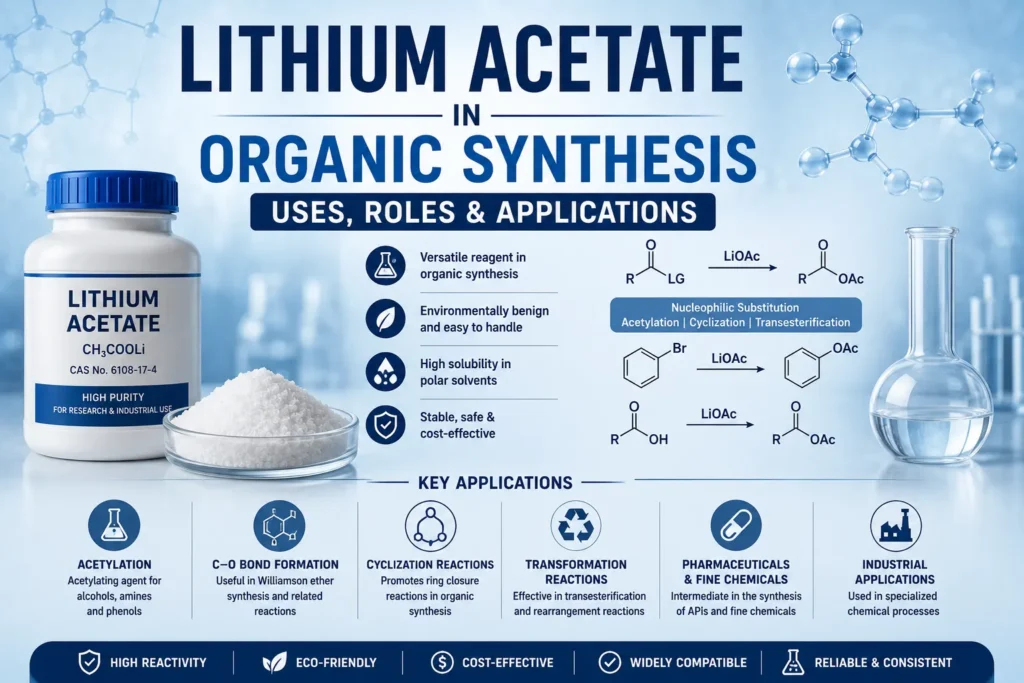
Lithium acetate (LiOAc) is a lithium salt of acetic acid that has applications across chemical synthesis, laboratory research, and industrial chemistry. In organic synthesis, lithium acetate can function as a catalyst, promoter, or reagent depending on the reaction system and desired transformation.
Its relatively mild basic character and compatibility with different reaction conditions make it useful in selected synthetic processes. Research has demonstrated lithium acetate-catalyzed aldol and Michael reactions, while other studies have reported its use as a catalyst in multicomponent organic reactions.
What Is Lithium Acetate?
Lithium acetate is an ionic compound consisting of lithium ions and acetate ions. It is commonly represented by the chemical formula CH₃COOLi or LiOAc. Lithium acetate is available in anhydrous and hydrated forms, including lithium acetate dihydrate.
Commercial chemical references describe lithium acetate and lithium acetate dihydrate as materials used in chemical reactions and as precursors for synthesizing various lithium-based compounds.
Because different applications may require different specifications, users should select the appropriate grade, purity, and hydration state for their intended process.
Why Is Lithium Acetate Used in Organic Synthesis?
Lithium acetate can be useful in organic synthesis because it can participate in reaction pathways as a mild ionic reagent or catalyst. Its role depends strongly on the substrates, solvent, temperature, and reaction mechanism.
Some of the reasons lithium acetate is considered in synthetic chemistry include:
- Its relatively mild chemical character
- Its ability to participate in catalytic reaction systems
- Compatibility with selected organic reaction conditions
- Availability in different grades and forms
- Use in specialized synthetic transformations
- Potential application in multicomponent reactions
Importantly, lithium acetate should not be considered a universal catalyst. Its effectiveness depends on the specific reaction and conditions being used.
Lithium Acetate as a Catalyst
One of the most interesting applications of lithium acetate in organic chemistry is its role as a catalyst or reaction promoter.
Research has demonstrated lithium acetate-catalyzed reactions under specific conditions. For example, lithium acetate has been reported as a catalyst for Michael reactions involving trimethylsilyl enolates and α,β-unsaturated carbonyl compounds.
It has also been investigated as a catalyst in aldol reactions. Studies have reported lithium acetate-catalyzed reactions between aldehydes and trimethylsilyl enolates under weakly basic conditions.
These examples demonstrate that lithium acetate can play an active catalytic role in certain organic transformations rather than serving only as an inorganic salt.
Lithium Acetate in Biginelli Reactions
Lithium acetate has also been investigated as a catalyst for Biginelli-type multicomponent reactions.
A published study reported lithium-acetate-mediated Biginelli synthesis involving aldehydes, 1,3-dicarbonyl compounds, and urea or thiourea. The researchers investigated lithium acetate as a catalyst under both solvent-based and solvent-free conditions.
The study highlights the potential of lithium acetate as a reaction promoter for synthesizing dihydropyrimidinone and related compounds.
This makes lithium acetate relevant to researchers exploring efficient multicomponent synthetic approaches.
Lithium Acetate as a Reagent
Beyond catalytic applications, lithium acetate can also serve as a reagent or chemical precursor in selected synthesis processes.
Its use depends on the chemistry of the target reaction. Lithium acetate can provide lithium and acetate ions to a reaction system and can be used as a starting or precursor material for preparing other lithium-containing compounds.
Commercial chemical references also identify lithium acetate and lithium acetate dihydrate as precursor materials for the synthesis of various lithium-based materials.
Lithium Acetate in Organic Reaction Applications
Lithium acetate has been investigated or used in several areas of synthetic chemistry, including:
1. Aldol Reactions
Lithium acetate can function as a Lewis-base catalyst in selected aldol reactions. Research has shown that lithium acetate can promote reactions between trimethylsilyl enolates and aldehydes under appropriate conditions.
2. Michael Reactions
Lithium acetate has also been reported as a catalyst for Michael reactions involving trimethylsilyl enolates and α,β-unsaturated carbonyl compounds.
3. Biginelli Reactions
Lithium acetate has been studied as a catalyst in Biginelli-type multicomponent synthesis, where it can promote the formation of dihydropyrimidinone derivatives.
4. Halogenation-Related Reactions
Research has also investigated lithium acetate as a catalyst in Hunsdiecker-type reactions. One study compared lithium acetate with other catalysts in the conversion of α,β-unsaturated carboxylic acids to corresponding halo compounds.
5. Synthesis of Lithium-Based Materials
Lithium acetate is also used as a precursor for synthesizing lithium-containing materials. Commercial references list applications involving lithium-based compounds, battery-related materials, and solid-state electrolyte synthesis.
Lithium Acetate vs. Lithium Acetate Dihydrate
Lithium acetate is available in different physical forms, including anhydrous lithium acetate and lithium acetate dihydrate.
The key distinction is the presence of water of crystallization in the dihydrate form. This difference can affect molecular weight, composition, and how the material is calculated or handled in a chemical process.
Therefore, researchers and manufacturers should verify whether an application requires anhydrous lithium acetate or lithium acetate dihydrate before purchasing or preparing a reaction.
Factors to Consider When Choosing Lithium Acetate
Selecting the right lithium acetate depends on the intended application.
Purity and Grade
High-purity material may be important for sensitive laboratory and synthesis applications where trace contaminants can influence reaction performance.
Hydration State
Check whether your process requires anhydrous lithium acetate or lithium acetate dihydrate.
Application Requirements
The appropriate specification can vary between laboratory synthesis, industrial manufacturing, material synthesis, and research applications.
Documentation
For commercial and research applications, documentation such as a Certificate of Analysis (COA), specification sheet, and batch information can help verify product quality.
Benefits of Using Lithium Acetate in Selected Synthetic Processes
Depending on the reaction system, lithium acetate can offer several practical advantages:
- Useful catalytic activity in selected organic reactions
- Mild reaction behavior in appropriate systems
- Application in multiple types of organic transformations
- Availability in anhydrous and hydrated forms
- Use as both a reaction component and chemical precursor
- Applications extending from organic synthesis to advanced material preparation
However, performance should always be evaluated against the specific reaction, substrate, solvent, catalyst loading, and process conditions.
Lithium Acetate for Laboratory and Industrial Applications
Lithium acetate is not limited to organic synthesis. Its applications extend to laboratory research, biotechnology, polymer-related processes, and materials chemistry.
Commercial references identify lithium acetate as a catalyst in selected chemical reactions and as a precursor for lithium-based materials.
This broad application range makes lithium acetate a useful specialty chemical for organizations working across research, synthesis, and manufacturing.
How to Choose a Lithium Acetate Supplier
When sourcing lithium acetate for research or industrial use, consider:
- Required purity and grade
- Anhydrous or dihydrate form
- Consistency between batches
- Product specifications
- COA availability
- Packaging options
- Technical support
- Supply reliability
- Application-specific requirements
For demanding synthesis and manufacturing processes, consistent product quality can be just as important as the nominal purity specification.
Frequently Asked Questions About Lithium Acetate
What is lithium acetate used for in organic synthesis?
Lithium acetate can be used as a catalyst, promoter, reagent, or precursor in selected organic synthesis processes. Its reported applications include aldol, Michael, Biginelli, and other specialized reactions.
Is lithium acetate a catalyst or a reagent?
It can serve different roles depending on the reaction. In some organic reactions, lithium acetate acts as a catalyst or promoter, while in other applications it functions as a reagent or precursor.
What is the difference between lithium acetate and lithium acetate dihydrate?
Lithium acetate dihydrate contains two molecules of water of crystallization per formula unit, whereas anhydrous lithium acetate does not. This difference affects molecular weight and how the compound is used in quantitative chemical processes.
Is lithium acetate used in Biginelli reactions?
Yes. Published research has investigated lithium acetate as a catalyst for Biginelli-type multicomponent synthesis.
Is lithium acetate used in aldol reactions?
Yes. Lithium acetate has been reported as a catalyst for selected aldol reactions involving trimethylsilyl enolates and aldehydes.
Is lithium acetate used in Michael reactions?
Yes. Research has reported lithium acetate-catalyzed Michael reactions involving trimethylsilyl enolates and α,β-unsaturated carbonyl compounds.
How should lithium acetate be selected for organic synthesis?
Consider the required purity, grade, hydration state, reaction requirements, packaging, and available quality documentation. The appropriate specification depends on the intended synthesis or industrial process.
Conclusion
Lithium acetate is a versatile specialty chemical with applications that extend beyond laboratory use. In organic synthesis, it has been investigated as a catalyst or promoter in several reactions, including aldol, Michael, Biginelli, and other specialized transformations.
Its use as a precursor for lithium-based materials further expands its relevance to chemical and materials research. Choosing the appropriate grade, purity, and hydration state is important for obtaining consistent results.
For researchers and manufacturers sourcing lithium acetate, evaluating product specifications, quality documentation, and supplier reliability can help ensure that the material is appropriate for the intended application.
