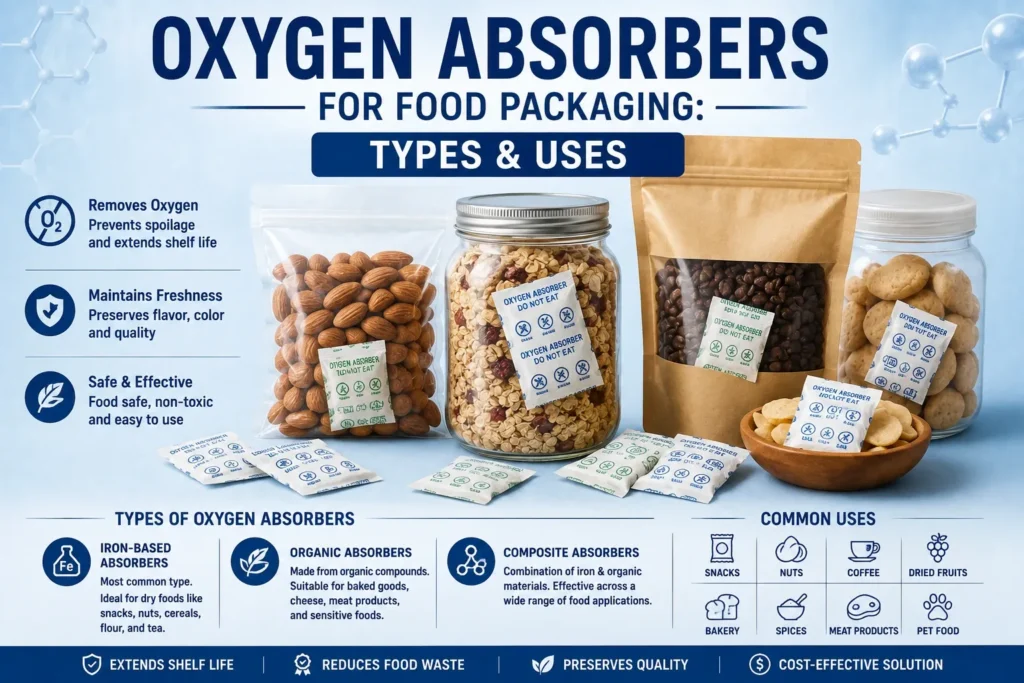
Oxygen absorbers are active packaging sachets that chemically remove residual oxygen trapped inside a sealed package. Removing that oxygen — rather than just slowing it down — is what protects packaged food from oxidation, spoilage, discoloration, and flavor loss over its shelf life.
By pulling the internal oxygen level down from roughly 21% (normal air) to well under 1%, oxygen absorbers help maintain freshness and support longer shelf life during storage and transportation, particularly for dry and semi-dry foods where oxidation is the main quality-loss pathway.
What Are Oxygen Absorbers?
An oxygen absorber is a small sachet, most commonly containing iron powder, sealed inside a permeable packet. Once placed inside a sealed package, the iron reacts with the surrounding oxygen — oxidizing, essentially rusting — and in doing so consumes that oxygen rather than simply blocking new oxygen from entering. This is a meaningfully different mechanism from a barrier film, which only stops new oxygen getting in and does nothing about the oxygen already trapped inside at the moment of sealing.
How Do Oxygen Absorbers Work?
The iron-oxidation reaction inside the sachet consumes oxygen molecules from the package headspace until the internal oxygen concentration drops to a fraction of a percent. This matters because oxidation is what drives most quality loss in packaged dry food: rancid fats and oils, faded color in spices, stale flavor in coffee and snacks, and conditions that favor mould and some bacteria.
A correctly functioning iron-based absorber typically feels slightly warm to the touch shortly after sealing — that is the oxidation reaction in progress, and it is the most reliable everyday sign it has activated.
Types of Oxygen Absorbers for Packaging
Not every oxygen absorber is built the same way, and picking the right type matters as much as picking the right size.
1. Iron-Based (Ferrous) Absorbers
The standard type used across most food packaging — effective, low-cost, and available in a full range of capacities. This is the default choice unless a specific constraint on the packaging line rules it out.
2. Non-Ferrous (Metal-Detectable-Safe) Absorbers
Formulated without iron powder specifically so they will not trigger a metal detector on a production line. Any facility running packaged food through in-line metal detection as a food-safety check needs this type — an iron-based sachet on a metal-detected line causes false-positive rejections and line stoppages.
3. Self-Adhesive Absorbers
Supplied with an adhesive backing so they can be stuck to the inside of a lid or package wall instead of sitting loose. Useful where a loose sachet could be mistaken for product, could shift during transport, or is impractical to drop in by hand on a fast packaging line.
Absorbers are also classified by speed of reaction: fast-acting for packages that need oxygen pulled down quickly after sealing, and slower, self-indicating variants used where a visual color-change tab is wanted to confirm the absorber is still active.
Uses of Oxygen Absorbers in Food Packaging
a. Dry Foods
Grains, pulses, dried fruit, and other dehydrated products use oxygen absorbers to extend storage life and guard against insect activity, which needs oxygen to survive.
b. Coffee and Tea
Coffee and tea contain volatile aromatic compounds that degrade quickly on oxygen exposure. Oxygen absorbers protect these flavor compounds far more completely than a one-way valve alone, since the valve only manages degassing, not the oxygen already sealed in at packing.
c. Bakery Products
Low-moisture baked goods use oxygen absorbers to protect texture and prevent mould, particularly in shelf-stable packaged formats sold without refrigeration.
d. Pet Food
Pet food shares the same oil-oxidation risk as human snack foods, so oxygen absorbers extend shelf life and prevent rancidity in the fats used in most formulations.
e. Nutraceutical and Pharmaceutical Packaging
Beyond food, the same mechanism protects oxygen-sensitive ingredients in nutraceutical and pharmaceutical packaging, supporting product stability during storage and transportation.
Benefits of Oxygen Absorbers for Food Packaging
Extended Shelf Life
Removing residual oxygen slows the oxidation reactions that are the primary cause of quality loss in packaged dry food, directly extending how long a product stays sellable.
Protection Against Oxidation
Because the absorber removes oxygen rather than merely reducing exposure to it, protection continues for the sachet’s full working capacity, not just until the package is opened.
Flavor and Aroma Retention
Volatile flavor and aroma compounds in products like coffee, tea, and spices oxidize and fade over time; removing oxygen from the package slows that loss.
Improved Product Appearance
Oxidation is a common cause of discoloration — browning in dried fruit, fading in spices — so removing oxygen helps packaged products look closer to fresh for longer.
Better Storage Stability
Lower oxygen levels reduce the rate of quality degradation across long storage and distribution chains, which matters most for products that spend weeks or months between packing and sale.
How to Choose the Right Oxygen Absorber Size
Absorber capacity is rated in cubic centimeters (cc) of oxygen absorbed — a 100cc absorber can absorb 100cc of oxygen over its working life. Sizing is the step buyers most often get wrong: an oversized absorber wastes money, an undersized one leaves the product under-protected for the second half of its shelf life. A larger absorber is not automatically better — capacity should be matched to the package’s actual oxygen-removal requirement, based on:
- Package headspace — the volume of empty air inside the sealed package
- Product type — some products (e.g. baked goods) release a small amount of gas over time, which the absorber needs spare capacity to handle
- Packaging material’s oxygen transmission rate — a less oxygen-tight film lets in more oxygen over the shelf life, increasing the required capacity
- Storage conditions and desired shelf-life period — longer shelf life and less controlled storage both call for more capacity
For commercial applications, working with a manufacturer or supplier can help confirm the appropriate capacity for your exact packaging system. Bee Chems provides technical support for selecting oxygen absorber capacity by application — reach out with your package volume and target shelf life.
How to Use Oxygen Absorbers Correctly
- Keep the master bag sealed until the moment of use. Absorbers activate on contact with air, so the bulk packaging is itself sealed to keep them inert until needed.
- Work quickly once the master bag is open. Every absorber left out is absorbing oxygen from the room, not from your product.
- Drop the absorber in immediately before sealing, not before the product is fully loaded — it should be one of the last things placed in the package.
- Reseal the master bag tightly right after removing what is needed for that batch.
- Seal the final package promptly after the absorber goes in.
- Don’t handle absorbers with wet hands or let them contact liquid — most formulations need to stay dry to function and are not designed to contact food directly.
Storage & Handling of Unused Oxygen Absorbers
- Store unopened master bags in a cool, dry place, away from direct heat and humidity, until needed.
- Once opened, use the remaining absorbers within the window your supplier specifies — commonly minutes to a couple of hours, not days, since the whole bag begins absorbing ambient oxygen as soon as it’s open.
- If a partial bag won’t be used soon, reseal it as airtight as possible rather than leaving it loosely folded over.
- Treat a bag that feels warm or has visibly changed color before use as compromised — that’s a sign it activated prematurely and has already used up part of its capacity.
Common Mistakes to Avoid
- Sizing by package weight alone, ignoring headspace — two packages of equal weight can have very different air volumes.
- Leaving the master bag open on a production line for extended periods, quietly draining capacity from every absorber left inside.
- Mixing absorber types across a product line without checking whether metal-detectable-safe absorbers are required.
- Assuming one absorber size fits every SKU in a product range — that optimizes for the supplier’s inventory, not your shelf life.
- Not accounting for products that release gas themselves, such as some baked or fermented items, which need extra capacity beyond the headspace oxygen alone.
You might be interested in: Lithium Bromide vs Lithium Chloride
Oxygen Absorbers vs. Desiccants
An oxygen absorber removes oxygen; a desiccant removes moisture. A product failing from rancidity and color loss has an oxidation problem and needs an oxygen absorber. A product failing from clumping, mould, or sogginess has a moisture problem and needs a desiccant. Some products need both, run side by side in the same package rather than as a substitute for each other.
Why Choose Bee Chems Oxygen Absorbers?
Bee Chems has manufactured specialty chemicals from its Kanpur facility since 1972, and supplies oxygen absorbers built for consistent performance across food, pharmaceutical, and industrial packaging. The range covers multiple packet sizes and capacities, food-grade formulations, and customized packaging options, backed by technical support to help identify the right type and capacity for a specific product and shelf-life target.
Get the Right Oxygen Absorber for Your Application
Share your package volume, product type, and target shelf life, and Bee Chems will help identify the right absorber type and capacity rather than leaving it to guesswork. Enquire now or browse the full oxygen absorbers range.
Frequently Asked Questions
Q1. What are oxygen absorbers used for in food packaging?
Ans: They remove residual oxygen from sealed packaging to prevent oxidation, spoilage, discoloration, and flavor loss, extending shelf life for dry and semi-dry foods.
Q2. How do oxygen absorbers work?
Ans: Most contain iron powder that oxidizes on contact with air, chemically consuming the oxygen trapped inside the sealed package rather than just blocking new oxygen from entering.
Q3. What foods can use oxygen absorbers?
Ans: Grains, pulses, dried fruit, nuts, coffee, tea, bakery products, snacks, pet food, and confectionery all commonly use oxygen absorbers to slow oxidation-driven quality loss.
Q4. How do I choose the right oxygen absorber size?
Ans: Size is rated in cc of oxygen absorbed and depends on package headspace, product type, the packaging material’s oxygen transmission rate, and target shelf life. Round up to the next standard capacity rather than down — see the sizing guide above for reference ranges and a worked example.
Q5. Do oxygen absorbers extend shelf life?
Ans: Yes. By removing the oxygen that drives rancidity, discoloration, and flavor loss, they extend how long a packaged product remains at sellable quality.
Q6. Are oxygen absorbers and desiccants the same?
Ans: No. Oxygen absorbers remove oxygen; desiccants remove moisture. They solve different preservation problems and are sometimes used together in the same package.
Q7. Where can I buy oxygen absorbers in bulk?
Ans: Directly from a manufacturer offering multiple capacities and customized packaging options. Contact Bee Chems with your package volume, product type, and target shelf life.
Q8. Can oxygen absorbers be customized?
Ans: Yes. Custom packet dimensions, absorption capacities, and packaging configurations can be selected according to product and packaging requirements.
Q9. How long can the master bag stay open before the absorbers lose effectiveness?
Ans: Typically only a short window — minutes to a couple of hours depending on the product — since the whole bag starts absorbing ambient oxygen the moment it’s opened. Reseal unused absorbers as airtight as possible if they won’t be used immediately.
Q10. How do I know if an oxygen absorber is actually working?
Ans: It should feel slightly warm shortly after sealing — that’s the oxidation reaction in progress. Self-indicating types show a visible color change on an included tab.
