Categories
Adsorbents Desiccants

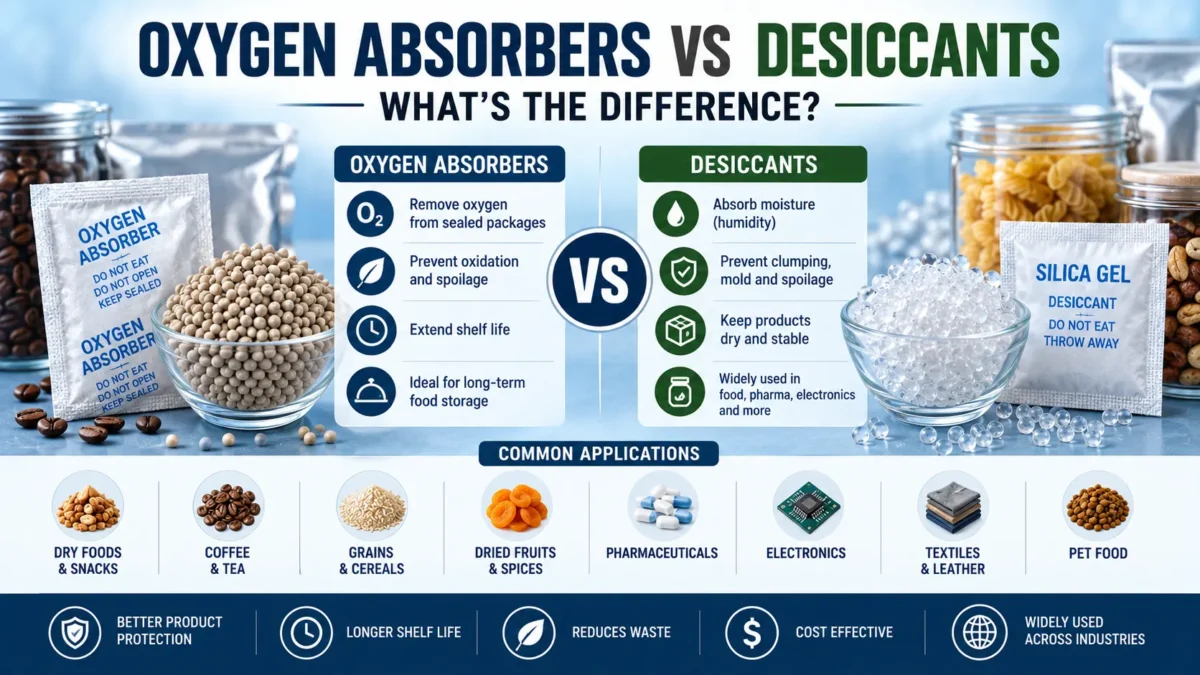
Oxygen Absorbers vs Desiccants: Key Differences Explained

Oxygen absorbers and desiccants are often mentioned in the same breath — both are small packets tucked into packaging to protect what’s inside. But they solve two completely different problems: one removes oxygen, the other removes moisture. Mixing up oxygen absorbers vs desiccants can mean protecting your product from the wrong threat entirely.

This guide breaks down how each oxygen absorber and desiccant actually works, where they differ, and when a product needs one, the other, or both. Browse Bee Chems’ full Adsorbents, Absorbents & Desiccants range to compare all options.

What Is an Oxygen Absorber?

An oxygen absorber is a small sachet — typically containing iron powder — that chemically reacts with oxygen trapped inside sealed packaging. As the iron oxidizes (essentially controlled rusting), it consumes the available oxygen, dropping oxygen levels inside the package to a fraction of a percent. This slows or stops oxidation-driven spoilage: rancidity in fats and oils, discoloration, flavor loss, and the growth of oxygen-dependent mold and insects.

What Is a Desiccant?

A desiccant is a moisture-absorbing material — such as silica gel, clay desiccant, or calcium chloride desiccant — that pulls water vapor out of the air inside a sealed package or container. Desiccants don’t touch oxygen levels at all; their entire job is controlling relative humidity to prevent mold growth, caking, corrosion, and moisture-driven texture changes like sogginess or clumping.

The Chemistry Behind Each One

An oxygen absorber’s reaction needs a small amount of moisture to proceed — the iron powder inside reacts with both oxygen and trace water vapor to form iron oxide (essentially rust), which is why some oxygen absorber sachets are slightly less effective in extremely dry environments. Its absorption capacity is measured in cubic centimeters (cc) of oxygen it can remove, and that number is what determines correct sizing for a given package volume and product type.

Desiccants, by contrast, work through two different mechanisms depending on the material: silica gel and clay physically adsorb water vapor onto their porous internal surface, while calcium chloride is hygroscopic and chemically binds with water, eventually converting to a liquid or gel as it absorbs. Neither desiccant mechanism involves or affects oxygen levels in any way.

Oxygen Absorbers vs Desiccants: Key Differences

Factor Oxygen Absorber Desiccant
What it removes Oxygen Moisture (water vapor)
Mechanism Chemical reaction (iron oxidation) Physical adsorption or chemical hygroscopic absorption
Protects against Oxidation, rancidity, discoloration, oxygen-dependent pests/mold Moisture-driven mold, caking, corrosion, sogginess
Common materials Iron powder-based sachets Silica gel, clay, calcium chloride
Typical packaging use Dry foods, pharmaceuticals, electronics sensitive to oxidation Any product sensitive to humidity or condensation
Visual indicator available Some absorbers include an oxygen indicator dot Indicating silica gel grades change color at set humidity levels

Why the Difference Matters

Using the wrong protection — or only one when a product needs both — can mean spoilage still happens, just from a different cause than the one you guarded against. A desiccant won’t stop nuts from going rancid, and an oxygen absorber won’t stop a hygroscopic powder from clumping in humid storage. Matching the right protection to the actual failure mode is what makes packaging protection effective in the first place.

Can You Use Both Together?

Yes — and for many dry, oxidation-and-moisture-sensitive products, using both is standard practice. Foods like jerky, pet treats, nuts, and some pharmaceuticals face both oxidation risk and moisture risk simultaneously, so combining an oxygen absorber with a desiccant in the same package addresses both failure modes at once, rather than leaving one uncovered.

Applications: When to Use Which

  • Oxygen absorbers alone: Products where oxidation is the primary concern and moisture is already controlled by packaging material — e.g., vacuum-sealed or low-humidity environments.
  • Desiccants alone: Products sensitive to humidity but not particularly prone to oxidation — e.g., electronics, leather goods, or moisture-sensitive powders in stable-oxygen environments.
  • Both together: Dry foods (jerky, dried fruit, pet food, bakery items), pharmaceuticals, and nutraceuticals where both oxidation and humidity threaten shelf life.

How to Verify They’re Still Working

Both oxygen absorbers and desiccants can be checked visually rather than guessed at. Some oxygen absorber sachets include a built-in oxygen indicator dot that changes color once oxygen levels drop to a safe threshold, confirming the absorber activated and did its job. For moisture control, humidity indicator cards placed alongside a desiccant change color at specific relative humidity levels, giving a quick visual confirmation of whether the package stayed dry throughout storage or transit.

Common Mistakes to Avoid

  • Leaving sachets exposed to air before sealing: Both oxygen absorbers and many desiccants begin working the moment they’re exposed to air — leaving them out too long before sealing the package wastes their capacity before it’s even needed.
  • Under-sizing for package volume: Using a sachet rated for a smaller package than what you’re actually protecting leaves residual oxygen or moisture unaddressed.
  • Assuming one covers the other’s job: As covered above, a desiccant does nothing for oxidation and an oxygen absorber does nothing for humidity — assuming otherwise is one of the most common packaging mistakes.
  • Poor package sealing: Neither an oxygen absorber nor a desiccant can compensate for a package that isn’t properly sealed, since outside air will simply keep entering and overwhelming their capacity.

Shelf Life and Storage Before Use

Both oxygen absorbers and many desiccants are single-use products that begin reacting as soon as they’re exposed to ambient air, so they should be stored in their original sealed packaging until the moment they’re placed inside the product packaging. Once opened and used, an oxygen absorber cannot be “recharged” — a fresh sachet is needed for each new package. Some desiccants, like silica gel, can be reactivated by heating to drive off absorbed moisture, though this isn’t practical for single-use packaging applications.

You might be interested in: How to Choose Container Desiccants for Shipping

How to Choose the Right One for Your Product

  1. Identify the failure mode: Does the product spoil from going stale/rancid (oxygen) or from clumping/molding/softening (moisture)? Often it’s both.
  2. Check your packaging material: Fully oxygen-barrier packaging reduces oxygen absorber demand; non-breathable moisture-barrier packaging reduces desiccant demand — but neither eliminates the need entirely in most real-world packaging.
  3. Size correctly: Oxygen absorber capacity (in cc) and desiccant capacity both need to match package volume and the product’s own moisture/oxygen content — confirm sizing with your supplier’s technical team.
  4. Consider shelf-life targets: Longer shelf-life claims generally need higher-capacity protection on both fronts.

Conclusion

Oxygen absorbers and desiccants aren’t interchangeable — one controls oxygen, the other controls moisture, and each protects against a different type of spoilage. Understanding which failure mode your product actually faces (or whether it faces both) is the key to choosing the right protection, rather than assuming either one covers everything. For more on oxygen-based shelf-life protection specifically, see our guide on Oxygen Absorbers for Food Packaging.

Not sure whether your product needs an oxygen absorber, a desiccant, or both? Talk to our technical team for a recommendation based on your product and packaging.

Frequently Asked Questions

Q1. Can I use a desiccant instead of an oxygen absorber?

Ans: No — they address different problems. A desiccant will not slow oxidation or rancidity, since it only removes moisture, not oxygen. If oxidation is a concern, you need an oxygen absorber specifically.

Q2. Do oxygen absorbers also remove moisture?

Ans: No, standard oxygen absorbers only target oxygen. Some combination sachets exist that include both oxygen-absorbing and moisture-absorbing components, but a standard oxygen absorber alone won’t control humidity.

Q3. Is it safe to use oxygen absorbers and desiccants in the same package?

Ans: Yes, this is common practice for products that face both oxidation and moisture risks, such as jerky, dried fruit, and certain pharmaceuticals — the two work independently without interfering with each other.

Q4. Which one do I need for long-term food storage?

Ans:  For long-term dry food storage (grains, beans, dehydrated foods), both are typically recommended together — the oxygen absorber prevents oxidation and insect activity, while the desiccant prevents moisture-related spoilage and clumping.

Q5. How do I know if my product needs an oxygen absorber, a desiccant, or both?

Ans:  Consider what actually causes the product to spoil: rancidity, discoloration, or oxygen-dependent pests point to an oxygen absorber; clumping, mold, or sogginess point to a desiccant. If both risks apply, use both.
 

Categories
Adsorbents Desiccants

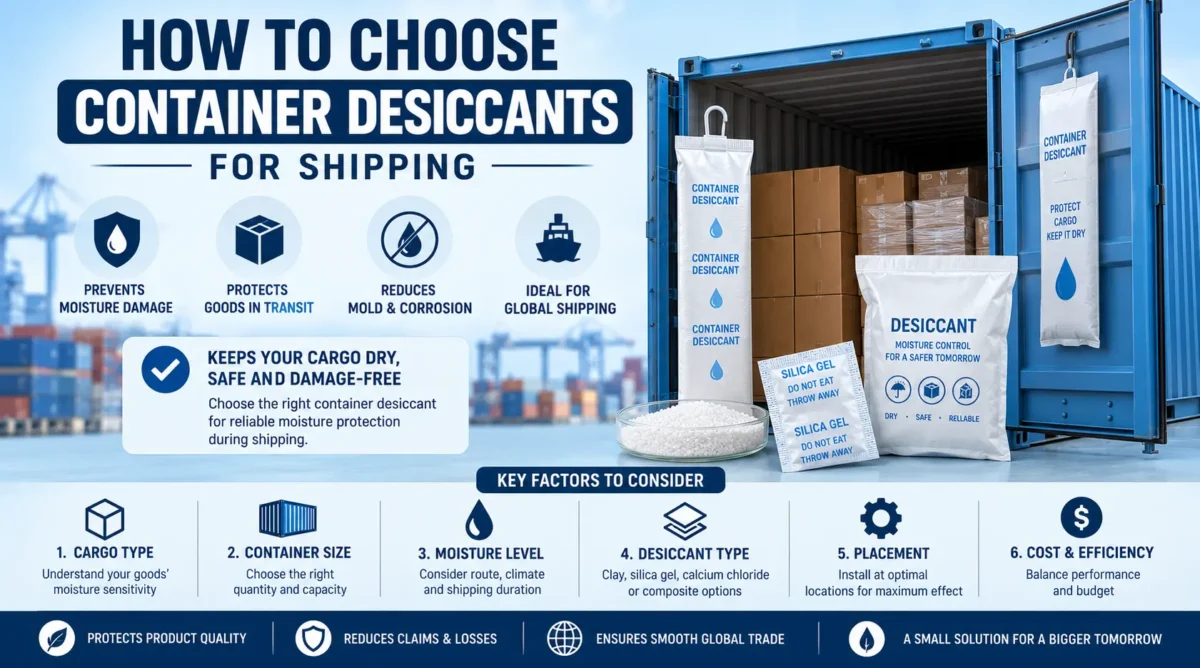
How to Choose Container Desiccants for Shipping

Moisture is one of the most common — and most avoidable — causes of cargo damage in international shipping. Choosing the right container desiccant can mean the difference between goods arriving in perfect condition and a container full of mold, rust, or water-stained packaging. But with several desiccant types, formats, and sizing considerations to weigh, picking the right one isn’t always straightforward.

This guide walks through exactly how to choose a container desiccant for shipping — the types available, the factors that actually affect your decision, and the mistakes that lead to moisture damage even when a desiccant was used. Browse Bee Chems’ full Adsorbents, Absorbents & Desiccants range to compare options.

Why Moisture Control Matters in Shipping Containers

Shipping containers experience significant temperature swings between day and night, and across climate zones during long ocean transits. Warm, humid air inside a container holds moisture until temperatures drop — at which point that moisture condenses on the container’s walls and ceiling, a phenomenon widely known as container rain or container sweat. That condensation drips onto cargo below, leading to:

  • Rust and corrosion on metal components
  • Mold and mildew on textiles, leather, and packaging
  • Warping or swelling of wood and paper-based products
  • Short circuits and failure in electronic components
  • Cargo rejection, insurance claims, and financial loss

A properly chosen desiccant actively absorbs that excess water vapor before it can condense, keeping humidity low throughout the transit.

How Desiccants Actually Work

Most container desiccants work through physical adsorption — they don’t react chemically with water so much as trap water molecules on or within their internal structure. Clay and silica gel both rely on a porous internal surface area that pulls moisture out of the surrounding air and holds it. Calcium chloride works differently: it’s a chemical (hygroscopic) desiccant that actually dissolves as it absorbs water, converting from a solid into a contained liquid or gel as it works — which is why it’s usually supplied in a leak-proof pouch or container rather than a simple breathable bag.

Understanding this distinction matters because it affects handling: physical desiccants like clay and silica gel stay solid and can be handled or disposed of easily even when saturated, while chemical desiccants like calcium chloride need to be handled and disposed of as a liquid-containing unit once they’ve absorbed their capacity.

Types of Container Desiccants

Not all desiccants work the same way. The main options used in container shipping include:

  • Clay desiccant: A natural, low-cost, eco-friendly option effective at moderate humidity levels — a good general-purpose choice for standard shipments.
  • Silica gel: Higher absorption capacity than clay, effective across a wider humidity range, commonly used where higher-value or more moisture-sensitive cargo is involved.
  • Calcium chloride desiccant: A chemical desiccant that absorbs large volumes of moisture and converts it into a contained liquid or gel, suited to very high-humidity, long-duration shipments where maximum absorption capacity matters most.

Container Desiccant vs Cargo Desiccant: What’s the Difference?

Container desiccant and cargo desiccant are closely related and often used interchangeably — both are moisture-absorbing bags designed to protect goods in transit. The distinction is mostly one of scope: “container desiccant” typically refers to products specifically sized and packaged for hanging or placement inside standard 20-foot and 40-foot shipping containers, while “cargo desiccant” is the broader term covering moisture protection across containers, pallets, and general sealed packaging.

In practice, if you’re shipping a full container load by ocean freight, the container desiccant range is the more specifically targeted choice. If you need moisture protection for palletized or mixed packaging beyond a single container, the cargo desiccant range offers more flexible options.

Key Factors to Consider When Choosing a Container Desiccant

  • Container size: A standard 20-foot container needs less desiccant than a 40-foot container — larger enclosed air volume means more potential moisture to absorb.
  • Cargo sensitivity: Electronics, pharmaceuticals, and leather goods need tighter humidity control than general hardware or industrial parts.
  • Transit duration and route: Longer voyages and routes crossing multiple climate zones increase the risk and duration of temperature-driven condensation.
  • Expected humidity and temperature conditions: Origin and destination climate, plus the season of shipment, affect how much moisture the desiccant will need to handle.
  • Packaging format: Hanging bags, placed sachets, or bulk units — the right format depends on how the container is loaded and how much handling the desiccant needs to withstand.

Desiccant Packaging Formats Explained

Beyond the desiccant material itself, the packaging format affects how well it performs during handling and transit:

  • Hanging bags: Suspended from container walls or roof hooks, keeping the desiccant clear of cargo and allowing airflow on all sides for more even absorption.
  • Placed sachets and pillow packs: Set directly on or near cargo — convenient for smaller shipments or where hanging points aren’t available. Bee Chems’ Desiccant Sachets and Bags cover this format across multiple sizes.
  • Bulk units: Larger-capacity packs designed for high-volume or long-duration shipments where frequent replacement isn’t practical.

The right format often comes down to how the container is loaded — dense, palletized loads may only leave room for placed sachets, while open-floor loads can accommodate hanging bags distributed evenly across the space.

How Much Desiccant Do You Need?

The right quantity depends on container size, cargo type, transit duration, and expected humidity — there’s no single number that applies to every shipment. As a general rule, larger containers, longer transit times, and more moisture-sensitive cargo all call for a higher desiccant capacity. Rather than guessing, it’s worth confirming the recommended quantity for your specific container size and route with your supplier’s technical team before shipping.

How to Verify Desiccant Performance During Transit

Since a shipping container isn’t opened again until it reaches its destination, there’s no way to physically check a desiccant mid-voyage — which is exactly why humidity indicator cards are commonly packed alongside desiccants. These cards change color at specific relative humidity thresholds, giving a simple visual confirmation the moment the container is opened of whether humidity stayed within a safe range throughout transit — and whether the desiccant was sized correctly for next time.

Desiccants vs Other Moisture Control Methods

Desiccants aren’t the only tool for container moisture control, and in some cases they work best alongside other methods rather than alone:

  • Container ventilation: Passive or powered vents can reduce humidity buildup, though they’re less effective for controlling condensation caused by temperature swings alone.
  • Vapor barrier liners: Sealed container liners reduce the amount of ambient moisture that enters in the first place, reducing the load a desiccant needs to handle.
  • Vapor corrosion inhibitors (VCIs): Used specifically to protect metal parts from rust and corrosion, VCIs work alongside — not instead of — a desiccant, since they address surface oxidation rather than general humidity.

For most standard shipments, a correctly sized desiccant alone is sufficient. Combining it with a vapor barrier liner or VCI is typically reserved for especially high-value, moisture-sensitive, or corrosion-prone cargo.

Common Mistakes to Avoid

  • Under-estimating quantity: Using too little desiccant for the container size or cargo sensitivity leaves excess moisture unaddressed.
  • Poor placement: Desiccant bags placed in one corner rather than distributed strategically won’t control humidity evenly throughout the container.
  • Ignoring transit duration: A desiccant sized for a short regional shipment may not have enough capacity for a multi-week ocean voyage.
  • Choosing the wrong desiccant type for cargo value: Using a basic clay desiccant for highly moisture-sensitive electronics or pharmaceuticals, where a higher-capacity option would be more appropriate.
  • Not accounting for container loading date vs. climate: Loading in a humid season without adjusting desiccant quantity accordingly increases condensation risk.

You might be interested in: Lithium Silicate vs Sodium Silicate

Step-by-Step: How to Choose the Right Container Desiccant

  1. Assess your cargo’s moisture sensitivity — general goods, or high-value/moisture-sensitive items like electronics and pharmaceuticals?
  2. Identify your container size — 20-foot, 40-foot, or other enclosed volume.
  3. Map your route and transit duration — climate zones crossed and expected voyage length.
  4. Choose the desiccant type — clay for general/cost-effective protection, silica gel for higher sensitivity, calcium chloride for maximum absorption on long, humid routes.
  5. Confirm quantity and placement with your supplier’s technical guidance for your specific container and cargo combination.

Conclusion

Choosing the right container desiccant comes down to matching desiccant type and quantity to your container size, cargo sensitivity, and transit conditions — not just grabbing whatever’s cheapest or most familiar. Getting this right protects your cargo, avoids costly claims, and keeps shipments arriving in the condition they left in.


Not sure which desiccant and quantity fits your shipment? Talk to our technical team for a recommendation based on your container size, cargo type, and route.


Frequently Asked Questions

Q1. What is the best desiccant for shipping containers?

Ans: There’s no single “best” option — clay desiccant suits general-purpose, cost-sensitive shipments, silica gel suits higher-sensitivity cargo, and calcium chloride desiccant suits long, high-humidity routes where maximum absorption capacity is needed.

Q2. How many desiccant bags does a shipping container need?

Ans: It depends on container size, cargo type, transit duration, and expected humidity levels. A standard 20-foot or 40-foot container typically needs multiple bags placed strategically — confirm the right quantity with your supplier’s technical team for your specific shipment.

Q3. Can container desiccants prevent container rain completely?

Ans: A correctly sized and placed desiccant significantly reduces the moisture available to condense, which greatly lowers the risk of container rain, but factors like extreme humidity, poor placement, or under-dosing can still allow some condensation to occur.

Q4. Is clay desiccant strong enough for long ocean shipments?

Ans: Clay desiccant works well for general, moderate-humidity shipments, but for longer voyages or higher-humidity routes, a higher-capacity option like silica gel or calcium chloride desiccant may provide more reliable protection.

Q5. Do I need a different desiccant for electronics vs general cargo?

Ans: Moisture-sensitive cargo like electronics generally benefits from a higher-absorption desiccant such as silica gel, while general goods and industrial components are often adequately protected with a cost-effective clay desiccant.


Categories
Nano Sols and Silicates

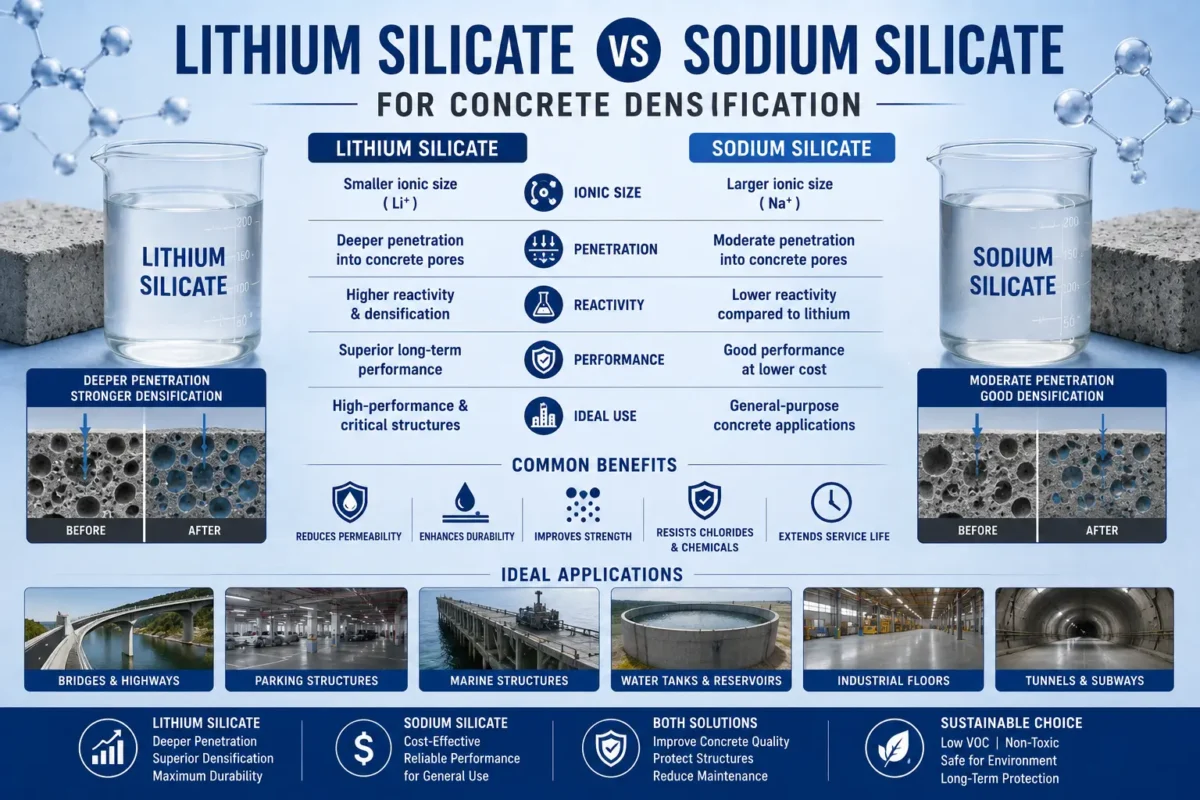
Lithium Silicate vs Sodium Silicate for Concrete Densification

When it comes to hardening and densifying concrete floors, two chemistries dominate the market: lithium silicate and sodium silicate. Both react with free lime inside cured concrete to build a denser, harder surface — but they don’t behave the same way, and choosing the wrong one can mean extra labor, slower turnaround, or a finish that doesn’t hold up.

This guide breaks down lithium silicate vs sodium silicate for concrete densification — how each one works, where a lithium silicate densifier and a sodium silicate concrete densifier actually differ in performance, and how to decide which is right for your project. Browse Bee Chems’ full Construction Chemicals range to see our densifier products.

What Is Lithium Silicate?

Lithium silicate is a water-soluble, inorganic compound of lithium oxide and silica. As a lithium concrete densifier, its smaller lithium ion allows it to penetrate deeper into the concrete matrix than larger alkali ions, where it reacts with free calcium hydroxide to form additional calcium silicate hydrate (C-S-H) — the same binding compound that gives concrete its strength. This reaction densifies and hardens the surface, reducing dusting and improving abrasion resistance.

What Is Sodium Silicate?

Sodium silicate — also known as water glass — is one of the oldest and most widely used inorganic densifying chemistries, made by fusing sodium carbonate and silica sand at high temperature. As a sodium silicate concrete densifier, it works through the same basic mechanism as lithium silicate: reacting with free lime to build additional C-S-H within the concrete’s pore structure. It remains a cost-effective, well-established option for general-purpose concrete hardening and dust-proofing.

How the Densification Reaction Works

Both chemistries rely on the same underlying chemistry: cured concrete always contains a portion of unreacted free calcium hydroxide (lime), left over from cement hydration, which does nothing for the concrete’s strength on its own. When a silicate densifier penetrates the surface, its reactive silica combines with that free lime to form more C-S-H gel, filling capillary pores and hardening the surface from within — rather than just coating it.

The difference lies in how efficiently each ion penetrates and reacts. Lithium’s smaller ionic radius lets it move deeper into the concrete’s pore structure and react more completely, while sodium’s larger ion penetrates less efficiently and tends to leave more unreacted, soluble sodium salts behind after the reaction.

Lithium Silicate vs Sodium Silicate: Key Differences

Factor Lithium Silicate Densifier Sodium Silicate Densifier
Penetration depth Deeper, due to smaller ion size Shallower, reacts closer to the surface
Reaction efficiency Reacts more completely with free lime Reacts less efficiently; more unreacted residue possible
Efflorescence / salt residue risk Lower — leaves minimal soluble byproduct Higher — often requires rinsing off excess sodium salts
Application timing Can often be applied earlier, including on newer (“green”) concrete Typically applied only to fully cured concrete
Post-application labor Generally single-pass, minimal rinsing Often needs neutralizing/rinsing after dwell time
Cost Higher Lower
Typical use case Premium polished concrete, fast-turnaround projects General-purpose, cost-sensitive densification

Where Does Potassium Silicate Fit In?

Lithium and sodium aren’t the only silicate chemistries used in concrete — potassium silicate is sometimes used as a middle-ground option. Its potassium ion is larger than lithium but smaller than sodium, giving it penetration and reaction characteristics that generally sit between the two. In practice, though, lithium and sodium silicate remain the two dominant choices for dedicated concrete densification, with potassium silicate seeing more use in other construction and industrial silicate applications.

Application Process: How Silicate Densifiers Are Applied

While exact procedures vary by product and manufacturer, the general application process for both lithium and sodium silicate densifiers follows a similar pattern:

  1. Surface preparation: The concrete is cleaned, and any existing coatings, curing compounds, or surface contaminants that could block penetration are removed — typically by grinding or mechanical abrasion.
  2. Dilution: The densifier is diluted with water according to the product’s technical data sheet, based on concrete porosity and desired reaction depth.
  3. Application: The diluted densifier is applied evenly by low-pressure sprayer, ensuring full, uniform coverage without pooling.
  4. Dwell time: The product is left to penetrate and react with free lime for a set dwell period, often while keeping the surface visibly wet by re-misting if it dries too quickly.
  5. Rinsing (sodium silicate) or squeegeeing (lithium silicate): Sodium silicate treatments are typically rinsed to remove unreacted surface residue; lithium silicate treatments generally require only squeegeeing off any excess before it dries.
  6. Mechanical polishing (optional): On polished concrete projects, the floor is then honed and polished to the desired sheen level after the densifier has fully cured.

Always follow the specific product’s technical data sheet for dilution ratios, dwell times, and equipment recommendations — these vary by concrete porosity, ambient temperature, and product grade.

Common Application Mistakes to Avoid

  • Applying too early or too late: Treating concrete before it’s ready (or, for sodium silicate, before it’s fully cured) can reduce reaction efficiency and surface performance.
  • Letting the product dry out mid-application: If the densifier dries before it fully reacts, it can leave a hazy or uneven residue instead of a clean, densified finish.
  • Skipping surface prep: Existing sealers, curing compounds, or surface contamination block penetration entirely, regardless of which chemistry is used.
  • Not rinsing sodium silicate treatments: Leaving unreacted sodium salts on the surface is one of the most common causes of efflorescence and slippery residue complaints.
  • Over-diluting to save cost: Under-dosing either chemistry reduces the amount of C-S-H formed, leading to a weaker, less durable result than the product is capable of.

Environmental & Safety Considerations

Both lithium and sodium silicate are water-based, inorganic chemistries with low VOC content, which makes them attractive for projects targeting sustainability certifications like LEED compared to solvent-based coatings. That said, both are alkaline in their concentrated form, so standard precautions apply:

  • Wear gloves and eye protection when handling concentrated product
  • Ensure adequate ventilation during spray application
  • Avoid contact with skin and eyes; rinse immediately if contact occurs
  • Always consult the product-specific Safety Data Sheet (SDS) before handling, storage, or disposal, since exact hazard classifications vary by grade and manufacturer

Benefits of a Lithium Silicate Densifier

  • Improves concrete hardness and abrasion resistance
  • Reduces surface dusting and water absorption
  • Lower efflorescence risk thanks to deeper, more complete reaction
  • Faster project turnaround with minimal post-treatment rinsing
  • Enhances long-term durability and wear resistance for high-traffic floors

Benefits of a Sodium Silicate Densifier

  • Lower material cost, making it attractive for large-area or budget-conscious projects
  • Long track record as a reliable general-purpose hardener
  • Effective dust-proofing for warehouses and industrial floors
  • Widely available and well understood by concrete contractors

Which One Should You Choose?

Choose a lithium silicate densifier if you need deeper penetration, faster project turnaround, minimal efflorescence risk, or the ability to treat newer concrete — common on premium polished concrete floors, distribution centers, and fast-track commercial projects.

Choose a sodium silicate densifier if budget is the primary driver and the project allows for the additional rinsing/neutralizing step and longer cure-to-treatment timelines — common on general warehouse floors and large-area industrial dust-proofing where cost per square foot matters more than premium finish.

For nano-silica-based alternatives that combine strong densification with additional surface protection, see Bee Chems’ Densifiers, Sealers and Guards range.

Applications

  • Industrial and warehouse floors
  • Distribution and logistics centers
  • Manufacturing plant floors
  • Parking structures
  • Polished concrete systems
  • Commercial and retail flooring

You might be interested in: Hydrated vs. Crystalline Calcium Silicate

Conclusion

Lithium silicate and sodium silicate both densify concrete through the same core reaction — combining with free lime to build additional C-S-H — but they differ sharply in penetration, reaction efficiency, labor, and cost. Lithium silicate suits projects that need speed, depth, and a clean finish; sodium silicate remains a dependable, budget-friendly choice for general industrial floors.

Not sure which densifier fits your project? Talk to our technical team for a recommendation based on your concrete age, project timeline, and budget.

Frequently Asked Questions

Q1. Is lithium silicate better than sodium silicate for concrete?

Ans: Not universally — lithium silicate offers deeper penetration, faster turnaround, and lower efflorescence risk, making it preferred for premium and fast-track projects. Sodium silicate remains a cost-effective, reliable choice for general-purpose densification where budget matters more than speed or finish quality.

Q2. Can lithium silicate be applied to new concrete?

Ans: Lithium silicate can often be applied earlier in the concrete’s life than sodium silicate, though exact timing still depends on the specific product and project conditions — always confirm with the technical data sheet before application.

Q3. Why does sodium silicate need to be rinsed after application?

Ans: Because sodium’s larger ion doesn’t react as completely with free lime, unreacted sodium silicate can remain on the surface as a soluble salt residue. If left unrinsed, this residue can cause efflorescence (white staining) or a slippery film, so it’s typically rinsed off after the reaction dwell time.

Q4. Does lithium silicate cost more than sodium silicate?

Ans: Yes, lithium silicate is generally more expensive per unit than sodium silicate, but its deeper penetration, single-pass application, and reduced labor can offset the higher material cost on time-sensitive projects.

Q5. Can lithium and sodium silicate be used together?

Ans: They’re typically chosen as alternatives rather than combined, since each is formulated to work as a standalone densifying treatment — mixing chemistries without technical guidance isn’t standard practice. Consult your supplier’s technical team before combining silicate treatments.


Categories
Nano Sols and Silicates

Hydrated vs. Crystalline Calcium Silicate: Key Differences

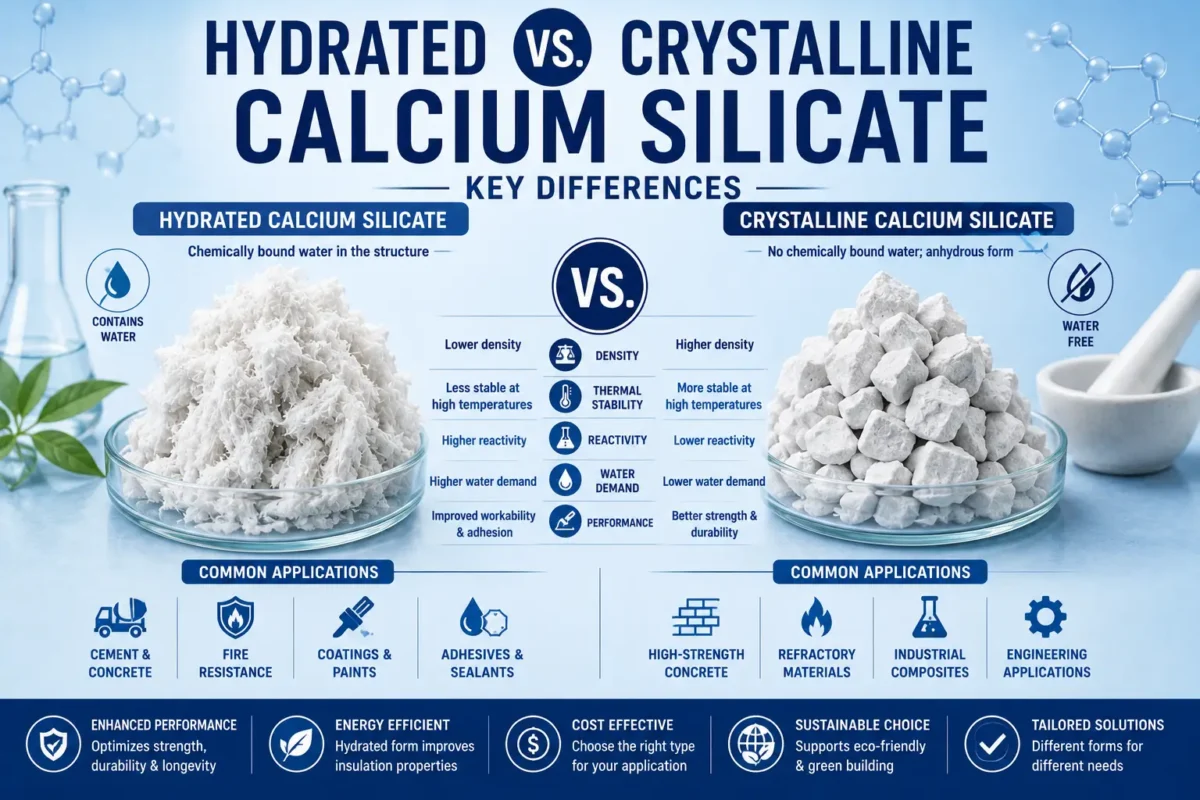
Calcium silicate is not a single compound but a family of related materials built from calcium, silicon, and oxygen. Depending on how it’s formed, calcium silicate can end up as an amorphous, hydrated powder or as an ordered, crystalline structure — and that structural difference changes almost everything about how the material performs, from surface area and absorbency to thermal stability and mechanical strength.

This guide breaks down hydrated vs. crystalline calcium silicate, covering how each form is made, where their properties diverge, and how to choose the right one for your application. Browse Bee Chems’ full Nano Sols and Silicates range to see our calcium silicate grades.

What Is Hydrated Calcium Silicate?

Hydrated calcium silicate is a synthetic, amorphous form of calcium silicate, typically produced through a controlled precipitation reaction between a soluble silicate source and a calcium salt. Because it lacks the ordered lattice structure of crystalline materials, it forms a highly porous, fine particle with a large internal surface area.

This amorphous structure is what gives hydrated calcium silicate its defining characteristics: high water and oil absorption capacity, low bulk density, and small, controllable particle size. It’s also generally considered safer to handle than naturally occurring crystalline forms, precisely because it doesn’t share their fibrous or crystalline particle morphology.

What Is Crystalline Calcium Silicate?

Crystalline calcium silicate refers to forms of the material with a defined, repeating atomic lattice — either occurring naturally (such as wollastonite, a naturally mined calcium silicate mineral) or produced synthetically through hydrothermal or autoclave crystallization processes that grow ordered structures like tobermorite or xonotlite.

Unlike the amorphous hydrated form, crystalline calcium silicate’s ordered structure gives it needle-like or platy particle morphology, greater dimensional stability, and — in engineered board and pipe-insulation products — much higher performance at elevated temperatures.

Hydrated vs. Crystalline Calcium Silicate: Structural Differences

The core distinction comes down to atomic order:

  • Hydrated (amorphous): No long-range order — calcium, silicon, and oxygen atoms are arranged randomly, creating an irregular, highly porous particle structure with a large surface area.
  • Crystalline: A repeating, ordered lattice — atoms are arranged in a fixed, predictable pattern, producing denser, more structurally defined particles (often fibrous or platy) with comparatively lower surface area.

This structural difference is the root cause of nearly every property difference discussed below.

Key Properties of Hydrated and Crystalline Calcium Silicate

Property Hydrated (Amorphous) Crystalline
Particle structure Irregular, porous, amorphous Ordered, fibrous or platy lattice
Surface area High Comparatively lower
Oil/water absorption High Low to moderate
Bulk density Low Higher
Particle size control Fine, tunable during synthesis Determined by crystal growth/mineral form
Typical origin Synthetic precipitation Natural mineral or hydrothermal synthesis


Thermal, Mechanical, and Chemical Properties

Crystalline calcium silicate structures — particularly the tobermorite and xonotlite forms used in insulation manufacturing — offer significantly higher thermal stability, often performing reliably at temperatures well above what amorphous forms can withstand, along with better compressive strength and dimensional stability under load. This is why crystalline calcium silicate boards are a standard choice for high-temperature industrial insulation and fire protection.

Hydrated calcium silicate, by contrast, isn’t engineered for structural or high-temperature performance — its value lies in functional properties: absorption capacity, low density, and fine particle size. It’s chemically stable across normal processing conditions but isn’t intended to bear mechanical load or extreme heat the way crystalline insulation-grade material is.

Applications of Hydrated Calcium Silicate

  • Food additive — anti-caking and moisture-absorbing agent
  • Pharmaceutical products, including antacid formulations and tablet excipients
  • Absorbent for liquids and gases in industrial processes
  • Paints and coatings — as a flatting and anti-settling agent
  • Filler in paper and plastics manufacturing, adding body to the final product
  • Carrier/filler in fertilizers and insecticides

Applications of Crystalline Calcium Silicate

  • High-temperature pipe insulation and insulation boards
  • Fireproof ceilings, fire-rated boards, and ceiling tiles
  • Refractory material in industrial furnaces
  • Friction materials such as brake pads and clutch facings (as an asbestos-free reinforcement)
  • Building materials — bricks, roof tiles, building boards, and some cement/glass formulations

Hydrated vs. Crystalline Calcium Silicate: A Comparison

Factor Hydrated Calcium Silicate Crystalline Calcium Silicate
Structure Amorphous Ordered crystal lattice
Primary role Functional additive (absorbent, anti-caking, filler) Structural/thermal material (insulation, fireproofing)
Thermal performance Not engineered for high heat High-temperature stable
Mechanical strength Low — not load-bearing Higher — used in structural insulation boards
Typical industries Food, pharma, paints, plastics, paper, agriculture Construction, insulation, refractories, friction materials
Handling Generally considered safer due to amorphous, non-fibrous structure Requires standard precautions for fibrous/particulate materials — always check the SDS


How to Choose the Right Calcium Silicate for Your Application

The right choice comes down to what the material needs to do in your application:

  • Choose hydrated calcium silicate if you need a functional additive — an absorbent, anti-caking agent, or filler—where high surface area and fine particle size matter more than structural strength.
  • Choose crystalline calcium silicate if your application involves high-temperature exposure, fire protection, or structural insulation, where the ordered lattice’s thermal and mechanical stability is essential.

Also factor in regulatory requirements (e.g., food-grade or pharmaceutical-grade specifications), particle size and absorption specs, and supply consistency — always confirm the exact grade and specification against your application’s technical data sheet before finalizing a formulation.

You might be interested in: Potassium Silicate in Agriculture

Conclusion

Hydrated and crystalline calcium silicate share a chemical family but serve very different purposes — one is a fine, absorbent, amorphous powder suited to food, pharma, and industrial filler applications; the other is a structurally engineered, high-temperature material built for insulation and fire protection. Understanding which structure your application actually needs is the first step to specifying the right grade.

Frequently Asked Questions

Q1. Is hydrated calcium silicate the same as crystalline calcium silicate?

Ans: No. Both are calcium-silicon-oxygen compounds, but hydrated calcium silicate is amorphous (no ordered structure), while crystalline calcium silicate has a defined, repeating atomic lattice. This structural difference drives most of their property and application differences.

Q2.  Which form of calcium silicate is used in food products?

Ans: Hydrated (amorphous) calcium silicate is the form typically used as a food additive, primarily as an anti-caking and moisture-absorbing agent.

Q3.  Why is crystalline calcium silicate used for insulation instead of hydrated calcium silicate?

Ans: Crystalline calcium silicate’s ordered lattice structure gives it much higher thermal stability and mechanical strength, making it suitable for high-temperature pipe insulation and fireproofing — properties the amorphous hydrated form isn’t engineered to provide.

Q4.  Is hydrated calcium silicate safe to handle?

Ans: Synthetic hydrated calcium silicate is generally considered safer to handle than natural crystalline forms, due to its amorphous, non-fibrous particle structure. As with any industrial material, standard handling precautions apply, and the product-specific Safety Data Sheet (SDS) should always be consulted.

Q5.  Can calcium silicate be produced in different grades?

Ans: Yes. Calcium silicate can be manufactured in industrial, agricultural, and food grades, varying by water/oil absorption capacity, bulk density, particle size, and surface area, depending on the application.

Categories
Nano Sols and Silicates

Potassium Silicate in Agriculture: Benefits and Uses

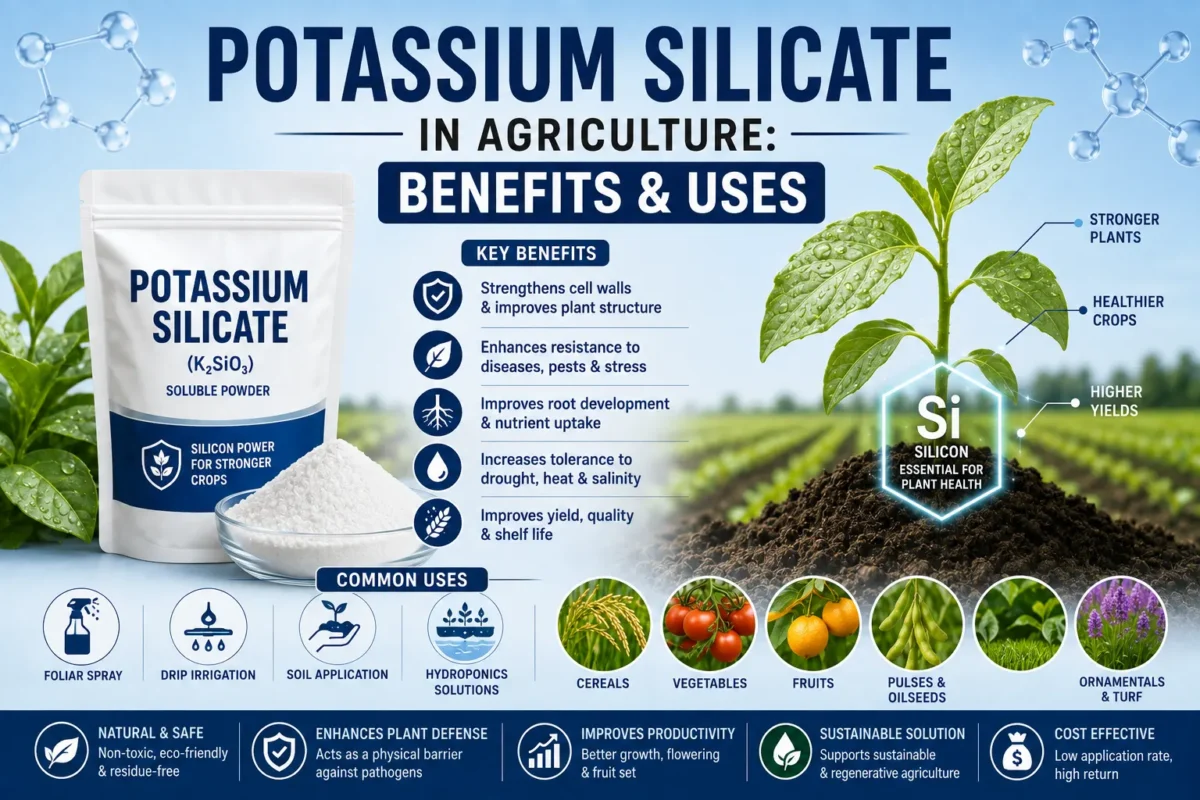
Potassium silicate is used in agriculture as a source of two nutrients at once: potassium, which plants need in large amounts, and soluble silicon, which most soils supply poorly. Applied as a foliar spray or through fertigation, it strengthens cell walls, hardens leaf surfaces against pests and fungal attack, and helps crops hold up under drought, heat and saline conditions. It is used most widely in rice, sugarcane, wheat, horticulture and protected cultivation.

This guide covers how it works in the plant, which crops respond, how it is applied, and how it compares with other silicon sources.

What Is Potassium Silicate?

Potassium silicate is an alkaline salt of potassium and silica, supplied as a clear liquid solution or as a soluble powder. In water it releases potassium ions and monosilicic acid — the only form of silicon a plant root can actually absorb.

That last point matters. Soil is full of silicon, but almost all of it is locked in mineral form that plants cannot take up. Intensive cropping removes plant-available silicon faster than weathering replaces it, which is why silicon deficiency is common in continuously cropped soils even though the element is abundant.

Property Detail
Appearance Clear to slightly hazy liquid, or soluble powder
Supplies Potassium (K₂O) and soluble silica (SiO₂)
Plant-available silicon form Monosilicic acid
Solution character Alkaline
Application methods Foliar spray, fertigation, hydroponic nutrient solution

Why Silicon Matters to Plants

Silicon is not classed as an essential nutrient for most crops, in the sense that a plant can complete its life cycle without it. It is, however, firmly established as a beneficial element, and in several major crops the practical difference is large.

Once absorbed, monosilicic acid moves to the leaves and stems and is deposited as amorphous silica in and around cell walls. That deposition is what produces most of the observed effects.

Stronger cell walls and better standing ability

Silica deposition stiffens stems and leaves. In cereals this shows up as improved standing ability — plants are less prone to lodging under wind, rain or heavy grain load. Leaves also hold a more erect posture, which improves light interception across the canopy.

A physical barrier against pests and disease

The silica layer beneath the leaf cuticle is a mechanical obstacle. Fungal hyphae have to penetrate a hardened surface, and chewing insects meet an abrasive one. This is why silicon application is associated with reduced pressure from diseases such as blast and powdery mildew, and from stem-boring and leaf-feeding insects.

It is a physical mechanism, not a chemical one. Silicon does not act as a fungicide or insecticide — it raises the cost of entry. It supports a crop protection programme; it does not replace one.

Tolerance of drought, heat and salinity

Silicon deposits around stomata and in the leaf epidermis reduce uncontrolled water loss, helping plants maintain turgor under water stress. Under saline conditions, silicon is associated with reduced sodium uptake and transport to the shoot, limiting the damage salt does to photosynthesis.

For growers on marginal or saline-affected land, this is often the reason silicon is applied at all.

Better nutrient balance

Silicon interacts usefully with other nutrients. It is associated with reduced uptake of toxic elements such as aluminium and manganese in acidic soils, and with improved phosphorus availability. The potassium supplied alongside it supports water regulation, enzyme activity and sugar transport in its own right.

Potassium Silicate for Plants: Which Crops Respond

Not every crop takes up silicon to the same degree. Response is strongest in species that accumulate it heavily.

High silicon accumulators — strongest response

  • Rice — the classic silicon-responsive crop. Associated with reduced blast and sheath blight pressure, better standing ability and improved grain filling.
  • Sugarcane — a very heavy silicon remover. Long-term cane soils are frequently silicon depleted.
  • Wheat, barley and other cereals — lodging resistance and foliar disease pressure.

Moderate accumulators — worthwhile response

  • Cucurbits — cucumber, melon, pumpkin. Widely used against powdery mildew pressure.
  • Tomato, chilli, capsicum — protected cultivation especially.
  • Banana and sugar beet

Ornamentals and protected cultivation

Roses, gerbera and other greenhouse ornamentals benefit from sturdier stems and reduced mildew pressure. In hydroponics and soilless media there is effectively no silicon supply at all unless it is added, which makes supplementation more important, not less.

How Potassium Silicate Is Applied

Foliar spray

The most common method. Applied to leaf surfaces, usually at intervals through the vegetative and early reproductive stages. Rates and intervals vary by crop and growth stage, so follow the recommendation supplied with the product.

  • Spray in the cooler part of the day to reduce scorch risk
  • Ensure good coverage of both leaf surfaces
  • Do not exceed the recommended concentration — potassium silicate is alkaline and excessive rates can mark foliage

Fertigation and soil application

Delivered through drip or in irrigation water, giving a steady supply of soluble silicon to the root zone. Suited to sugarcane, banana and protected horticulture where fertigation is already in place.

Hydroponics and soilless media

Added to the nutrient solution. Because inert media supply no silicon, this is where deficiency is most predictable and supplementation most consistently useful.

Compatibility — read this before tank mixing

Potassium silicate is alkaline. Mixing it directly with acidic fertilisers or with calcium and magnesium salts can cause precipitation or gelling, blocking nozzles and wasting product.

  1. Never mix concentrates. Dilute potassium silicate fully before adding anything else.
  2. Keep it away from calcium and magnesium — in hydroponics, dose from a separate tank.
  3. Jar test first. Mix a small sample at field dilution and leave it 30 minutes. If it clouds, thickens or forms solids, do not tank mix.
  4. Check pH after mixing. It will raise solution pH; adjust if your crop needs it lower.

Potassium Silicate Fertilizer vs Other Silicon Sources

Source Silicon availability Speed Also supplies Best suited to
Potassium silicate High — soluble Fast Potassium Foliar, fertigation, hydroponics
Sodium silicate High — soluble Fast Sodium Industrial use; sodium limits agricultural suitability
Calcium silicate / slag Low — slow release Slow Calcium, liming effect Bulk soil correction over seasons
Diatomaceous earth Low Very slow Soil amendment
Rice husk ash Low to moderate Slow Potassium, organic matter Soil building

Why potassium silicate is usually chosen for in-season use: it is immediately plant available, it can go through a sprayer or a drip line, and the potassium it carries is a nutrient the crop wants anyway. Slow-release sources such as calcium silicate are cheaper per unit of silicon but correct soil status over seasons rather than feeding a crop in front of you.

Note that sodium silicate, while chemically similar and widely used in industry, introduces sodium — which is why potassium silicate is the preferred agricultural grade.

Limitations and Good Practice

Silicon is not a rescue treatment. Setting expectations honestly:

  • It is preventive, not curative. The benefit comes from silica deposited in tissue before stress or infection arrives. Applying it to an already-infected crop will not reverse the damage.
  • Response varies by crop. A high accumulator such as rice will show more than a low accumulator.
  • It supplements, it does not replace. Silicon supports a crop protection and nutrition programme rather than substituting for either.
  • Soil silicon status matters. Long-cropped, weathered and sandy soils tend to be most depleted and most responsive.

Where possible, test soil available silicon before planning a programme.

You might be interested in: Lithium Acetate in Organic Synthesis

Potassium Silicate From Bee Chems

Bee Chems manufactures potassium silicate in liquid and powder grades for agricultural and industrial use, and has supplied silicates since 1972. Every consignment is supplied with a certificate of analysis.

If you are planning a silicon programme and are unsure which grade or concentration suits your crop and application method, send us your crop, soil type and delivery method and our technical team will advise.

Conclusion

Potassium silicate in agriculture offers a practical way to combine essential potassium nutrition with the tissue-strengthening, stress-tolerance benefits of silicon in a single, water-soluble input. Whether applied as a foliar spray, through fertigation, or in a hydroponic reservoir, it’s a versatile addition to a modern crop nutrition program.

Looking for the right potassium silicate grade for your application? Talk to our technical team for guidance on grade selection and application rates.

Frequently Asked Questions

Q1. What is potassium silicate used for in agriculture?

Ans: It is used as a combined source of potassium and plant-available silicon. Applied as a foliar spray or through fertigation, it strengthens cell walls, improves standing ability, adds a physical barrier against fungal disease and insect feeding, and helps crops tolerate drought, heat and salinity.

Q2. Is potassium silicate good for plants?

Ans: Yes, particularly for silicon-accumulating crops such as rice, sugarcane, wheat and cucurbits, and in hydroponic systems where no silicon is otherwise supplied. The benefit is preventive, so it is most useful applied before stress or disease pressure arrives.

Q3. How is potassium silicate fertilizer applied?

Ans: Most commonly as a dilute foliar spray during vegetative and early reproductive stages, or through fertigation. In hydroponics it is added to the nutrient solution, dosed separately from calcium and magnesium to avoid precipitation.

Q4. Can potassium silicate be mixed with other fertilisers?

Ans: Not without checking. It is alkaline and can precipitate or gel when mixed with acidic fertilisers or calcium and magnesium salts. Always dilute it fully first, keep it separate from calcium and magnesium, and jar test any intended tank mix at field dilution before spraying.

Q5. Does potassium silicate control pests and diseases?

Ans: It reduces pressure rather than controlling outbreaks. Silica deposited in leaf tissue forms a physical barrier that makes fungal penetration and insect feeding harder. It is not a fungicide or insecticide and should support, not replace, a crop protection programme.

Q6. Which crops benefit most from potassium silicate?

Ans: Rice and sugarcane respond most strongly, followed by other cereals, cucurbits, solanaceous vegetables, banana and greenhouse ornamentals. Hydroponic and soilless crops benefit regardless of species, since those systems supply no silicon on their own

Categories
Uncategorized

Lithium Acetate in Organic Synthesis: Uses, Roles & Applications

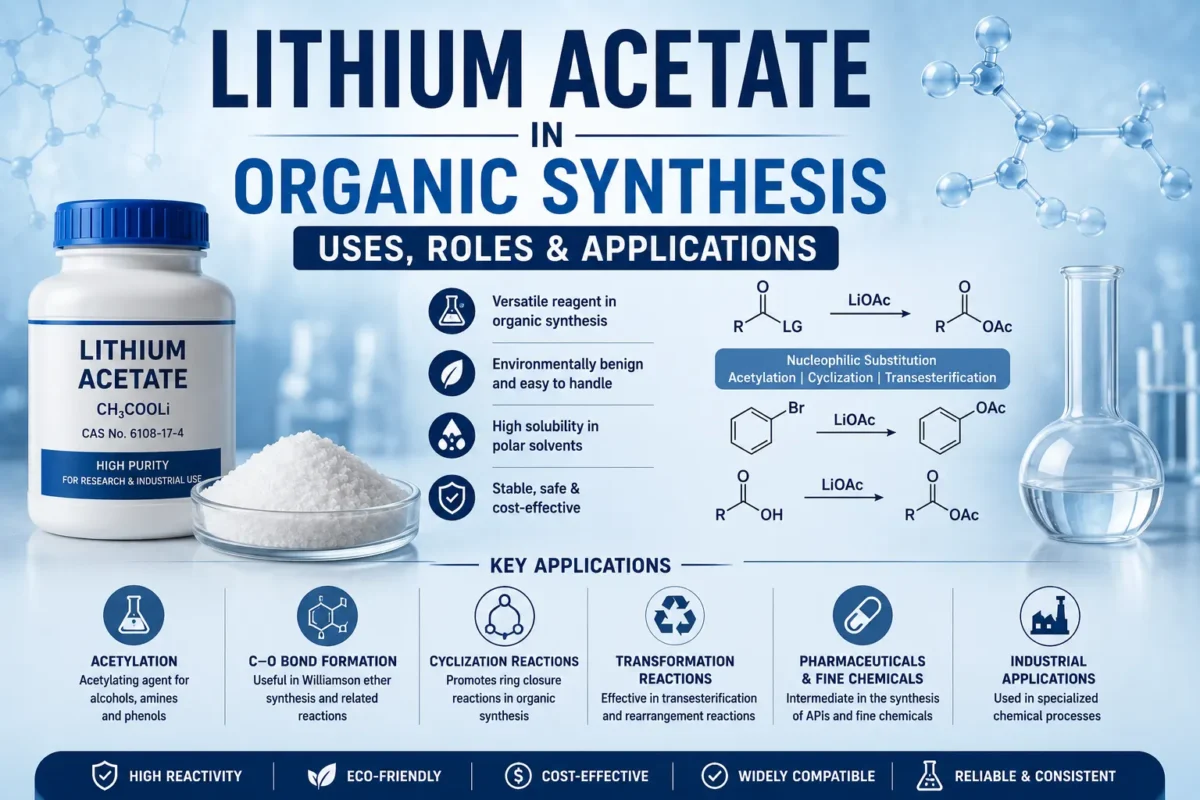
Lithium acetate (LiOAc) is a lithium salt of acetic acid that has applications across chemical synthesis, laboratory research, and industrial chemistry. In organic synthesis, lithium acetate can function as a catalyst, promoter, or reagent depending on the reaction system and desired transformation.

Its relatively mild basic character and compatibility with different reaction conditions make it useful in selected synthetic processes. Research has demonstrated lithium acetate-catalyzed aldol and Michael reactions, while other studies have reported its use as a catalyst in multicomponent organic reactions.

What Is Lithium Acetate?

Lithium acetate is an ionic compound consisting of lithium ions and acetate ions. It is commonly represented by the chemical formula CH₃COOLi or LiOAc. Lithium acetate is available in anhydrous and hydrated forms, including lithium acetate dihydrate.

Commercial chemical references describe lithium acetate and lithium acetate dihydrate as materials used in chemical reactions and as precursors for synthesizing various lithium-based compounds.

Because different applications may require different specifications, users should select the appropriate grade, purity, and hydration state for their intended process.

Why Is Lithium Acetate Used in Organic Synthesis?

Lithium acetate can be useful in organic synthesis because it can participate in reaction pathways as a mild ionic reagent or catalyst. Its role depends strongly on the substrates, solvent, temperature, and reaction mechanism.

Some of the reasons lithium acetate is considered in synthetic chemistry include:

  • Its relatively mild chemical character
  • Its ability to participate in catalytic reaction systems
  • Compatibility with selected organic reaction conditions
  • Availability in different grades and forms
  • Use in specialized synthetic transformations
  • Potential application in multicomponent reactions

Importantly, lithium acetate should not be considered a universal catalyst. Its effectiveness depends on the specific reaction and conditions being used.

Lithium Acetate as a Catalyst

One of the most interesting applications of lithium acetate in organic chemistry is its role as a catalyst or reaction promoter.

Research has demonstrated lithium acetate-catalyzed reactions under specific conditions. For example, lithium acetate has been reported as a catalyst for Michael reactions involving trimethylsilyl enolates and α,β-unsaturated carbonyl compounds.

It has also been investigated as a catalyst in aldol reactions. Studies have reported lithium acetate-catalyzed reactions between aldehydes and trimethylsilyl enolates under weakly basic conditions.

These examples demonstrate that lithium acetate can play an active catalytic role in certain organic transformations rather than serving only as an inorganic salt.

Lithium Acetate in Biginelli Reactions

Lithium acetate has also been investigated as a catalyst for Biginelli-type multicomponent reactions.

A published study reported lithium-acetate-mediated Biginelli synthesis involving aldehydes, 1,3-dicarbonyl compounds, and urea or thiourea. The researchers investigated lithium acetate as a catalyst under both solvent-based and solvent-free conditions.

The study highlights the potential of lithium acetate as a reaction promoter for synthesizing dihydropyrimidinone and related compounds.

This makes lithium acetate relevant to researchers exploring efficient multicomponent synthetic approaches.

Lithium Acetate as a Reagent

Beyond catalytic applications, lithium acetate can also serve as a reagent or chemical precursor in selected synthesis processes.

Its use depends on the chemistry of the target reaction. Lithium acetate can provide lithium and acetate ions to a reaction system and can be used as a starting or precursor material for preparing other lithium-containing compounds.

Commercial chemical references also identify lithium acetate and lithium acetate dihydrate as precursor materials for the synthesis of various lithium-based materials.

Lithium Acetate in Organic Reaction Applications

Lithium acetate has been investigated or used in several areas of synthetic chemistry, including:

1. Aldol Reactions

Lithium acetate can function as a Lewis-base catalyst in selected aldol reactions. Research has shown that lithium acetate can promote reactions between trimethylsilyl enolates and aldehydes under appropriate conditions.

2. Michael Reactions

Lithium acetate has also been reported as a catalyst for Michael reactions involving trimethylsilyl enolates and α,β-unsaturated carbonyl compounds.

3. Biginelli Reactions

Lithium acetate has been studied as a catalyst in Biginelli-type multicomponent synthesis, where it can promote the formation of dihydropyrimidinone derivatives.

4. Halogenation-Related Reactions

Research has also investigated lithium acetate as a catalyst in Hunsdiecker-type reactions. One study compared lithium acetate with other catalysts in the conversion of α,β-unsaturated carboxylic acids to corresponding halo compounds.

5. Synthesis of Lithium-Based Materials

Lithium acetate is also used as a precursor for synthesizing lithium-containing materials. Commercial references list applications involving lithium-based compounds, battery-related materials, and solid-state electrolyte synthesis.

Lithium Acetate vs. Lithium Acetate Dihydrate

Lithium acetate is available in different physical forms, including anhydrous lithium acetate and lithium acetate dihydrate.

The key distinction is the presence of water of crystallization in the dihydrate form. This difference can affect molecular weight, composition, and how the material is calculated or handled in a chemical process.

Therefore, researchers and manufacturers should verify whether an application requires anhydrous lithium acetate or lithium acetate dihydrate before purchasing or preparing a reaction.

Factors to Consider When Choosing Lithium Acetate

Selecting the right lithium acetate depends on the intended application.

Purity and Grade

High-purity material may be important for sensitive laboratory and synthesis applications where trace contaminants can influence reaction performance.

Hydration State

Check whether your process requires anhydrous lithium acetate or lithium acetate dihydrate.

Application Requirements

The appropriate specification can vary between laboratory synthesis, industrial manufacturing, material synthesis, and research applications.

Documentation

For commercial and research applications, documentation such as a Certificate of Analysis (COA), specification sheet, and batch information can help verify product quality.

Benefits of Using Lithium Acetate in Selected Synthetic Processes

Depending on the reaction system, lithium acetate can offer several practical advantages:

  • Useful catalytic activity in selected organic reactions
  • Mild reaction behavior in appropriate systems
  • Application in multiple types of organic transformations
  • Availability in anhydrous and hydrated forms
  • Use as both a reaction component and chemical precursor
  • Applications extending from organic synthesis to advanced material preparation

However, performance should always be evaluated against the specific reaction, substrate, solvent, catalyst loading, and process conditions.

Lithium Acetate for Laboratory and Industrial Applications

Lithium acetate is not limited to organic synthesis. Its applications extend to laboratory research, biotechnology, polymer-related processes, and materials chemistry.

Commercial references identify lithium acetate as a catalyst in selected chemical reactions and as a precursor for lithium-based materials.

This broad application range makes lithium acetate a useful specialty chemical for organizations working across research, synthesis, and manufacturing.

How to Choose a Lithium Acetate Supplier

When sourcing lithium acetate for research or industrial use, consider:

  • Required purity and grade
  • Anhydrous or dihydrate form
  • Consistency between batches
  • Product specifications
  • COA availability
  • Packaging options
  • Technical support
  • Supply reliability
  • Application-specific requirements

For demanding synthesis and manufacturing processes, consistent product quality can be just as important as the nominal purity specification.

Frequently Asked Questions About Lithium Acetate

What is lithium acetate used for in organic synthesis?

Lithium acetate can be used as a catalyst, promoter, reagent, or precursor in selected organic synthesis processes. Its reported applications include aldol, Michael, Biginelli, and other specialized reactions.

Is lithium acetate a catalyst or a reagent?

It can serve different roles depending on the reaction. In some organic reactions, lithium acetate acts as a catalyst or promoter, while in other applications it functions as a reagent or precursor.

What is the difference between lithium acetate and lithium acetate dihydrate?

Lithium acetate dihydrate contains two molecules of water of crystallization per formula unit, whereas anhydrous lithium acetate does not. This difference affects molecular weight and how the compound is used in quantitative chemical processes.

Is lithium acetate used in Biginelli reactions?

Yes. Published research has investigated lithium acetate as a catalyst for Biginelli-type multicomponent synthesis.

Is lithium acetate used in aldol reactions?

Yes. Lithium acetate has been reported as a catalyst for selected aldol reactions involving trimethylsilyl enolates and aldehydes.

Is lithium acetate used in Michael reactions?

Yes. Research has reported lithium acetate-catalyzed Michael reactions involving trimethylsilyl enolates and α,β-unsaturated carbonyl compounds.

How should lithium acetate be selected for organic synthesis?

Consider the required purity, grade, hydration state, reaction requirements, packaging, and available quality documentation. The appropriate specification depends on the intended synthesis or industrial process.

Conclusion

Lithium acetate is a versatile specialty chemical with applications that extend beyond laboratory use. In organic synthesis, it has been investigated as a catalyst or promoter in several reactions, including aldol, Michael, Biginelli, and other specialized transformations.

Its use as a precursor for lithium-based materials further expands its relevance to chemical and materials research. Choosing the appropriate grade, purity, and hydration state is important for obtaining consistent results.

For researchers and manufacturers sourcing lithium acetate, evaluating product specifications, quality documentation, and supplier reliability can help ensure that the material is appropriate for the intended application.

Categories
Uncategorized

Oxygen Absorbers for Food Packaging: Types & Uses

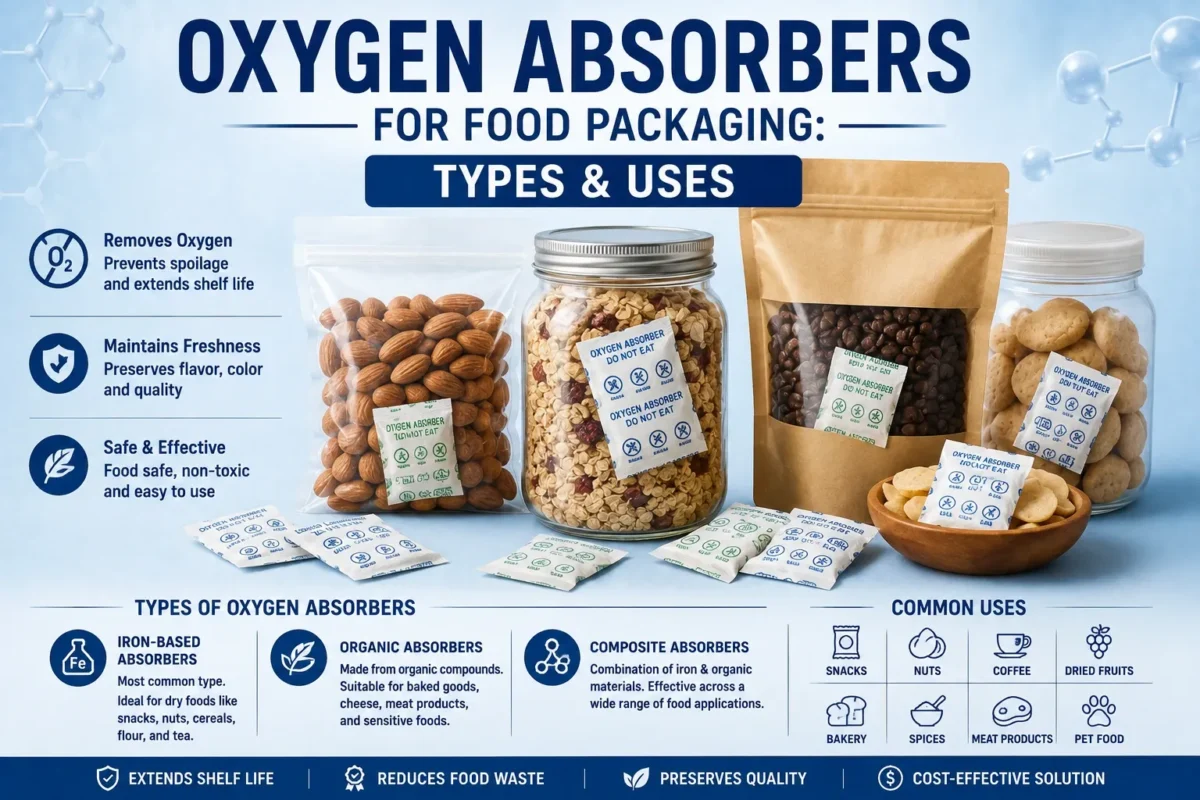
Oxygen absorbers are active packaging sachets that chemically remove residual oxygen trapped inside a sealed package. Removing that oxygen — rather than just slowing it down — is what protects packaged food from oxidation, spoilage, discoloration, and flavor loss over its shelf life.

By pulling the internal oxygen level down from roughly 21% (normal air) to well under 1%, oxygen absorbers help maintain freshness and support longer shelf life during storage and transportation, particularly for dry and semi-dry foods where oxidation is the main quality-loss pathway.

What Are Oxygen Absorbers?

An oxygen absorber is a small sachet, most commonly containing iron powder, sealed inside a permeable packet. Once placed inside a sealed package, the iron reacts with the surrounding oxygen — oxidizing, essentially rusting — and in doing so consumes that oxygen rather than simply blocking new oxygen from entering. This is a meaningfully different mechanism from a barrier film, which only stops new oxygen getting in and does nothing about the oxygen already trapped inside at the moment of sealing.

How Do Oxygen Absorbers Work?

The iron-oxidation reaction inside the sachet consumes oxygen molecules from the package headspace until the internal oxygen concentration drops to a fraction of a percent. This matters because oxidation is what drives most quality loss in packaged dry food: rancid fats and oils, faded color in spices, stale flavor in coffee and snacks, and conditions that favor mould and some bacteria.

A correctly functioning iron-based absorber typically feels slightly warm to the touch shortly after sealing — that is the oxidation reaction in progress, and it is the most reliable everyday sign it has activated.

Types of Oxygen Absorbers for Packaging

Not every oxygen absorber is built the same way, and picking the right type matters as much as picking the right size.

1. Iron-Based (Ferrous) Absorbers

The standard type used across most food packaging — effective, low-cost, and available in a full range of capacities. This is the default choice unless a specific constraint on the packaging line rules it out.

2. Non-Ferrous (Metal-Detectable-Safe) Absorbers

Formulated without iron powder specifically so they will not trigger a metal detector on a production line. Any facility running packaged food through in-line metal detection as a food-safety check needs this type — an iron-based sachet on a metal-detected line causes false-positive rejections and line stoppages.

3. Self-Adhesive Absorbers

Supplied with an adhesive backing so they can be stuck to the inside of a lid or package wall instead of sitting loose. Useful where a loose sachet could be mistaken for product, could shift during transport, or is impractical to drop in by hand on a fast packaging line.

Absorbers are also classified by speed of reaction: fast-acting for packages that need oxygen pulled down quickly after sealing, and slower, self-indicating variants used where a visual color-change tab is wanted to confirm the absorber is still active.

Uses of Oxygen Absorbers in Food Packaging

a. Dry Foods

Grains, pulses, dried fruit, and other dehydrated products use oxygen absorbers to extend storage life and guard against insect activity, which needs oxygen to survive.

b. Coffee and Tea

Coffee and tea contain volatile aromatic compounds that degrade quickly on oxygen exposure. Oxygen absorbers protect these flavor compounds far more completely than a one-way valve alone, since the valve only manages degassing, not the oxygen already sealed in at packing.

c. Bakery Products

Low-moisture baked goods use oxygen absorbers to protect texture and prevent mould, particularly in shelf-stable packaged formats sold without refrigeration.

d. Pet Food

Pet food shares the same oil-oxidation risk as human snack foods, so oxygen absorbers extend shelf life and prevent rancidity in the fats used in most formulations.

e. Nutraceutical and Pharmaceutical Packaging

Beyond food, the same mechanism protects oxygen-sensitive ingredients in nutraceutical and pharmaceutical packaging, supporting product stability during storage and transportation.

Benefits of Oxygen Absorbers for Food Packaging

Extended Shelf Life

Removing residual oxygen slows the oxidation reactions that are the primary cause of quality loss in packaged dry food, directly extending how long a product stays sellable.

Protection Against Oxidation

Because the absorber removes oxygen rather than merely reducing exposure to it, protection continues for the sachet’s full working capacity, not just until the package is opened.

Flavor and Aroma Retention

Volatile flavor and aroma compounds in products like coffee, tea, and spices oxidize and fade over time; removing oxygen from the package slows that loss.

Improved Product Appearance

Oxidation is a common cause of discoloration — browning in dried fruit, fading in spices — so removing oxygen helps packaged products look closer to fresh for longer.

Better Storage Stability

Lower oxygen levels reduce the rate of quality degradation across long storage and distribution chains, which matters most for products that spend weeks or months between packing and sale.

How to Choose the Right Oxygen Absorber Size

Absorber capacity is rated in cubic centimeters (cc) of oxygen absorbed — a 100cc absorber can absorb 100cc of oxygen over its working life. Sizing is the step buyers most often get wrong: an oversized absorber wastes money, an undersized one leaves the product under-protected for the second half of its shelf life. A larger absorber is not automatically better — capacity should be matched to the package’s actual oxygen-removal requirement, based on:

  • Package headspace — the volume of empty air inside the sealed package
  • Product type — some products (e.g. baked goods) release a small amount of gas over time, which the absorber needs spare capacity to handle
  • Packaging material’s oxygen transmission rate — a less oxygen-tight film lets in more oxygen over the shelf life, increasing the required capacity
  • Storage conditions and desired shelf-life period — longer shelf life and less controlled storage both call for more capacity

For commercial applications, working with a manufacturer or supplier can help confirm the appropriate capacity for your exact packaging system. Bee Chems provides technical support for selecting oxygen absorber capacity by application — reach out with your package volume and target shelf life.

How to Use Oxygen Absorbers Correctly

  1. Keep the master bag sealed until the moment of use. Absorbers activate on contact with air, so the bulk packaging is itself sealed to keep them inert until needed.
  2. Work quickly once the master bag is open. Every absorber left out is absorbing oxygen from the room, not from your product.
  3. Drop the absorber in immediately before sealing, not before the product is fully loaded — it should be one of the last things placed in the package.
  4. Reseal the master bag tightly right after removing what is needed for that batch.
  5. Seal the final package promptly after the absorber goes in.
  6. Don’t handle absorbers with wet hands or let them contact liquid — most formulations need to stay dry to function and are not designed to contact food directly.

Storage & Handling of Unused Oxygen Absorbers

  • Store unopened master bags in a cool, dry place, away from direct heat and humidity, until needed.
  • Once opened, use the remaining absorbers within the window your supplier specifies — commonly minutes to a couple of hours, not days, since the whole bag begins absorbing ambient oxygen as soon as it’s open.
  • If a partial bag won’t be used soon, reseal it as airtight as possible rather than leaving it loosely folded over.
  • Treat a bag that feels warm or has visibly changed color before use as compromised — that’s a sign it activated prematurely and has already used up part of its capacity.

Common Mistakes to Avoid

  • Sizing by package weight alone, ignoring headspace — two packages of equal weight can have very different air volumes.
  • Leaving the master bag open on a production line for extended periods, quietly draining capacity from every absorber left inside.
  • Mixing absorber types across a product line without checking whether metal-detectable-safe absorbers are required.
  • Assuming one absorber size fits every SKU in a product range — that optimizes for the supplier’s inventory, not your shelf life.
  • Not accounting for products that release gas themselves, such as some baked or fermented items, which need extra capacity beyond the headspace oxygen alone.

You might be interested in: Lithium Bromide vs Lithium Chloride

Oxygen Absorbers vs. Desiccants

An oxygen absorber removes oxygen; a desiccant removes moisture. A product failing from rancidity and color loss has an oxidation problem and needs an oxygen absorber. A product failing from clumping, mould, or sogginess has a moisture problem and needs a desiccant. Some products need both, run side by side in the same package rather than as a substitute for each other.

Why Choose Bee Chems Oxygen Absorbers?

Bee Chems has manufactured specialty chemicals from its Kanpur facility since 1972, and supplies oxygen absorbers built for consistent performance across food, pharmaceutical, and industrial packaging. The range covers multiple packet sizes and capacities, food-grade formulations, and customized packaging options, backed by technical support to help identify the right type and capacity for a specific product and shelf-life target.

Get the Right Oxygen Absorber for Your Application

Share your package volume, product type, and target shelf life, and Bee Chems will help identify the right absorber type and capacity rather than leaving it to guesswork. Enquire now or browse the full oxygen absorbers range.

Frequently Asked Questions

Q1. What are oxygen absorbers used for in food packaging?

Ans: They remove residual oxygen from sealed packaging to prevent oxidation, spoilage, discoloration, and flavor loss, extending shelf life for dry and semi-dry foods.

Q2. How do oxygen absorbers work?

Ans: Most contain iron powder that oxidizes on contact with air, chemically consuming the oxygen trapped inside the sealed package rather than just blocking new oxygen from entering.

Q3. What foods can use oxygen absorbers?

Ans: Grains, pulses, dried fruit, nuts, coffee, tea, bakery products, snacks, pet food, and confectionery all commonly use oxygen absorbers to slow oxidation-driven quality loss.

Q4. How do I choose the right oxygen absorber size?

Ans: Size is rated in cc of oxygen absorbed and depends on package headspace, product type, the packaging material’s oxygen transmission rate, and target shelf life. Round up to the next standard capacity rather than down — see the sizing guide above for reference ranges and a worked example.

Q5. Do oxygen absorbers extend shelf life?

Ans: Yes. By removing the oxygen that drives rancidity, discoloration, and flavor loss, they extend how long a packaged product remains at sellable quality.

Q6. Are oxygen absorbers and desiccants the same?

Ans: No. Oxygen absorbers remove oxygen; desiccants remove moisture. They solve different preservation problems and are sometimes used together in the same package.

Q7. Where can I buy oxygen absorbers in bulk?

Ans: Directly from a manufacturer offering multiple capacities and customized packaging options. Contact Bee Chems with your package volume, product type, and target shelf life.

Q8. Can oxygen absorbers be customized?

Ans: Yes. Custom packet dimensions, absorption capacities, and packaging configurations can be selected according to product and packaging requirements.

Q9. How long can the master bag stay open before the absorbers lose effectiveness?

Ans: Typically only a short window — minutes to a couple of hours depending on the product — since the whole bag starts absorbing ambient oxygen the moment it’s opened. Reseal unused absorbers as airtight as possible if they won’t be used immediately.

Q10. How do I know if an oxygen absorber is actually working?

Ans: It should feel slightly warm shortly after sealing — that’s the oxidation reaction in progress. Self-indicating types show a visible color change on an included tab.


Categories
General

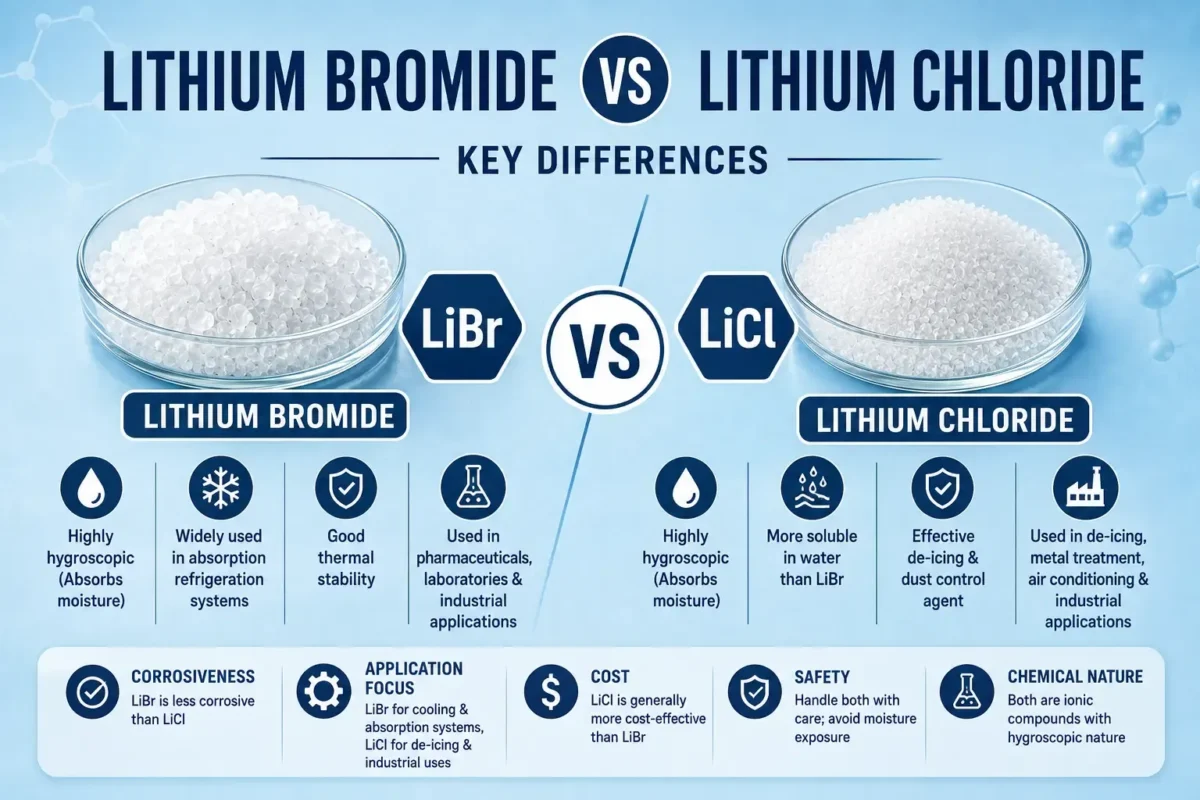
Lithium Bromide vs Lithium Chloride: Key Differences

Lithium bromide and lithium chloride sit next to each other on the shelf, share the same lithium cation, and are both prized for one property: an extraordinary appetite for water. That similarity is exactly why they get confused — and why substituting one for the other can quietly wreck a system’s performance.

The short version: lithium bromide is the absorption-chiller salt, and lithium chloride is the desiccant-and-electrolysis salt. They overlap in moisture control, but their solubility, cost and chemistry push them toward genuinely different jobs.

This guide breaks down the difference between lithium bromide and lithium chloride — properties, mechanism, cost, applications, and a decision framework for choosing between them. Browse our full Lithium Salts & Solutions range to see the grades we manufacture.

Lithium Bromide: Properties and Primary Role

Lithium bromide (LiBr) is an inorganic salt formed from lithium and bromine — a white crystalline solid that is among the most hygroscopic materials in common industrial use. Its defining commercial characteristic is exceptionally high water solubility, which lets it form very concentrated aqueous solutions that remain stable and pumpable.

That single property is what built its industry: lithium bromide is the working absorbent in vapour absorption machines (VAMs), the chillers that produce cooling from waste heat, steam or direct-fired gas instead of from electrically driven compressors.

Key Characteristics of Lithium Bromide

  • Chemical formula LiBr, CAS 7550-35-8, molar mass 86.85 g/mol
  • Melting point approximately 552 °C
  • Very high water solubility — roughly 167 g per 100 mL at 20 °C, about twice that of lithium chloride
  • Extremely hygroscopic; forms stable, highly concentrated brines
  • Usually supplied as a solution at a specified concentration rather than as a dry solid
  • Corrosive to common metals in solution, so inhibited formulations are standard
  • Available from Bee Chems in multiple concentrations and custom packaging

Lithium Chloride: Properties and Primary Role

Lithium chloride (LiCl) is the chloride analogue — also a white crystalline solid, also strongly hygroscopic, and highly soluble in water as well as in alcohol and ether. It is produced by reacting a lithium base such as lithium carbonate or lithium hydroxide with hydrochloric acid.

Where lithium chloride differs is breadth. It is not tied to one flagship application. It serves as a liquid and solid desiccant, as a brazing flux constituent, as the electrolyte for producing lithium metal, and as a laboratory reagent — a wider but shallower footprint than lithium bromide’s.

Key Characteristics of Lithium Chloride

  • Chemical formula LiCl, CAS 7447-41-8, molar mass 42.39 g/mol
  • Melting point approximately 610 °C — notably higher than lithium bromide
  • High water solubility — roughly 85 g per 100 mL at 20 °C
  • Strongly hygroscopic; forms stable complexes with water
  • Supplied in solid form (anhydrous LiCl or hydrous LiCl·H₂O) and as an aqueous solution
  • Lower molar mass means more moles of salt per kilogram purchased
  • Available from Bee Chems in solid and aqueous grades

Difference Between Lithium Bromide and Lithium Chloride

Feature Lithium Bromide Lithium Chloride
Chemical formula LiBr LiCl
CAS number 7550-35-8 7447-41-8
Molar mass 86.85 g/mol 42.39 g/mol
Melting point ~552 °C ~610 °C
Water solubility (20 °C) ~167 g/100 mL — roughly double ~85 g/100 mL
Typical supplied form Aqueous solution at specified concentration Solid (anhydrous or hydrous) and aqueous solution
Flagship application Vapour absorption chillers and refrigeration Desiccant dehumidification, brazing flux, lithium metal electrolysis
Relative cost per kg Higher — bromine is costlier than chlorine Lower
Suitability for molten-salt electrolysis Not used for lithium metal production Standard electrolyte, typically in a LiCl/KCl bath
Key operational risk Crystallisation in chiller circuits if concentration or temperature limits are exceeded Caking and moisture pickup if containers are left open
Breadth of use Narrow and deep — dominated by absorption cooling Broad — cooling, drying, metallurgy, electronics, laboratory

How They Work: Moisture Absorption Explained

Both salts work by the same underlying physics. A concentrated solution of either has a water vapour pressure well below that of the surrounding air. Expose the solution to a humid air stream or a low-pressure water vapour space, and water migrates out of the vapour phase and into the brine, because vapour always moves from higher to lower vapour pressure. Neither salt is consumed in the process — the diluted brine is regenerated with heat, driving the absorbed water back off so the solution can be recirculated.

The difference lies in how far you can push the concentration. Lithium bromide’s much higher solubility means it can be run as a far more concentrated brine before crystals begin to drop out. A more concentrated brine means a lower vapour pressure, and a lower vapour pressure means the salt can pull water vapour down to the very low pressures that an absorption chiller’s evaporator needs in order to boil water at around 4–6 °C and produce useful chilled water. Lithium chloride simply saturates too early to hit those conditions efficiently.

Run the comparison in a liquid desiccant dehumidifier instead, and the calculus flips. There you are stripping moisture from air at ordinary atmospheric pressure, not chasing a deep vacuum. Lithium chloride’s solubility is entirely sufficient for that duty — so the deciding factor becomes cost per kilogram, and the cheaper chloride wins.

In lithium metal production the mechanism is different again and moisture is irrelevant. Molten lithium chloride, usually blended with potassium chloride to lower the operating temperature, acts as the electrolyte in an electrolytic cell: current through the molten bath reduces lithium ions to lithium metal at the cathode while chlorine is released at the anode. Lithium bromide has no role here.

Selecting the Right Salt for Your Duty

There is no universal winner. The right salt depends entirely on the duty.

Choose Lithium Bromide When:

  • You are charging, topping up or replacing the absorbent in a vapour absorption chiller or absorption refrigeration system
  • The application requires water vapour pressure driven very low, beyond what a chloride brine can reach
  • You need a very highly concentrated brine that stays stable without crystallising
  • The system was engineered around lithium bromide — its heat exchangers, inhibitor package and control limits are all specified for that salt
  • You are working in heat transfer or heat-recovery processes built on absorption cycles

Choose Lithium Chloride When:

  • You need a liquid or solid desiccant for dehumidification and industrial drying at atmospheric pressure
  • Cost per kilogram matters and the duty does not demand bromide-level solubility
  • You need an electrolyte for lithium metal production by molten-salt electrolysis
  • The application is a brazing flux or brazing bath, where the chloride dissolves surface oxides so filler metal wets cleanly
  • You are working in photovoltaic cell manufacturing, laboratory synthesis, or as a general drying agent
  • You need the salt as a dry solid rather than a solution

A practical warning worth stating plainly: do not substitute one for the other in an absorption chiller. The machine’s corrosion inhibitor package, crystallisation margins and heat-exchanger design are all matched to lithium bromide. Charging a chloride brine instead will cost you capacity and can damage the plant.

Recommended Salt by Application

Application Preferred Salt Why
Vapour absorption chillers Lithium bromide Only its solubility supports the concentration needed for deep vacuum operation
Absorption refrigeration Lithium bromide Established working fluid with proven cycle performance
Heat transfer & heat recovery systems Lithium bromide Suits absorption-cycle thermodynamics
Liquid desiccant dehumidification Lithium chloride Sufficient solubility at far lower cost
Industrial drying & moisture control Either — commonly lithium chloride Chloride is more economical unless the system specifies bromide
Brazing fluxes and brazing baths Lithium chloride Dissolves surface oxides for clean filler-metal flow
Lithium metal production Lithium chloride Standard molten-salt electrolyte, typically LiCl/KCl
Photovoltaic cell manufacturing Lithium chloride Established in solar materials processing
Laboratory reagent & drying agent Lithium chloride Widely available in high-purity solid grades

Storage and Handling Guidelines

Both salts are handled under broadly similar precautions, and both share one practical hazard rooted in the property that makes them useful — they will pull water out of the air given any opportunity.

  • Keep containers sealed. Both are strongly hygroscopic and will absorb atmospheric moisture, causing caking in solids and dilution in solutions. Close containers between uses and store in a dry area.
  • Expect corrosivity in solution. Lithium bromide brines in particular are corrosive to common metals, which is why absorption systems run an inhibitor package — typically based on salts such as lithium nitrate or lithium molybdate — and exclude oxygen from the circuit. Bee Chems supplies lithium nitrate and other lithium derivatives for exactly this kind of formulation work.
  • Use standard PPE. Gloves and eye protection when handling concentrated product; avoid prolonged skin contact and avoid breathing mist when spraying or transferring.
  • Treat lithium salts as systemically toxic if ingested. These are industrial chemicals, not food-grade materials, and lithium compounds carry real toxicity on ingestion. Never use either as a salt substitute or allow contamination of food-contact surfaces.
  • Check the SDS for your specific grade. Concentrations and inhibitor packages vary, and the Safety Data Sheet for the exact product you receive is the authority on handling, storage and disposal.

Why Choose Bee Chems for Lithium Bromide & Lithium Chloride

Bee Chems has manufactured specialty chemicals from its Kanpur plant since 1972, and one advantage of that is straightforward: we make both salts, so the recommendation you get is not shaped by what happens to be in stock.

We supply lithium bromide in customised concentrations with packaging to suit, and lithium chloride in anhydrous, hydrous and aqueous grades, packed in 25/50 kg poly-lined drums, 250 kg HDPE barrels and 1000 L IBC tote tanks. Alongside them we produce lithium hydroxide, lithium acetate, lithium silicate, lithium fluoride, lithium nitrate and other derivatives — so a single enquiry can cover the whole lithium side of your formulation.

Behind that sits an in-house general and R&D laboratory used for in-process quality control, over five decades of product development experience, and more than 200 regular customers across sectors from pharma and oil to electronics and paints. If you are unsure which salt your duty calls for, tell us the application and we will advise before you order. Request a quote →

Conclusion

Lithium bromide and lithium chloride are close chemical cousins that have specialised into different roles. Lithium bromide’s roughly double solubility lets it form the ultra-concentrated brines that absorption chillers depend on, and that is where nearly all of it goes. Lithium chloride is cheaper, available as a dry solid, higher-melting, and consequently far more versatile — the salt of choice for desiccant dehumidification, brazing fluxes, lithium metal electrolysis and laboratory work.

Match the salt to the duty rather than to the price list, and never swap one for the other in equipment engineered around a specific absorbent. For a deeper look at where the chloride is used, see our guide to the top 7 applications of lithium chloride.

Frequently Asked Questions

Q1. What is the main difference between lithium bromide and lithium chloride?
Ans: Solubility and application. Lithium bromide dissolves in water roughly twice as readily as lithium chloride, which lets it form the ultra-concentrated brines that vapour absorption chillers require. Lithium chloride is cheaper, available as a dry solid, and used mainly for desiccant dehumidification, brazing fluxes and lithium metal production.

Q2.  Can lithium chloride replace lithium bromide in an absorption chiller?
Ans: No. The machine’s crystallisation margins, corrosion inhibitor package and heat-exchanger design are all specified for lithium bromide. A chloride brine cannot reach the required concentration and vapour pressure, so you would lose cooling capacity and risk damaging the plant.

Q3.  Which is more expensive, lithium bromide or lithium chloride?
Ans: Lithium bromide is generally more expensive per kilogram, because bromine is a costlier raw material than chlorine. Where a duty does not require bromide-level solubility, lithium chloride is usually the more economical choice.

Q4.  Which one is more hygroscopic?
Ans: Both are strongly hygroscopic. In practice lithium bromide is the more aggressive absorbent because its far higher solubility allows a much more concentrated solution, and it is concentration that drives the vapour-pressure difference doing the work.

Q5.  Why is lithium bromide used in absorption chillers instead of lithium chloride?
Ans: An absorption chiller has to pull water vapour down to a very low pressure so that water boils at around 4–6 °C in the evaporator. Reaching that requires an extremely concentrated brine with a very low vapour pressure. Lithium bromide’s solubility supports that concentration; lithium chloride saturates too early.

Q6.  Do both salts need corrosion inhibitors?
Ans: Both are corrosive to common metals in solution, but inhibitor packages are most critical in lithium bromide absorption systems, which run inhibitors such as lithium nitrate or lithium molybdate and exclude oxygen from the circuit to protect the equipment over long service life.

Q7.  Does Bee Chems supply both lithium bromide and lithium chloride?
Ans: Yes. We manufacture both, along with lithium hydroxide, lithium acetate, lithium silicate, lithium fluoride and lithium nitrate. Share your application, required concentration or form, and quantity, and we will recommend the appropriate grade and quote accordingly.

Categories
Uncategorized

Silica Gel vs Molecular Sieve: Which Is Better?

When it comes to controlling moisture — in packaging, industrial gas streams, insulated glass units, or storage tanks — two desiccants dominate the market: silica gel and molecular sieve. They’re often used interchangeably in casual conversation, but they’re chemically different materials with distinct adsorption behavior, and choosing the wrong one can mean under-performing moisture control or unnecessary cost.

This guide breaks down the difference between silica gel and molecular sieve, how each one actually works, where each performs best, and how to decide which is the right desiccant for your application. Browse our full Adsorbents, Absorbents & Desiccants range to see all the grades we manufacture.

What Is Silica Gel?

Silica gel is an amorphous, porous form of silicon dioxide (SiO₂) manufactured to have a highly porous internal structure. It’s not actually a “gel” in the everyday sense — it’s a rigid, granular solid with a network of microscopic pores that give it an enormous internal surface area (roughly 700–800 m² per gram), which is what allows it to physically adsorb water vapor from the surrounding air.

Key Characteristics of Silica Gel

  • Amorphous (non-crystalline) structure with a broad, uneven pore-size distribution
  • Adsorbs moisture efficiently at ambient temperature and relative humidity above ~40%
  • Available in white/regular (e.g. Bee Chems’ Sorbogel® Silica Gel), and indicating grades — Silica Gel Blue and cobalt-free Silica Gel Orange
  • Low cost and widely available in beads or granules
  • Common in packaging, electronics, pharmaceuticals, and general shipping/storage applications

What Is Molecular Sieve?

Molecular sieve is a synthetic crystalline zeolite — an aluminosilicate mineral structure engineered to have a highly uniform pore diameter, unlike the irregular pores of silica gel. Because every pore is essentially the same size, molecular sieves don’t just adsorb by surface area — they adsorb selectively, letting molecules smaller than the pore diameter in while excluding larger ones. This is literally where the name comes from: it “sieves” molecules.

Key Characteristics of Molecular Sieve

  • Crystalline structure with a precise, uniform pore size (commonly 3Å, 4Å, 5Å, or 13X grades — see Bee Chems’ Molcat™ Molecular Sieves)
  • Adsorbs moisture down to very low residual levels, even at low humidity and elevated temperature
  • Can selectively separate specific gas molecules, not just water
  • Higher cost than silica gel due to more complex manufacturing
  • Common in natural gas dehydration, cryogenic air separation, insulated glass units, and refrigerant drying

Difference Between Silica Gel and Molecular Sieve

Feature Silica Gel Molecular Sieve
Structure Amorphous SiO₂ with irregular pore sizes Crystalline zeolite with uniform, precise pore size
Adsorption mechanism Physical adsorption based on surface area Selective adsorption based on molecular size (“sieving”)
Effective humidity range Best above ~40% RH Effective even at very low humidity (<10% RH)
Operating temperature Performs best at ambient temperature; loses capacity as temperature rises Retains strong adsorption capacity even at elevated temperatures
Moisture capacity High total capacity at high humidity Lower total capacity, but achieves much lower final dew points
Selectivity Non-selective — adsorbs based on pore size distribution only Selective — can separate specific molecules (e.g., water vs. hydrocarbons)
Regeneration Regenerates at relatively low temperatures (~120°C) Requires higher regeneration temperatures (~200–300°C)
Cost Lower Higher
Typical use case Packaging, electronics, general shipping desiccants, humidity indicators Natural gas dehydration, insulated glass, cryogenic/PSA gas separation, refrigerant drying

How They Work: Adsorption Mechanism Explained

Both materials are physical adsorbents — they trap water molecules on their internal surface rather than reacting chemically with them (unlike a chemical desiccant such as calcium chloride, e.g. Bee Chems’ Calcium Chloride Desiccant). But the mechanism differs in an important way:

  • Silica gel relies purely on surface area and capillary condensation within its irregular pore network. It picks up moisture readily when humidity is moderate-to-high, but its adsorption capacity drops off sharply as relative humidity falls, because there isn’t enough vapor pressure to drive water into the pores efficiently.
  • Molecular sieve relies on strong electrostatic interactions within its uniform crystal lattice, plus its precise pore geometry. This lets it continue pulling water molecules out of the air even when very little moisture is present — which is exactly why it’s the material of choice when you need to hit very low dew points (e.g., -60°C or lower) rather than just “dry.”

Which Is Better? A Decision Guide

There’s no universal winner — the right choice depends entirely on the application:

Choose Silica Gel When:

  • You need a cost-effective, general-purpose desiccant for packaging or storage
  • Ambient relative humidity is moderate to high
  • You need a visual humidity indicator (blue/orange indicating grades)
  • The application doesn’t require extremely low residual moisture levels

Choose Molecular Sieve When:

  • You need to achieve very low dew points or trace-level moisture removal
  • Operating conditions involve low humidity, high temperature, or high pressure
  • You need selective separation (e.g., removing water without removing other gases, or vice versa)
  • The application is industrial gas drying, cryogenic separation, insulated glass, or refrigerant systems

In many industrial dehydration systems, both are actually used together — silica gel or activated alumina as a bulk-moisture pre-drying stage, followed by molecular sieve as a polishing stage to hit ultra-low final moisture specs (see our Activated Alumina vs Molecular Sieve comparison for how that third material fits in). This layered approach balances cost with performance.

Applications at a Glance

Application Preferred Desiccant Why
Product packaging & shipping Silica gel Cost-effective, sufficient for ambient humidity control
Pharmaceutical & electronics packaging Silica gel Low cost, effective at typical storage humidity
Insulated glass (IGUs) Molecular sieve Must perform across wide temperature swings without releasing moisture
Natural gas dehydration Molecular sieve Needed to hit pipeline-spec dew points
Compressed air drying Molecular sieve or silica gel (staged) Depends on required final dew point
Cryogenic air separation Molecular sieve Removes both moisture and CO₂ to prevent freezing in cryogenic equipment
Refrigerant/AC systems Molecular sieve Must dry refrigerant to very low moisture levels without degrading at operating temperature

Safety & Handling

Both silica gel and molecular sieve are generally regarded as low-hazard, inert solids, but a few handling notes apply:

  • Dust exposure: Fine dust from either material can cause mild respiratory or eye irritation; use standard dust masks and eye protection when handling bulk/loose material.
  • Not for consumption: Standard desiccant packets are marked “do not eat” — while non-toxic in small amounts, they are a choking hazard and not intended for ingestion.
  • Indicating silica gel: Older orange-indicating silica gel used cobalt chloride, which is classified as a carcinogen in some regulations — Bee Chems’ Silica Gel Orange is cobalt-free; check the SDS if this matters for your application.
  • Regeneration handling: Both materials release absorbed moisture as steam during thermal regeneration — ensure adequate ventilation and follow equipment-specific procedures.
  • Storage: Store in sealed, moisture-proof packaging until use; both materials will begin adsorbing ambient moisture immediately once exposed to air.

Why Choose Bee Chems for Silica Gel & Molecular Sieve

Bee Chems has been serving the silica and alumina chemicals industry since 1972, with an integrated manufacturing setup covering silica gel, activated alumina, and molecular sieves under one roof. Our Sorbogel® Silica Gel range — including Blue and cobalt-free Orange indicating grades — and our Molcat™ Molecular Sieves are backed by decades of production experience and direct technical support to help you choose the right desiccant for your application.

You might be wondering: Colloidal Silica: Uses, Benefits

Conclusion

Silica gel and molecular sieve solve the same basic problem — controlling moisture — but through very different mechanisms, and that difference is exactly what determines which one you should use. For general packaging and moderate-humidity storage, silica gel offers the best balance of cost and performance. For industrial gas drying, insulated glass, or any application demanding very low residual moisture, molecular sieve is the better-engineered solution.


Need help selecting the right desiccant grade for your application? Talk to our technical team for a recommendation based on your specific humidity, temperature, and dew-point requirements.


Frequently Asked Questions


Q1. Is molecular sieve better than silica gel?

Ans: Not universally — molecular sieve achieves lower final moisture levels and works better at low humidity or high temperature, but it costs more. Silica gel is more cost-effective for general-purpose, moderate-humidity applications.

Q2. Can silica gel and molecular sieve be used together?

Ans: Yes. Many industrial drying systems use silica gel or activated alumina for bulk moisture removal first, followed by molecular sieve to polish the gas or liquid down to very low residual moisture.

Q3. Which desiccant lasts longer?

Ans: Molecular sieve generally has better long-term structural stability and can be regenerated repeatedly at higher temperatures, but both materials will eventually lose capacity with extended use and require replacement per manufacturer guidance.

Q4. Does molecular sieve work in very dry conditions where silica gel doesn’t?

Ans: Yes — this is molecular sieve’s key advantage. Its uniform pore structure keeps pulling moisture out of the air even at low relative humidity, where silica gel’s adsorption capacity drops significantly.

Q5. Is silica gel safe to use in food packaging?

Ans: Food-grade silica gel is commonly used as a packaging desiccant and is considered safe when kept in its sealed sachet — it should never be opened or ingested.

Categories
Colloidal Silica

Colloidal Silica: Uses, Benefits & Safety Guide

Colloidal silica is a suspension of nanoscale silicon dioxide (SiO₂) particles dispersed in a liquid, usually water. Unlike bulk silica, these particles stay suspended rather than settling out, which gives colloidal silica its defining properties: high surface area, strong binding ability, and controllable particle size. Bee Chems has manufactured colloidal silica in India since 1972, and was the first Indian company to produce it domestically.

This guide covers what colloidal silica is, how it’s made, its main grades, its benefits, where it’s used, how it compares to sodium silicate, and how to handle it safely. Browse our full colloidal silica product range or explore the broader Nano Sols and Silicates category.

What Is Colloidal Silica?

Colloidal silica consists of amorphous (non-crystalline) SiO₂ nanoparticles, typically 1–100 nanometers in size, stabilized in an aqueous solution so they don’t clump together or settle. The “colloidal” part of the name refers to this stable suspension — the particles are small and light enough that Brownian motion keeps them evenly dispersed rather than sinking.

Because the particles are so small, colloidal silica has an extremely high surface-area-to-volume ratio. That’s what makes it useful as a binder, a strengthening agent, and a carrier for other active ingredients across construction, industrial, and specialty chemical applications.

How Colloidal Silica Is Made?

Colloidal silica is produced through one of two primary industrial processes:

1. Ion Exchange Method

This is the most common commercial method. It starts with sodium silicate solution, which is passed through an ion-exchange resin to remove sodium ions and produce silicic acid. The silicic acid is then polymerized under controlled conditions (temperature, pH, and concentration) to grow uniform silica particles to the desired size, after which the dispersion is stabilized — usually with a small amount of alkali (sodium or ammonium) to prevent gelation.

2. Sol-Gel (Stöber) Process

Used more often for specialty or high-purity grades, this method hydrolyzes a silicon alkoxide (such as TEOS — tetraethyl orthosilicate) in an alcohol-water mixture with a catalyst. It allows very precise control over particle size and size distribution, making it popular for electronics, optical, and precision-casting applications.

The finished product is filtered, concentrated, and stabilized to ensure long-term shelf stability without particles aggregating or gelling prematurely.

Grades of Colloidal Silica

Grade Description
Standard construction-grade Moderate particle size and concentration, optimized for concrete densification and surface hardening
Fine particle-size grades Used in precision applications like chemical-mechanical polishing (CMP) slurries and catalyst supports
High-concentration grades Used where a smaller dosage needs to deliver a stronger binding or hardening effect
Stabilized/coating-grade Formulated for consistent film formation in paints, coatings, and textile treatments

Choosing the right grade depends on the specific application — a grade optimized for concrete densification isn’t the same one you’d use for a polishing slurry. For applications needing an even finer particle size, see our colloidal nano silica grade. Bee Chems also manufactures related silicate products, including potassium silicate and lithium silicate, under the same Nano Sols and Silicates line.

Key Benefits of Colloidal Silica

  • High binding strength relative to the amount used, thanks to the large surface area of the nanoparticles
  • Improved durability in treated surfaces — colloidal-silica-densified concrete resists abrasion and dusting significantly better than untreated concrete
  • Water-based and low-VOC, since the carrier is water rather than a solvent, which matters for indoor and environmentally sensitive applications
  • Chemically stable across a range of pH and temperature conditions when properly formulated, giving it a longer usable shelf life than some alternative binders
  • Versatile carrier — because of its fine particle size, it can be formulated into coatings, textiles, and papers without adding significant bulk or weight

Uses of Colloidal Silica

Because of its unique binding, thickening, and reinforcing properties, colloidal silica is used across a wide range of industries:

  • Construction: Concrete densifiers, surface hardeners, and protective coatings (detailed below).
  • Precision investment casting: As a binder for ceramic shell molds in metal casting.
  • Textiles and paper: As a retention aid and coating agent to improve strength and printability.
  • Catalysis: As a carrier or support material for industrial catalysts.
  • Electronics: In chemical-mechanical planarization (CMP) slurries for polishing silicon wafers.
  • Refractories: As a binder for high-temperature ceramic and refractory products.
  • Adhesives and coatings: To improve scratch resistance, anti-blocking, and matting properties.
  • Water treatment: As a flocculation aid in certain purification processes.


Colloidal Silica vs. Sodium Silicate: Key Differences

Colloidal silica and sodium silicate are related but distinct products, and buyers sometimes confuse them:

Colloidal Silica Sodium Silicate
Form Stable suspension of discrete SiO2 nanoparticles Alkaline solution of dissolved sodium silicate ions
pH Typically near-neutral to mildly alkaline Strongly alkaline
Reaction with concrete Reacts with free lime to densify without leaving a soluble residue Can leave soluble sodium salts (efflorescence risk) after reaction
Typical use case High-performance concrete densification, precision polishing, coatings Adhesives, detergents, general silicate chemistry, and as a precursor to make colloidal silica
Relationship Often manufactured from sodium silicate via ion exchange The raw material/precursor for colloidal silica

In short: sodium silicate is the broader, more alkaline starting material; colloidal silica is a refined, particle-based product made from it (or synthesized separately) for applications needing controlled particle size and minimal residue. For concrete densification specifically, colloidal silica generally outperforms sodium silicate because it doesn’t leave behind the soluble salts that can cause efflorescence (white surface staining) over time.

Colloidal Silica in Construction: Concrete Densifiers & Coatings

Construction is one of the largest and fastest-growing applications for colloidal silica, primarily in two forms:

  • Concrete Densifiers

When applied to cured concrete, colloidal silica’s nanoparticles penetrate the pore structure and react with free lime (calcium hydroxide) — a byproduct of cement hydration that would otherwise remain unreacted and weak. This reaction forms additional calcium silicate hydrate (C-S-H), the same binding compound that gives concrete its strength. The result is a denser, harder, more abrasion- and chemical-resistant surface, commonly used in:

  • Industrial and warehouse floors
  • Parking structures
  • Polished concrete finishes
  • Loading docks and high-traffic commercial floors

Because the reaction happens throughout the penetrated depth (not just at the surface), colloidal silica densifiers tend to produce more consistent, long-lasting results compared to sodium-silicate-based hardeners, with lower risk of surface efflorescence or dusting.

  • Protective Coatings

Colloidal silica is also used as a component in protective and decorative coatings, where it contributes:

  • Improved abrasion and scratch resistance
  • Enhanced adhesion to mineral substrates
  • Reduced dusting and improved surface gloss
  • Compatibility with sealers and stains for polished concrete systems

Its low VOC profile (being water-based) also makes it attractive for projects targeting sustainability certifications like LEED.

Safety & Handling Guidelines

Colloidal silica in its liquid, suspended form is generally low-hazard compared to dry crystalline silica dust, but standard industrial chemical handling practices still apply:

  • Skin and eye contact — colloidal silica can cause mild irritation on prolonged contact; wear gloves and eye protection when handling concentrated product
  • Ventilation — handle in a well-ventilated area, particularly when spraying or applying as a coating, to avoid inhaling fine mist
  • Storage — store in sealed containers at the manufacturer’s recommended temperature range; freezing or extreme heat can destabilize the suspension and cause particles to aggregate
  • Important distinction — the health concerns associated with “silica dust” in occupational safety discussions relate to crystalline silica dust from cutting, grinding, or sandblasting solid materials — not the amorphous, liquid-suspended colloidal silica covered in this guide. Always check the specific product’s Safety Data Sheet (SDS) for exact handling instructions, as formulations vary by grade and manufacturer
  • Disposal — follow local regulations for chemical waste disposal; do not pour concentrated product directly into drains without checking local wastewater discharge rules

Why Choose Bee Chems for Colloidal Silica

Bee Chems has manufactured colloidal silica in India since 1972 and was the first Indian company to produce it domestically — over five decades of production experience behind every batch. As a specialty chemical manufacturer with dedicated Nano Sols and Silicates and Construction Chemicals product lines, Bee Chems supplies colloidal silica in multiple grades suited to construction densification, coatings, and industrial applications, with direct technical support to help you choose the right grade for your project.

Enquire Now →

Frequently Asked Questions

Q1. Is colloidal silica the same as sodium silicate?

Ans: No. Sodium silicate is an alkaline solution and is often the raw material used to manufacture colloidal silica via ion exchange. Colloidal silica is a refined suspension of discrete silica nanoparticles with different properties and use cases — see the comparison above.

Q2. Is colloidal silica dangerous to work with?

Ans: Colloidal silica in liquid form is considered low-hazard with standard precautions (gloves, eye protection, ventilation). It should not be confused with crystalline silica dust, which carries separate, well-documented inhalation risks from cutting or grinding solid materials — colloidal silica is amorphous and suspended in liquid, not airborne dust.

Q3. What’s the main benefit of using colloidal silica on concrete?

Ans: It penetrates and densifies the surface by reacting with free lime to form additional C-S-H binder, which reduces dusting and improves abrasion resistance — without leaving the soluble salt residue that sodium silicate treatments can leave behind.

Q4.  Can colloidal silica be used indoors?

Ans:  Yes — because it’s water-based with low VOC content, it’s commonly used for indoor concrete floor treatments in warehouses and industrial facilities where solvent-based alternatives would be less suitable.

ENQUIRE NOW

Request Call Back

    Input this code: captcha